Made in Europe, buy from Europe.
Image licensing is how you let someone use your photo without handing over the copyright. You keep ownership, and the license spells out how, where and for how long they can use the image, and what they pay for it.
If you sell photography, licensing is where repeat income comes from. One sunrise over the harbor can earn from a calendar, a hotel website and a magazine, each under its own terms.
If you run a site with other people’s photos, a license is what keeps you out of trouble.
This guide covers both sides of photo licensing. Jump to what you need:
- What image licensing is
- The types of image licenses, including print release vs copyright release
- What to put in writing (with a template)
- How much a license costs
- How to show licenses on your WordPress site
- What “Licensable” means in Google Images
What is image licensing?
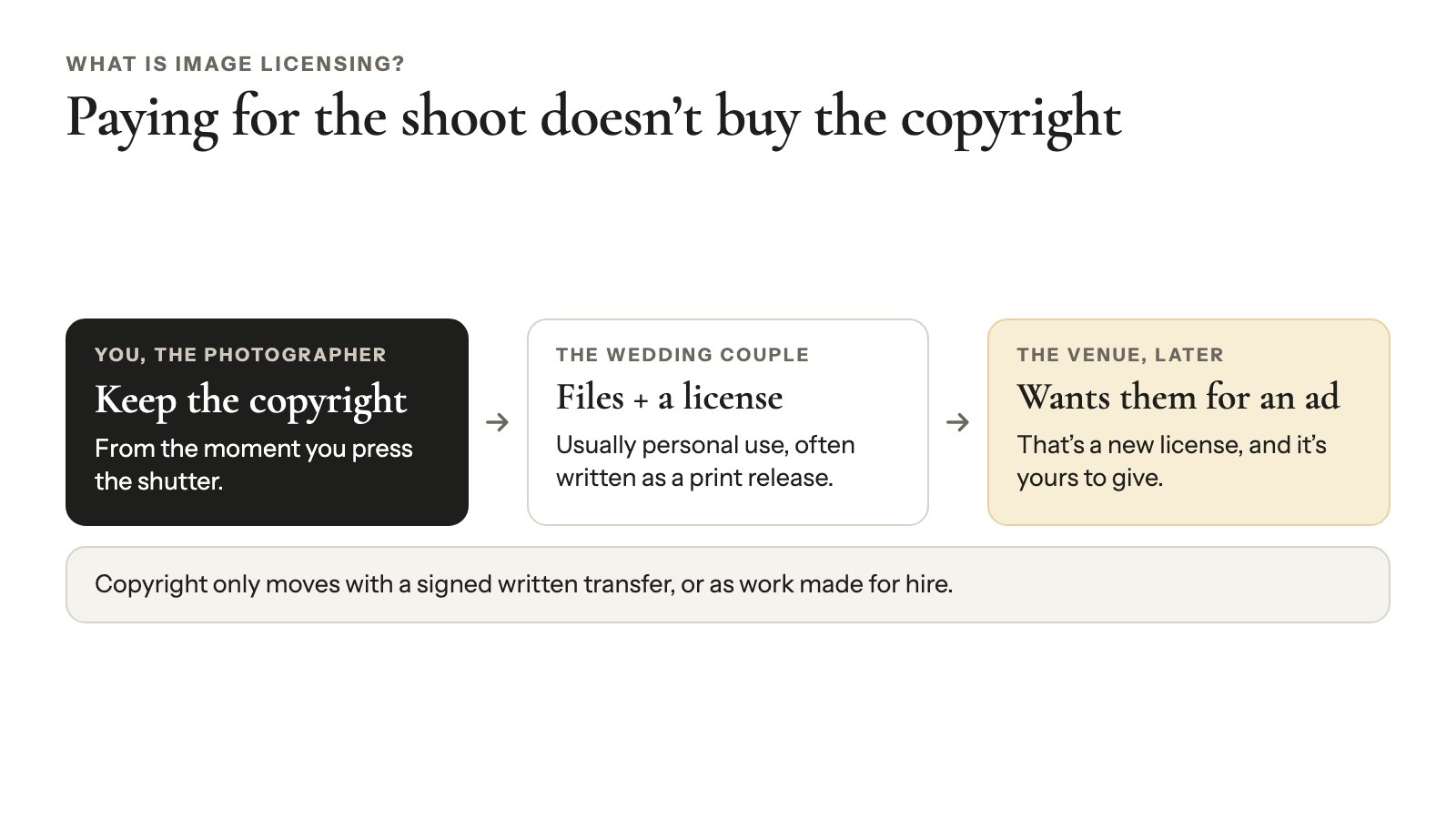
An image license is permission to use a photo on the copyright owner’s terms. The owner (the licensor) keeps the copyright. The person or business using the photo (the licensee) gets exactly the rights the license lists, and nothing more.
Think of it as renting, not buying. A tenant can’t sublet or knock down a wall unless the lease says so, and when the lease ends, it’s still the landlord’s apartment.
In the US, copyright exists from the moment a work is “created and fixed in a tangible form” (U.S. Copyright Office). For a photo, that’s when you press the shutter.
The copyright only moves to someone else in two cases:
- A written transfer. Under 17 U.S.C. § 204(a), a transfer “is not valid unless” it’s in writing and signed by the owner.
- Work made for hire. Photos an employee takes as part of the job belong to the employer. So do a few kinds of commissioned work, if both sides sign a work-for-hire agreement.
That’s why a wedding couple who paid for the shoot still doesn’t own the copyright. They get the files plus the license in your contract, usually personal use, often written as a print release.
If the venue later wants those photos for an ad, that’s a new license, and it’s yours to give.
Why image licensing matters
Image licensing turns one photo into repeat income, puts your name on every use and settles disputes before they start.
- It shows the work is yours. A license with your name on it adds credibility and shows you take copyright seriously.
- Your name travels with the photo. Most licenses ask for a credit line. A blogger writes “Photo: Jane Doe”, a reader clicks, and you have a lead.
- It heads off disputes. Clear terms answer “I paid, so it’s mine, right?” before anyone argues. Both sides know how the photo will be used.
- One photo can earn more than once. Unless you sold exclusive rights, you can license the same shot to bloggers, designers and businesses again and again. Some become regular clients.
- Google Images can show it. License data on your page can earn a “Licensable” badge, which Google added in 2020, with a link to your terms.
Types of image licenses
The main types of image licenses are royalty-free, rights-managed, editorial, commercial, exclusive and Creative Commons. Each one answers three questions: how the price works, what the photo is used for and who else may use it.
| License | What the licensee gets | Common for |
|---|---|---|
| Royalty-free | Pay once, use many times within the terms | Stock photos, blogs, marketing |
| Rights-managed | One defined use, priced by that use | Advertising, book covers, campaigns |
| Editorial | Use in news, commentary or education only | Magazines, news sites, textbooks |
| Commercial | Use that promotes or sells something | Ads, product pages, brand social media |
| Exclusive | The only right to use the image, for the agreed scope | Brand campaigns, covers |
| Creative Commons | Free use under public conditions, such as credit | Blogs, wikis, open projects |
Royalty-free vs rights-managed
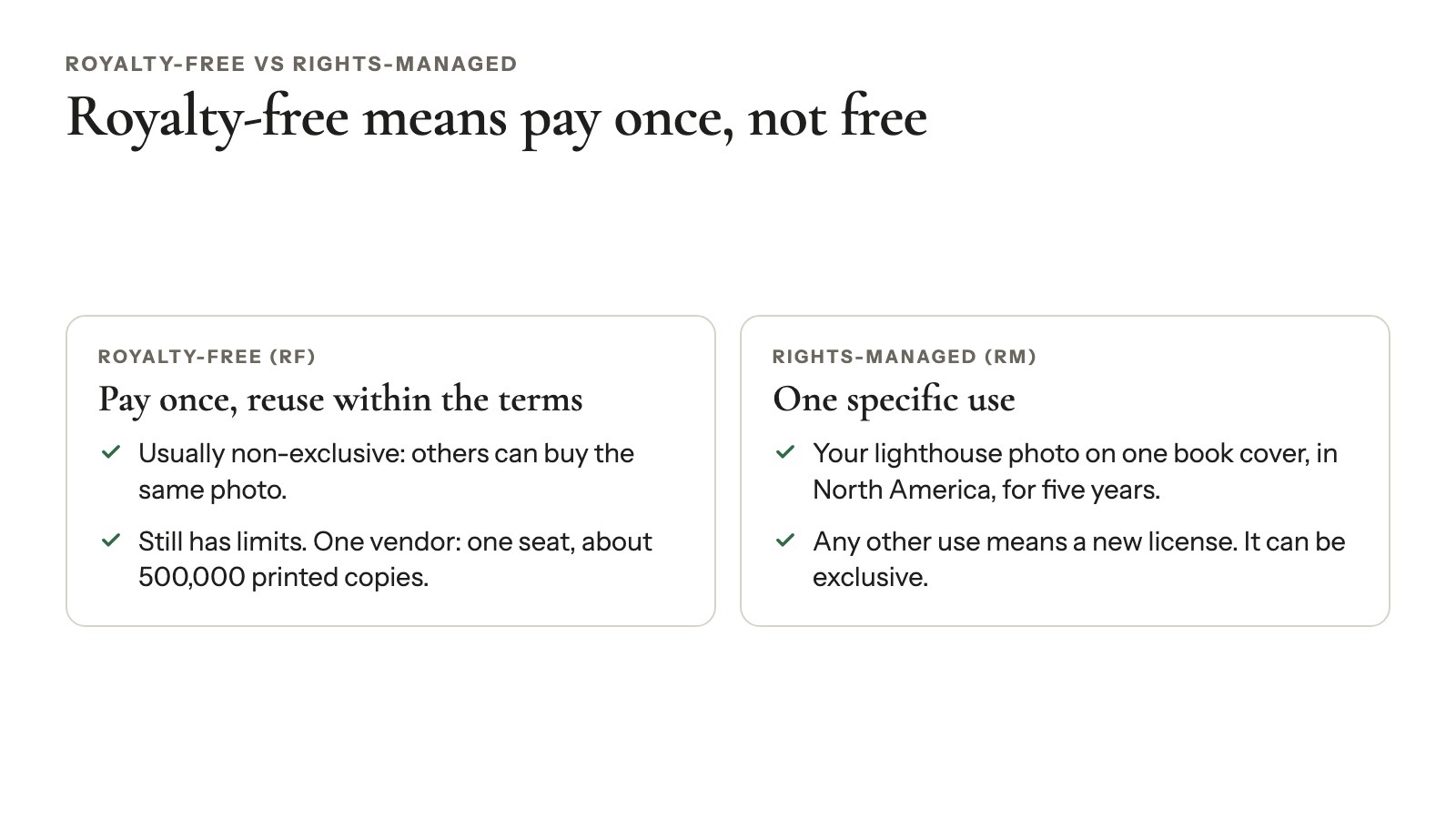
Royalty-free (RF) doesn’t mean free. The buyer pays once and can reuse the image without paying per use, within the license terms. RF licenses are usually non-exclusive, so others can buy the same photo.
Standard RF licenses still have limits. One stock vendor’s example: one user (a “seat”) and a print run of about 500,000 copies. Limits vary by agency, so read the one you’re buying.
A rights-managed (RM) license covers one specific use: say, your lighthouse photo on one book cover, in North America, for five years. Any other use means a new license. RM licenses can be exclusive, which is why brands like them for campaigns.
Commercial, editorial and personal use
Commercial use means the image helps sell or promote something: an ad, a product page, a company’s Instagram. For that, photos of recognizable people or private property usually need signed model or property releases: written permission from the people shown or the property’s owner.
Editorial use covers news, commentary, reviews and education. Your shot of a busy farmers market can run in the local paper’s story about it.
The same shot in the market’s ad for new vendors needs a commercial license, plus releases from the faces you can recognize.
Personal use covers a print for your own wall or a non-commercial project.
Print release vs copyright release
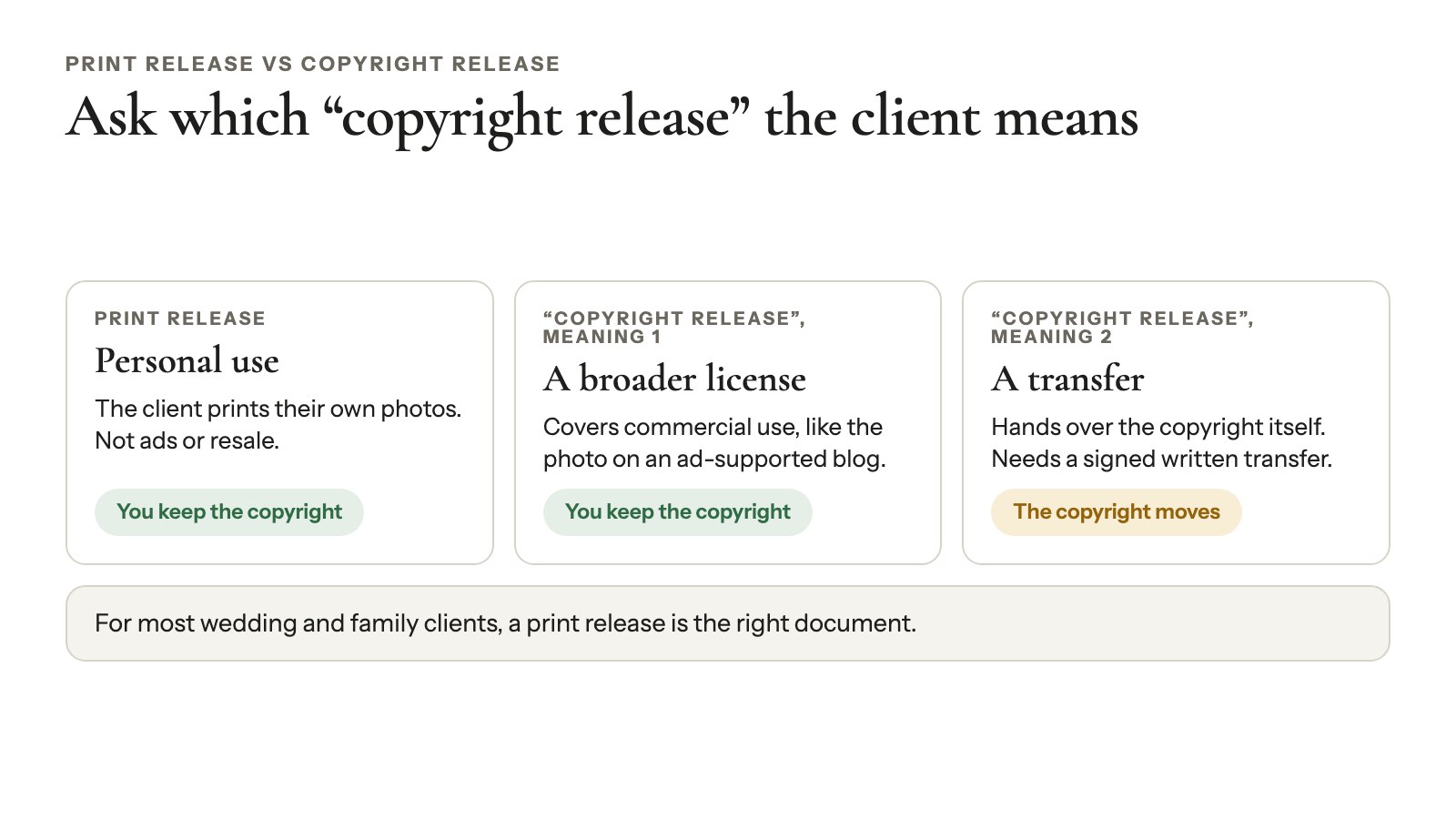
A print release is a personal-use license: it lets a client print their photos without infringing your copyright. Clients show it to a print lab or store that wants proof they’re allowed to print professional work.
You keep the copyright, and the release covers the client’s own prints, not ads or resale.
A copyright release is a looser term. Sometimes it means a broader license that covers commercial use. In LegalZoom’s example, a canvas print for the client’s home needs only a print release, but the same photo on an ad-supported blog needs a copyright release.
Other times it means handing over the copyright itself, which takes a signed written transfer under 17 U.S.C. § 204(a). When a client asks for a copyright release, ask which one they mean, and write the answer into the agreement.
For most wedding and family clients, a print release is the right document. Say in it whether personal social media posts are fine too. Neither document is a model release, which comes from the person in the photo.
Exclusive, non-exclusive and extended licenses
Non-exclusive is the default: you can license the same image to others. An exclusive license promises nobody else will use it, for the agreed scope and time. It costs more, because you give up other sales.
Magazines often ask for first rights (they publish it first, then you can license it elsewhere) or one-time use (one issue, one printing).
An extended license adds what a standard license leaves out, such as products made for resale (mugs, posters) or print runs above the standard cap.
Creative Commons and public domain (CC0)
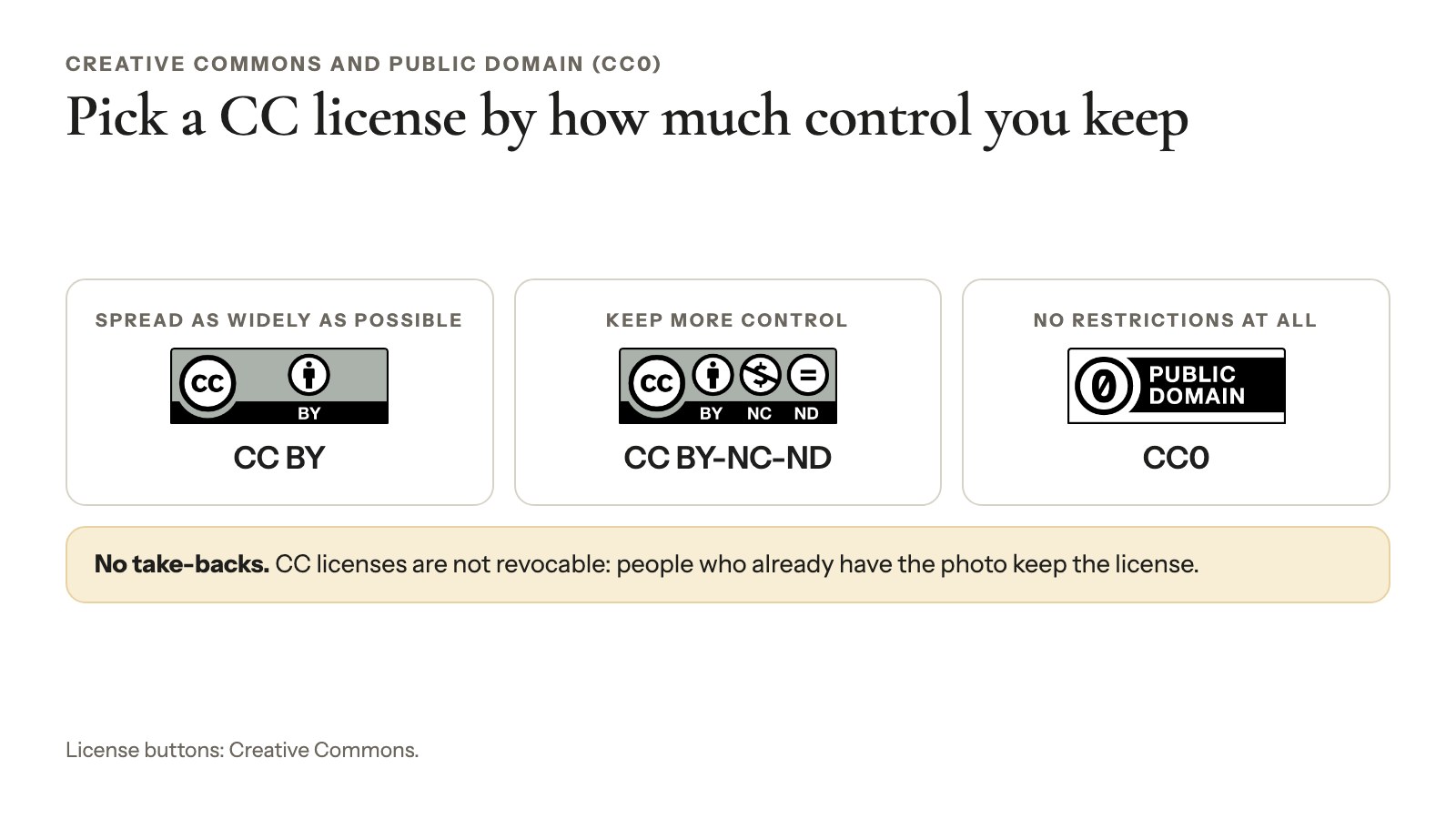
Creative Commons (CC) licenses are free, standard licenses anyone can attach to their work. They mix four conditions: credit (BY), share alike (SA), no commercial use (NC) and no changes (ND). The table shows what each license lets people do with your photos.
| License | Commercial use | Changes allowed | They must |
|---|---|---|---|
| CC BY 4.0 | Yes | Yes | Credit you |
| CC BY-SA 4.0 | Yes | Yes | Credit you, share changes under the same license |
| CC BY-NC 4.0 | No | Yes | Credit you |
| CC BY-NC-SA 4.0 | No | Yes | Credit you, share changes under the same license |
| CC BY-ND 4.0 | Yes | No | Credit you |
| CC BY-NC-ND 4.0 | No | No | Credit you |
| CC0 1.0 | Yes | Yes | Nothing: you give up your rights |
Which one should you pick? To spread your photos as widely as possible, choose a permissive license like CC BY. To keep more control, choose CC BY-NC-ND. For no restrictions at all, use CC0.
Know the downsides first:
- You can’t take it back. CC licenses “are not revocable” (Creative Commons FAQ). You can stop sharing a photo, but people who already have it keep the license.
- You don’t get paid. There’s no fee for any use the license already allows.
- “NonCommercial” can be fuzzy. Is a nonprofit’s fundraising page commercial? An ad-supported blog? People disagree.
- You don’t pick who uses it. Anyone can, as long as they follow the terms.
Our guide to the types of Creative Commons licenses explains each one with examples.
What to include in an image license agreement
Every image license belongs in writing. For an exclusive license, US law requires it: 17 U.S.C. § 101 counts an exclusive license as a transfer, and § 204(a) makes a transfer valid only in writing, signed by the owner.
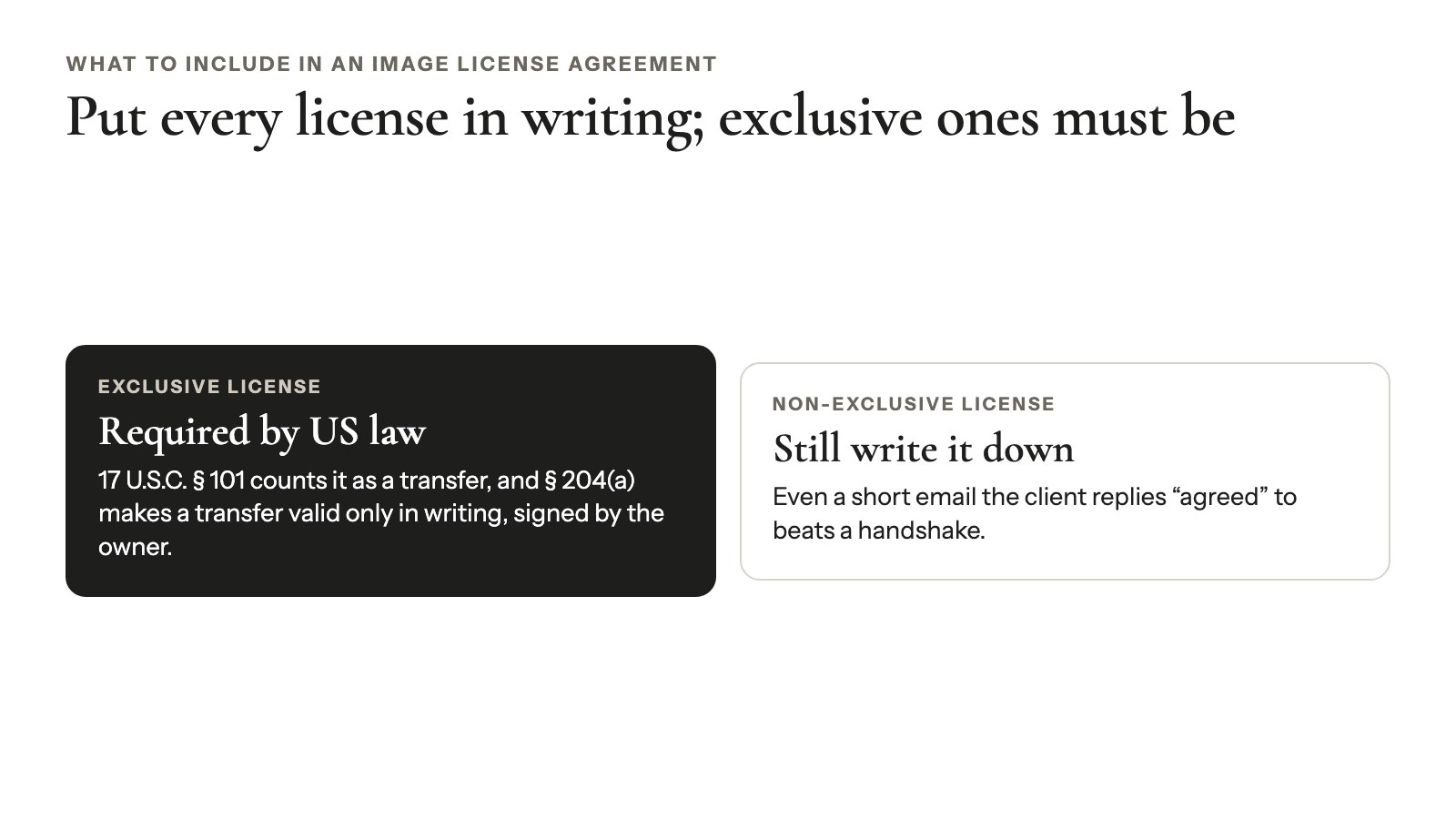
For a non-exclusive one, even a short email the client replies “agreed” to beats a handshake. A clear photo license agreement covers:
- Who: you (the licensor) and the client (the licensee), with contact details.
- Which images: file names or thumbnails.
- Use: website, print ad, packaging; commercial or editorial.
- Media and size: from a blog thumbnail to a full-page ad.
- Territory: one city, one country or worldwide.
- Duration: start and end dates, or “perpetual”.
- Exclusivity: whether you may license the image to others.
- Changes: whether the client may crop, edit or combine it.
- Credit: whether your name must appear, and how.
- Sub-licensing: whether the client may pass the images on, say to their ad agency or printer.
- Your own use: whether you can still show the photos in your portfolio and on social media, and from when.
- Fee: the price, when it’s due, and that the license starts once it’s paid.
- Breaches: what happens if the image is used beyond the license.
Image licensing agreement template
Fill in the brackets and delete what doesn’t apply:
Example
Image license
[Your name or studio] (“Licensor”) grants [Client] (“Licensee”) a [non-exclusive / exclusive] license to use [file names] for [use, e.g. Licensee’s website and social media] in [territory], from [start date] to [end date].
Fee: [amount], due [date]. The license starts when the fee is paid.
Licensee [may / may not] crop or edit the images. Credit, where practical: “[Photo: Your Name]”.
Licensee may not sub-license or resell the images, except to [printer / agency] for the uses above. Any other use needs a new license.
Licensor keeps the copyright and may show the images in their portfolio [from date].
Signed: [Licensor], [date] / [Licensee], [date]
This guide isn’t legal advice. For large or exclusive deals, have a lawyer check the contract.
How much does it cost to license an image?
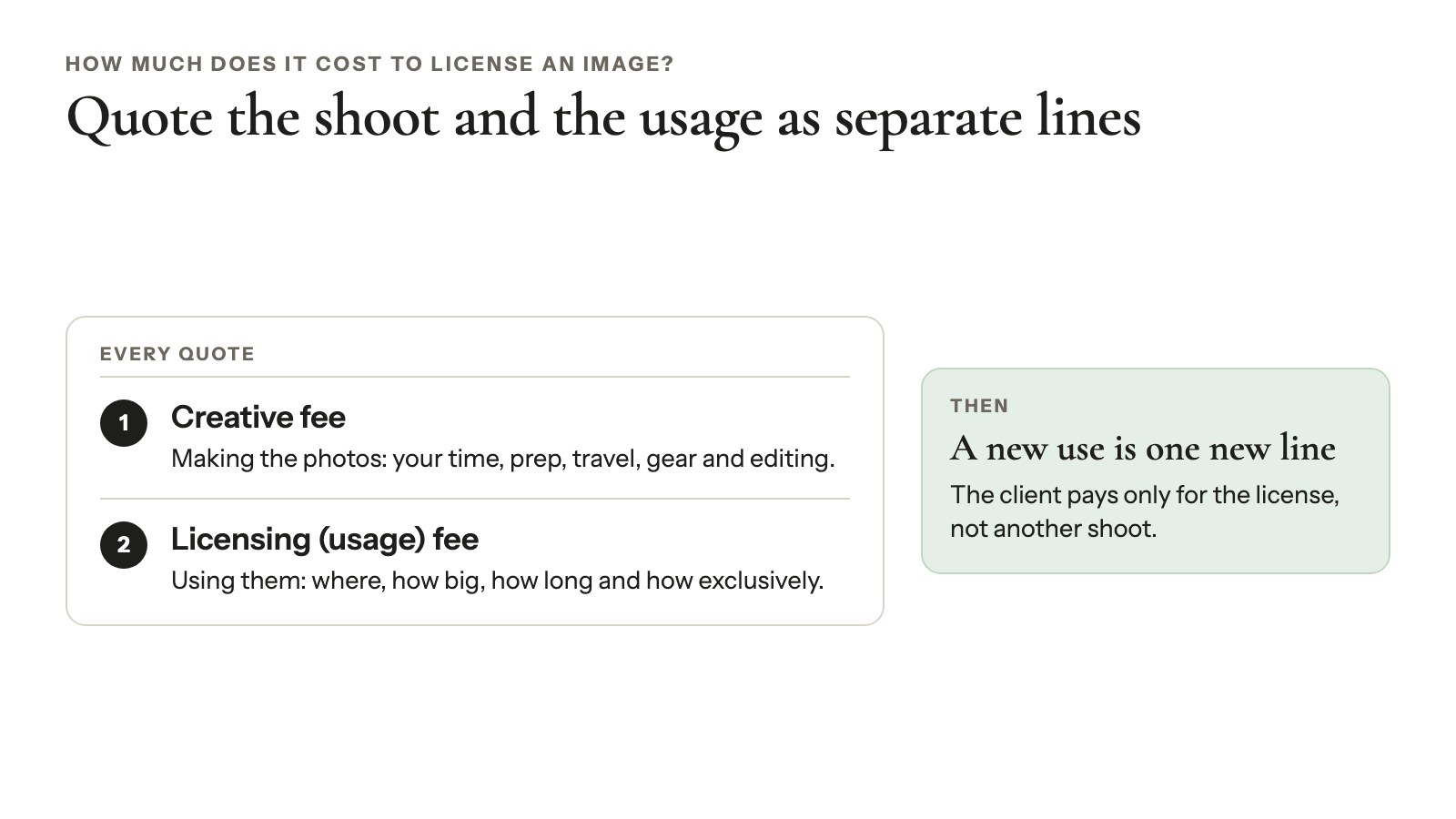
There’s no list price for licensing an image. The fee depends on the use, and a professional quote has two parts:
- The creative fee pays for making the photos: your time, prep, travel, gear and editing.
- The licensing (usage) fee pays for the right to use them: where, how big, how long and how exclusively.
Write them as separate lines on every quote, and say on your pricing page whether a price includes usage. Then a client who comes back for a new use pays only for the license, not another shoot.
What moves the licensing fee:
- Type of use: advertising costs more than editorial or personal use.
- Reach: 500 flyers cost less than 500,000.
- Size and placement: an 800-pixel image in a blog post isn’t worth what a full-page ad is.
- Duration and territory: one year in one country costs less than forever, worldwide.
- Exclusivity: the client pays for the sales you give up.
- The photo itself: how rare it is and what it cost to make.
How to quote a license, step by step
- Pin down the images. How many, and which ones?
- Pick the license type. Royalty-free, rights-managed, exclusive?
- List where they’ll appear. Website, social, paid ads, print or out-of-home (billboards, bus stops). Paid and out-of-home cost more.
- Set the term and territory.
- Check the market. See what Getty Images or Adobe Stock charge for a similar image and use, then adjust for the client’s size. Fee calculators give a ballpark, but they don’t know your client.
- Put it in writing and get a yes before you deliver.
Take a made-up client. A neighborhood café books a half-day shoot: 15 dishes for the menu and website.
Your quote has two lines: the creative fee for the shoot and editing, and a non-exclusive license for their website, menus and social accounts for one year.
Six months later, they want the pancake shot on bus-stop posters across the city for a month. No reshoot. You send one new line: out-of-home print, one city, four weeks.
That’s new income from a photo you already delivered, because the first license was clear about what it covered.
When the client wants the copyright
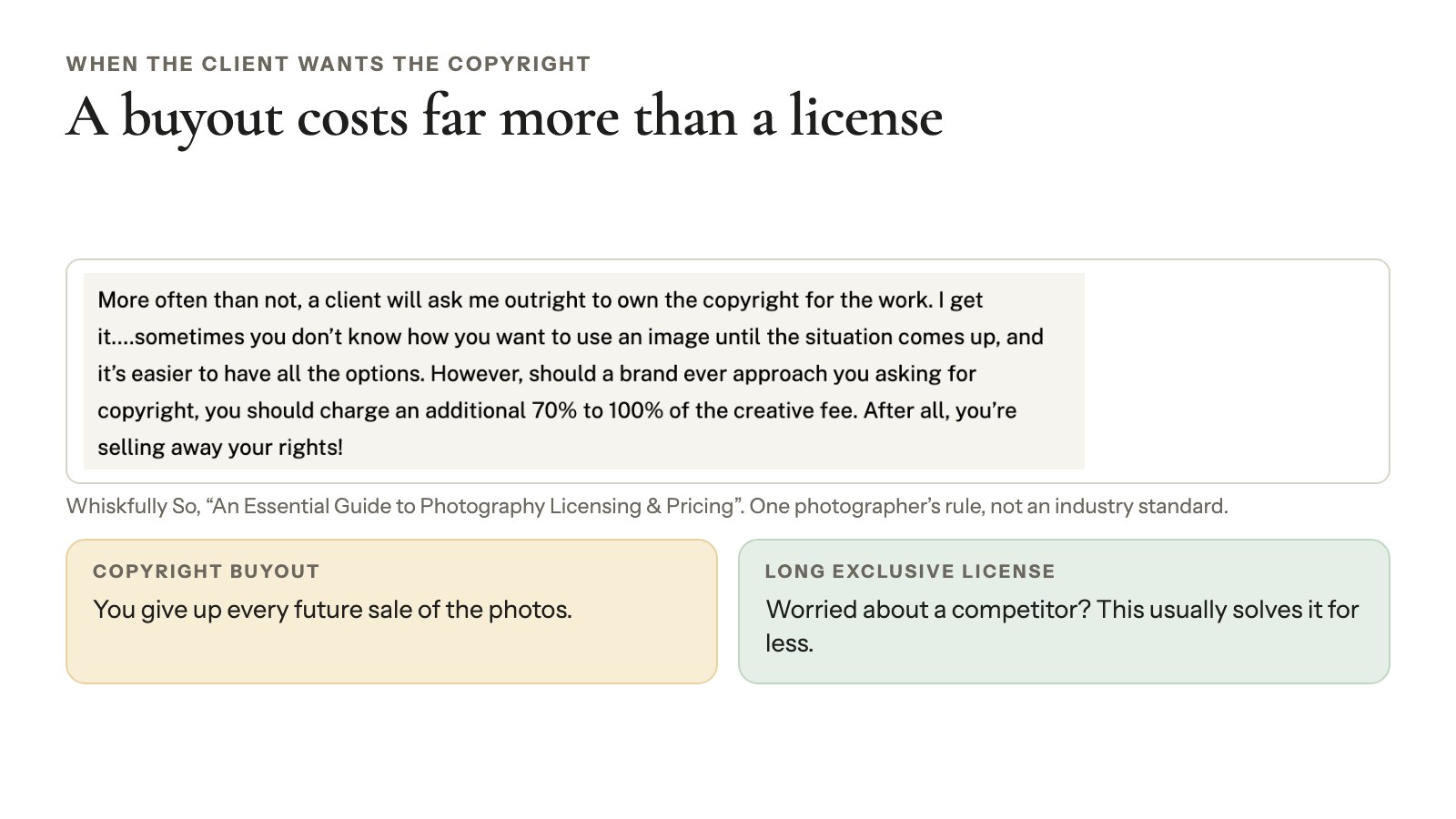
Sometimes a client wants to “own” the photos. A copyright buyout is possible, but it usually costs far more than a license, because you give up every future sale.
One photographer’s guide to photography licensing and pricing on Whiskfully So adds 70–100% to the creative fee for a buyout. That’s one person’s rule, not an industry standard.
Ask what the client is worried about. If it’s a competitor using the same image, a long exclusive license usually solves it for less.
How to license your photos, step by step
Licensing your own photos takes seven steps, from picking a license model to checking where your photos turn up.
- Choose your model. Royalty-free for broad, cheaper sales; rights-managed or exclusive for high-value uses; Creative Commons for free sharing with credit.
- Write your standard terms. Put them on a license page: what buyers can and can’t do.
- Put your details in the files. Before you export, add your name, copyright notice and license page link to the metadata. Lightroom and Photoshop both have fields for this.
- Protect your previews. Show watermarked versions until someone buys. See how to watermark photos.
- Show the license where you publish. Under the gallery, in the lightbox or in the caption.
- Decide where to sell (agency shares checked October 2026):
- Stock agencies, the best-known image licensing companies, handle buyers and payments, then pay you a share. Adobe Stock pays 33% for photos, Shutterstock 15% to 40% (six levels that reset every January 1). Getty Images and iStock pay 15% to 45% per license, more for exclusive content. Alamy is another big one; check its contributor pages for its share.
- Publications such as magazines license directly, often for first rights or one-time use.
- Your own website lets you keep the full fee, but you handle quotes, contracts and payments.
- Keep an eye on use. Run a reverse image search now and then, and follow up on unlicensed copies.
How to show image licenses on your WordPress site
On a WordPress site, the license belongs next to the photos, not on a page visitors never open.
We make Modula, a WordPress gallery plugin with 160,000+ active installations. It sets licenses site-wide or per gallery, so you don’t tag hundreds of images one by one. You embed a gallery with the Embed button (a shortcode) or the Modula block.
Free: one license in every gallery’s code
- Go to Modula → Settings and find Image licensing in the Galleries section.
- Pick a License: one of the seven Creative Commons licenses, CC0 included.
- Under License details, fill in Author and Company.
- Click Save changes.
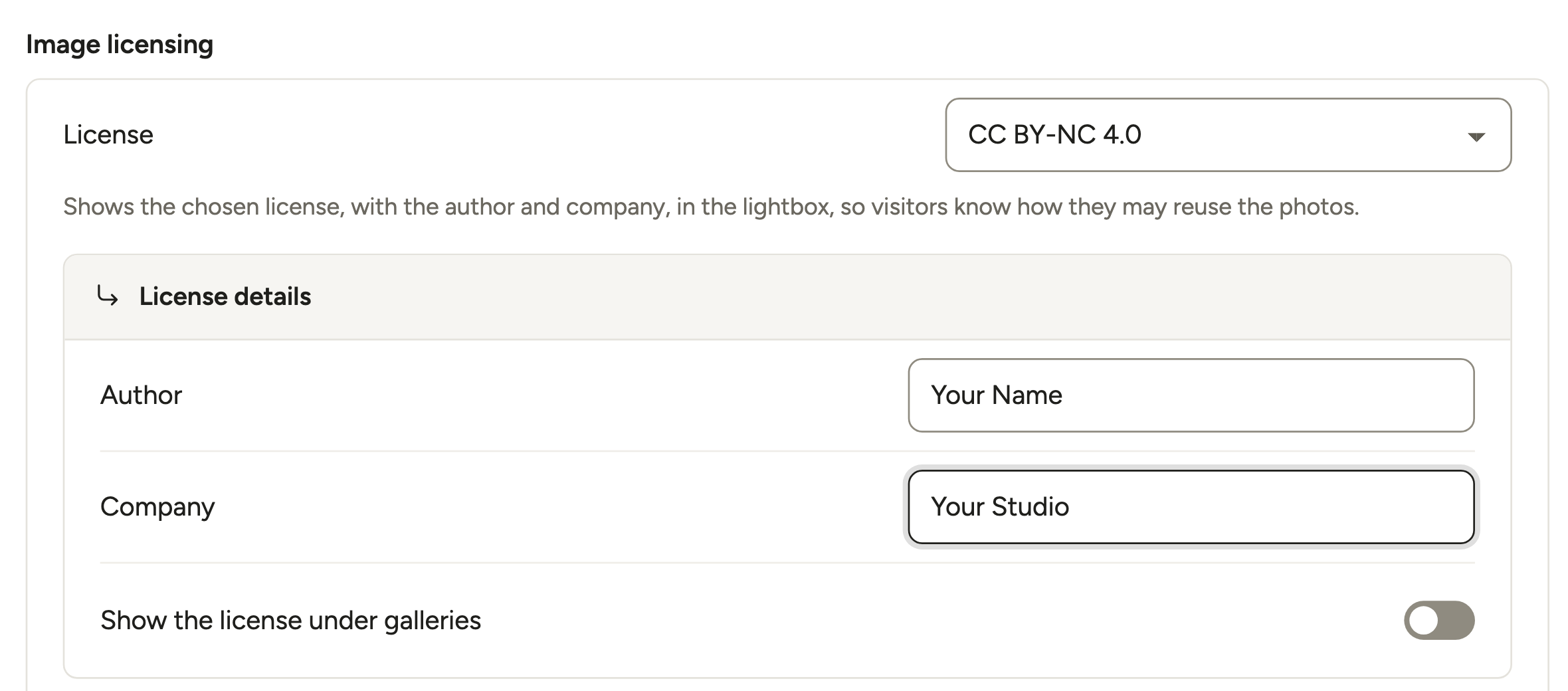
Modula then adds the license to every gallery’s code as structured data, the machine-readable labels Google reads.
Visitors don’t see it, though: in Modula 3.0, the free version shows no license line under galleries, even with Show the license under galleries switched on. That’s what Pro adds.
Pro: a license for each gallery
The Image Licensing extension gives each gallery its own license, shown to visitors with a link to it. It’s in the Trio plan and up.
- Go to Modula → Extensions and turn on Image Licensing.
- Open the gallery and click Protect in the left rail.
- Turn on Image licensing.
- Choose the License: All rights reserved, or a Creative Commons license.
- Fill in the Credit line and Company.
- Under Where it shows, turn on Under the gallery, In the lightbox, or both.
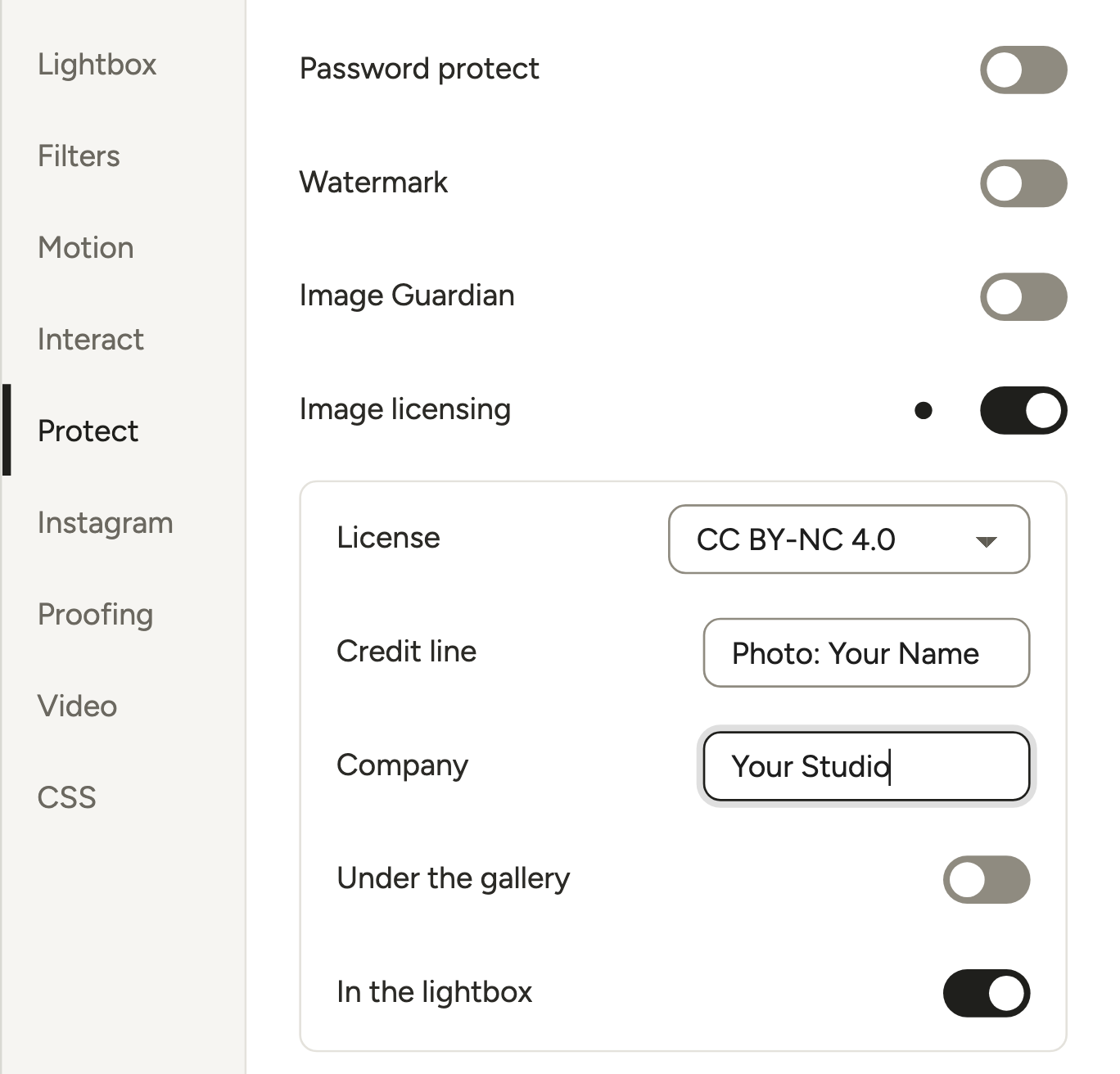
Click Save in the top bar when you’re done. Keep the lightbox option on: that’s where people see your photos full size and decide whether to save, share or buy one.
Custom licenses with your own terms
If you sell licenses, you want your own terms, such as “Commercial web use, 1 year”. You need the Trio plan or higher:
- Go to Modula → Content and open the Licenses tab.
- Click Add New License.
- Type the license name in the title field (Add title), then fill in Company Name and Author Name.
- Add the License Page URL (your full terms) and the Buy Page URL (where people buy a license). The Buy page is optional, so you can add it later.
- Click Publish.

Your license then appears in the License list under Settings → Image licensing, next to the Creative Commons ones. The image licensing documentation covers every setting.
Tip
“All rights reserved” can’t earn the Licensable badge, because it has no license page for Google to link to. If you sell all-rights-reserved photos, create a custom license instead.
Point the License page URL at your terms and the Buy page URL at your contact form or shop. Modula doesn’t take payments, so link your shop or contact form from that license page.
Other ways to credit images in WordPress
Image attribution is the credit line saying who made a photo and under which license. Modula covers your galleries. For single photos in posts, or other people’s photos, you have these options (WordPress.org data checked October 24, 2026):
| Option | What it credits | Where the credit shows | Price | Last updated |
|---|---|---|---|---|
| Modula | Gallery images | Gallery code (free); license line under the gallery and in the lightbox (Pro) | Free; visible license on the Trio plan | Oct 2026 |
| Image Source Control Lite | Media Library images | On the image, or in a list below the post | Free | Aug 2026 |
| Media Credit | Media Library images | Under the image | Free | Apr 2023 |
| Image block caption | One image at a time | The caption | Built in | n/a |
- The caption is the simplest: “Photo: Jane Doe, CC BY 4.0”, linked to the source and license. It’s manual, so it suits a blog with a few borrowed photos.
- Image Source Control Lite (3,000+ installs, 4.6/5 from 42 ratings) adds source fields to your media and can build a page listing every image credit.
- Media Credit (900 installs) was last tested with WordPress 6.2, so try it on a staging site first.
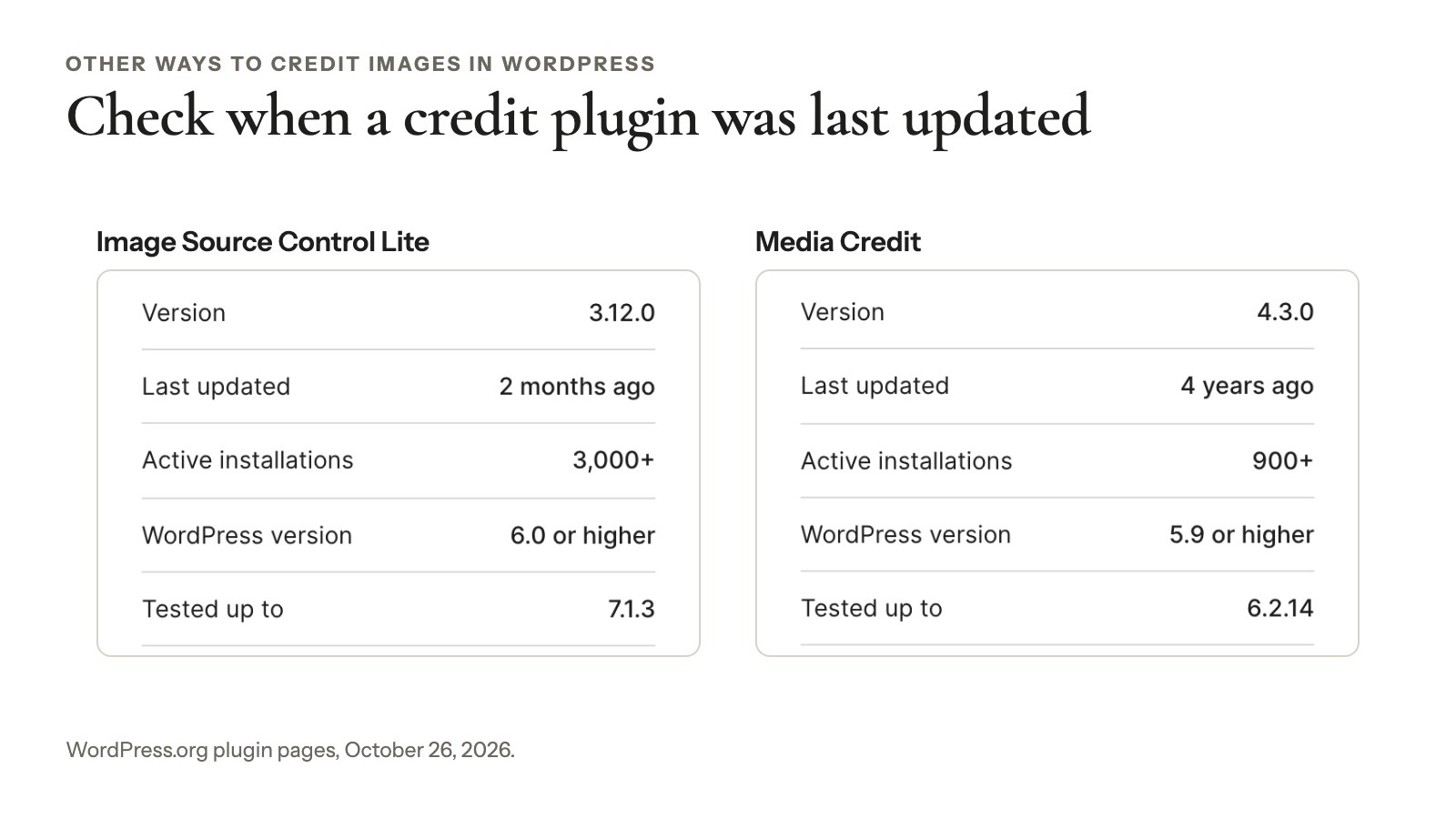
Two picks from our old list of attribution plugins no longer hold up. Attributron 2000 was last updated in May 2012 and tested up to WordPress 3.3.2. Simple Attribution credits the article a post was sourced from, not images.
What to look for in an image credit plugin
- Credits stored with each image in the Media Library, so they follow it everywhere
- A license name and a link to the license
- Credits that show automatically
- Bulk editing for large libraries
- A recent update, tested with your WordPress version
- An active support forum
Then match it to your site. A portfolio needs one license per gallery. A blog using other people’s photos needs a credit on each image.
A shop, like a potter selling from 12 product shots, should use its own photos or licensed stock, and keep the receipts.
What “Licensable” means in Google Images (and how to get the badge)
A “Licensable” badge in Google Images means the photo’s owner has published license information for it.
It isn’t free to use: click through and you’ll see the license and, if the owner offers one, a page where you can get a license. Google launched the badge in 2020.
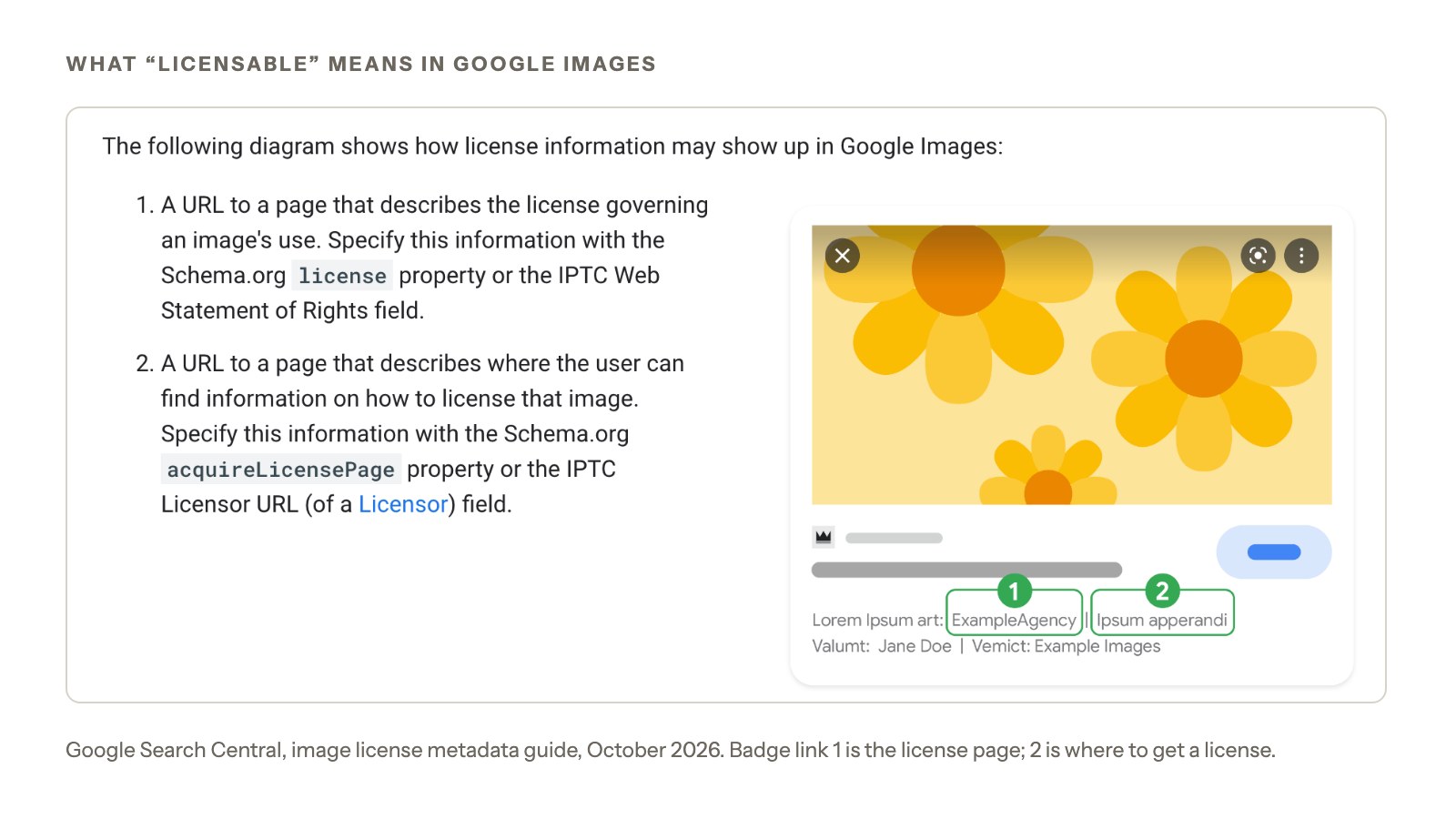
Searchers can also filter by license: in Google Images, Tools → Usage rights, then Creative Commons licenses or Commercial & other licenses. The second shows images with other license information, often paid. Even so, Google’s help page says: “Always confirm an image’s license information.”
What Google needs from your page
Google reads license data from structured data on the page or from IPTC metadata, the rights fields saved inside the image file. Its image license metadata guide asks for:
contentUrl, the image itself, plus at least one ofcreator,creditText,copyrightNoticeorlicense.license, a link to a page describing the license. The badge needs this one.acquireLicensePage, a link to a page explaining how to get a license. Google recommends it.
On the IPTC route, the badge needs the Web Statement of Rights field (Lightroom calls it Copyright Info URL), and Google recommends Licensor URL. Some hosts and image optimizers strip metadata from the resized copies WordPress makes, so structured data is the more reliable route.
What Modula adds for you
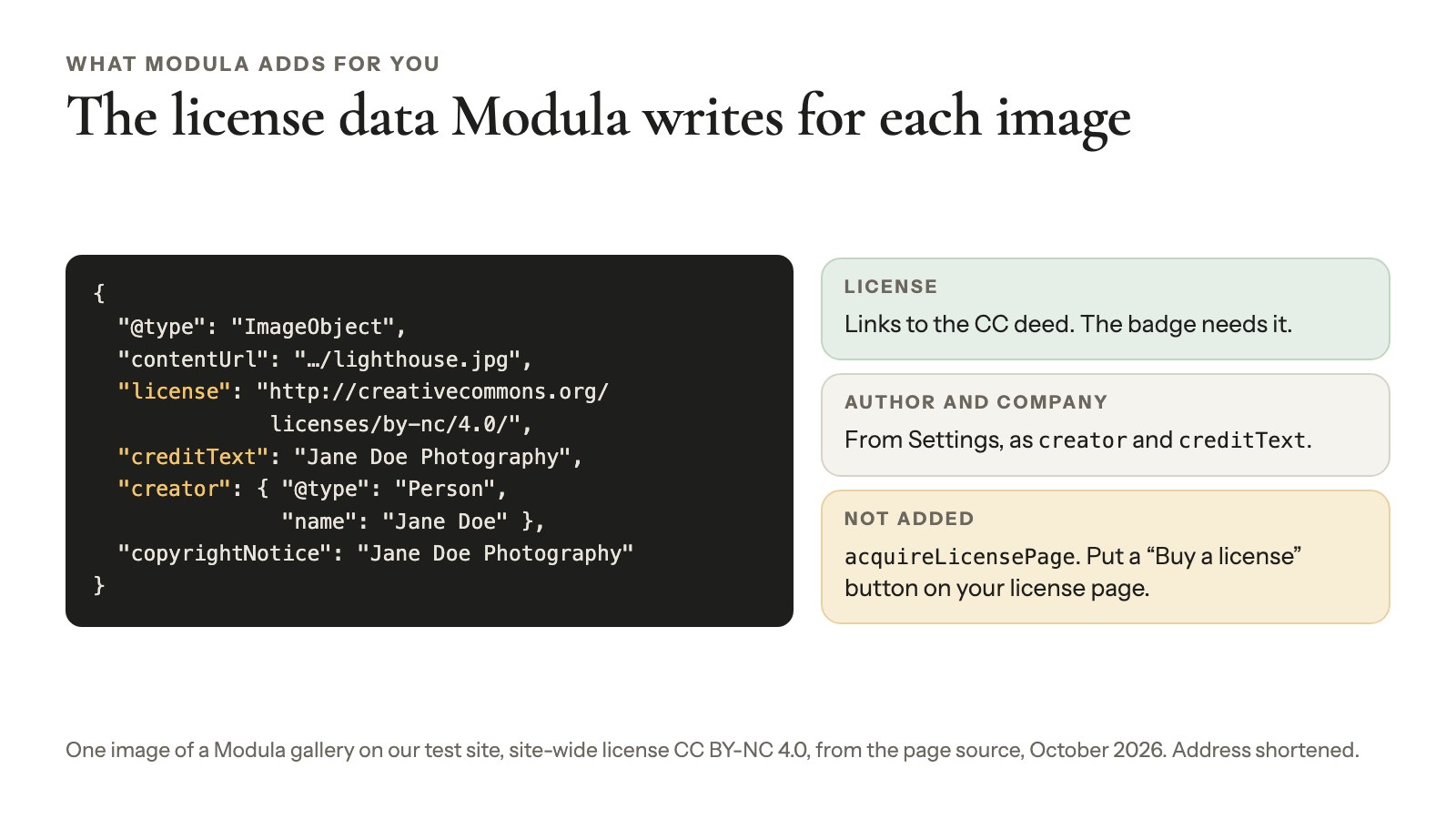
Once you set a license, Modula adds structured data to every image in the gallery, no code needed.
Each image gets a schema.org ImageObject with the image URL and the license link: the Creative Commons page, or your License page URL for a custom license.
With the site-wide license, the Author and Company from Settings become the creator and credit. A custom license puts your License page URL in that link.
Google also recommends a buy link (acquireLicensePage), which 3.0 galleries don’t add, so give your license page a clear “Buy a license” button: anyone who clicks through from the badge is then one click from buying.
To check your work, paste a gallery page into Google’s Rich Results Test, then use URL Inspection in Search Console after you publish. Keep expectations honest, though: Google “does not guarantee that structured data or IPTC photo metadata will show up in search results”.
Using someone else’s photos: check the license first
“I found it on Google” isn’t a license. A photo you didn’t take needs a license you can point to, so before you use one:
- Find the license. Unsplash and Pexels use their own licenses. They allow most uses, commercial ones included, but still set limits, such as not selling unaltered copies.
- Search by license. The Creative Commons search portal and Google’s Usage rights filter help, but a filter result isn’t proof. Read the license on the source page.
- Credit the way the license asks. For Creative Commons: title, author, source and license, with links. “Mountain Lake” by Jane Doe, licensed under CC BY 4.0. Creative Commons has more examples.
- Keep a record. Save the license page or receipt with the date.
Common image licensing mistakes
Most image licensing mistakes come from terms nobody wrote down, or nobody read.
- Nothing in writing. A handshake leaves both sides guessing about use, time and territory.
- “I paid for the shoot, so I own the photos.” The fee buys the work and the agreed license, not the copyright.
- “Unlimited use” or “full usage” in the contract. These say nothing about where, how long or how big.
- Signing the client’s contract unread. Watch for “in perpetuity”, “all rights” or a copyright transfer in the small print.
- Trusting “free” without reading. Free photo sites and CC licenses still have conditions. Under CC 4.0, a missed credit ends the license automatically, and it only comes back if you fix it within 30 days of finding out or the owner reinstates it (CC BY 4.0, Section 6).
- Using an editorial image in an ad. Editorial licenses don’t cover marketing, and the people in the photo may not have signed releases.
- No end date, or not tracking it. Without one, both sides remember the deal differently later. With one, renewals are income, so put the dates in your calendar.
Licensing works best alongside other protection. On the Trio plan and up, Modula can disable right-click on your images and password-protect galleries. The Business plan adds a watermark. More ideas are in how to protect images from theft and on our image protection page.
Frequently asked questions
Image licensing is permission from a photo’s copyright owner to use it under set conditions: how, where, for how long and for what fee. The photographer keeps the copyright, so the buyer gets the agreed use, not ownership. The copyright only changes hands through a signed written transfer (17 U.S.C. § 204(a)), which usually costs far more than a license.
A licensed image has an owner who holds the copyright and sets the terms of use. To use it, you need a license of your own: buy one from the owner or an agency, or follow a public license such as Creative Commons and give the credit it asks for. Being online doesn’t make an image free to use.
There’s no fixed price for licensing an image. A professional quote usually has two parts: a creative fee for making the photos and a licensing fee for using them. The licensing fee rises with the type of use, reach, size, duration, territory and exclusivity, so an ad campaign costs more than a blog post.
The main types are royalty-free, rights-managed, editorial, commercial, exclusive and Creative Commons. Royalty-free means pay once and reuse within the terms; rights-managed covers one defined use. Public domain images need no license at all, and CC0 is how an owner puts a work as close to the public domain as the law allows.
Pick a license model, publish your terms on a license page and add your name and license link to the file metadata. Show the license next to your photos and choose where to sell: stock agencies, publications or your own website. On your own site, a license page with a buy link lets you keep the full fee, and a Modula Pro custom license keeps both links in one place. Put every deal in writing.
“Licensable” means the photo’s owner has published license information for it, so the image isn’t free to use. Google links to the license details and, if the owner provides one, to a page where you can get a license. Owners earn the badge with structured data or IPTC metadata that includes a license link.
“Commercial & other licenses” is an option in the Google Images Usage rights filter, under Tools. It shows images whose owners published license information other than Creative Commons, which often means a paid license. The filter is a starting point, not permission: open the source page and read the license before you use the image.
Only if the license allows it. Credit is a condition of most Creative Commons licenses, so giving it is part of following them. But a credit line doesn’t give you permission to use a photo whose owner reserves all rights. For that, you need a license from the owner.