Made in Europe, buy from Europe.
The best WordPress portfolio plugins do three things well. They show your work in a grid, let a client filter straight to the shoots they care about, and open each photo full-screen in a lightbox. If you’re building a WordPress photography portfolio, add two more: it has to look good on a phone, and it has to stay fast when you’ve uploaded 400 images.
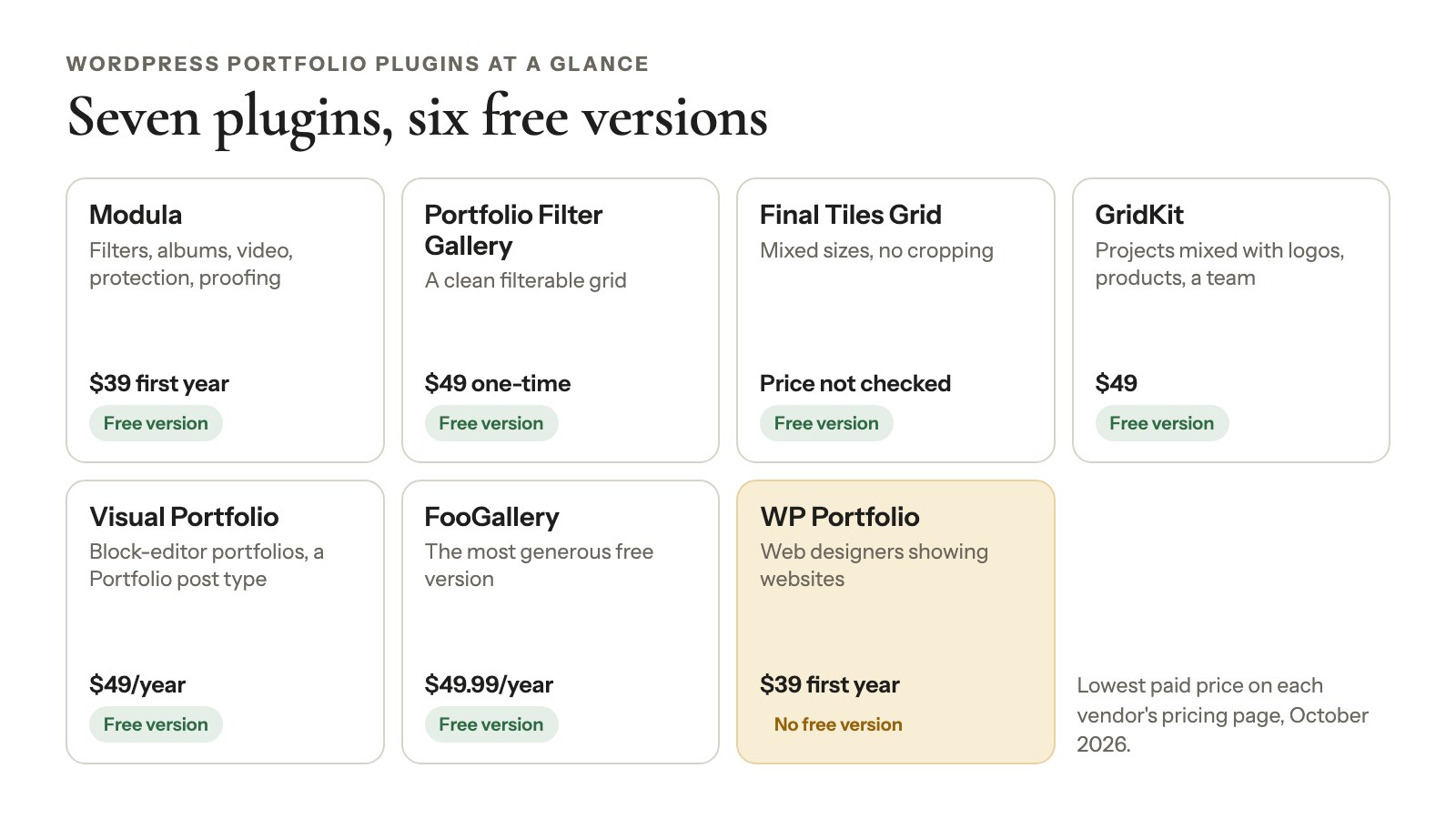
Good news first: six of the seven plugins below have a free version, so you can test almost all of them with your own photos before you spend a cent. Here’s the short version:
- Modula: filters, albums, video, protection and client proofing in one gallery plugin.
- Portfolio Filter Gallery: a clean filterable grid, free or $49 one-time.
- Final Tiles Grid: photos of mixed sizes, without cropping a pixel.
- GridKit: portfolios that mix your projects with client logos, products or a team.
- Visual Portfolio: block-editor portfolios with a real Portfolio post type.
- FooGallery: the most generous free version, with albums and password protection.
- WP Portfolio: web designers showing the websites they built.
One thing you should know before you read on: we make Modula and Final Tiles Grid (both come from WPChill). We’ve tried to be fair, and you’ll see us send you to other plugins when they fit a job better. Every price below comes from the vendor’s own pricing page, checked in October 2026. Where we couldn’t check one, we say so.
WordPress portfolio plugins compared at a glance
Six of the seven WordPress portfolio plugins compared here have a free version, three offer client proofing for a fee (a paid plan or add-on), and three help you sell photos through WooCommerce. Paid prices are for one site unless the table says otherwise. Installs, ratings and update dates come from WordPress.org (Modula’s install count is our own figure).
| Plugin | Free version | Paid from (checked Oct 2026) | Client proofing | Sell photos | Active installs | Last updated |
|---|---|---|---|---|---|---|
| Modula | Yes | $39 first year, then $78/year | Business plan | No, no built-in selling | 160,000+ | Oct 2026 |
| Portfolio Filter Gallery | Yes | $49 one-time | Not listed | Premium (WooCommerce products) | 20,000+ | Oct 2026 |
| Final Tiles Grid | Yes | Not checked (vendor site down) | Not listed | PRO (WooCommerce) | 20,000+ | Oct 2026 |
| GridKit | Yes | $49 | Not listed | Not listed | 6,000+ | Aug 2025 |
| Visual Portfolio | Yes | $49/year | Pro plan | Not listed | 60,000+ | Oct 2026 |
| FooGallery | Yes | $49.99/year | Paid add-on ($39.99/year) | Commerce (WooCommerce) | 100,000+ | Oct 2026 |
| WP Portfolio | No | $39 first year, then $49/year (unlimited sites) | Not listed | Not listed | Not on WordPress.org | Aug 2026 (its changelog) |
Client proofing means clients pick their favorite shots right in the gallery. “Not listed” means the vendor’s feature list doesn’t mention it. It doesn’t mean you can’t bolt it on with a second plugin.
What a photographer needs from a WordPress portfolio plugin
A photographer’s WordPress portfolio plugin has to look right on a phone, stay fast with hundreds of big images, and help clients find the work they’d hire you for. Everything after that depends on what you shoot.
What your visitors notice
- It looks right on a phone. In September 2026, 58.99% of web traffic worldwide came from phones (StatCounter; 49.1% in the US). A four-column grid that looks great on your 27-inch monitor turns into postage stamps on a phone. Look for separate column counts for tablets and phones, and a preview for each. More in our mobile-responsive gallery guide.
- It stays fast. Images already make up about 42% of the median mobile page (911 KB of 2,164 KB, per the Web Almanac 2025), and a portfolio is almost all images. Lazy loading (photos load as visitors scroll to them), properly sized images and compression keep a 60-photo wedding gallery from crawling. Here’s how to speed up gallery images.
- Layouts that suit your work. Masonry (equal-width columns where each photo keeps its shape) suits a mix of portrait and landscape shots. Justified rows (equal-height rows that fill the width) give a calm editorial look, and a slider shows off a handful of hero images.
- Filters. A couple looking for a wedding photographer shouldn’t have to scroll past your corporate headshots. Buttons like Weddings, Portraits and Products let them skip ahead. See how to filter a WordPress portfolio.
- Video in the same grid. If you shoot films too, put them next to the photos instead of on a separate page. Here’s how to build a video portfolio.

What you need behind the scenes
- A free version to try with your own photos. Demo galleries always look perfect. Upload 20 of your own shots, open the page on your phone, and you’ll know in ten minutes.
- A page per project, when you need one. Albums, standalone gallery pages or project posts let each shoot have its own home. The next sections cover when that’s worth it.
- Protection. Watermarks for photos that get shared, right-click protection, and passwords for private client galleries.
- Client proofing. Picture a wedding with 300 proofs. With proofing, the couple taps their 60 favorites and you get the list. Without it, you’re decoding file names from an email.
- It works with your editor or page builder. Block editor, Elementor, Divi, Beaver Builder: if you build pages in Elementor, a portfolio plugin with its own Elementor widget beats copying shortcodes (bracketed snippets you paste into a page) around.
- Templates or presets. Some plugins ship ready-made demo sites or templates. Others give you presets, saved settings you apply to the next gallery. Know which one you’re paying for.
Think one step ahead, too. You might not need watermarks or proofing today, but a plugin that already has them saves you from adding a second plugin the week you land your first wedding client.
Portfolio plugin or your theme’s portfolio?
Use a portfolio plugin if you want your portfolio to outlive your WordPress theme. A theme’s built-in portfolio is fine to start with, but it lives inside the theme: switch themes and those portfolio items can stop showing until you rebuild them.
That’s the real catch. A built-in portfolio feels like a free bonus, until the day you want a new design and find out your work is tied to the old one. A plugin keeps your galleries through every redesign.
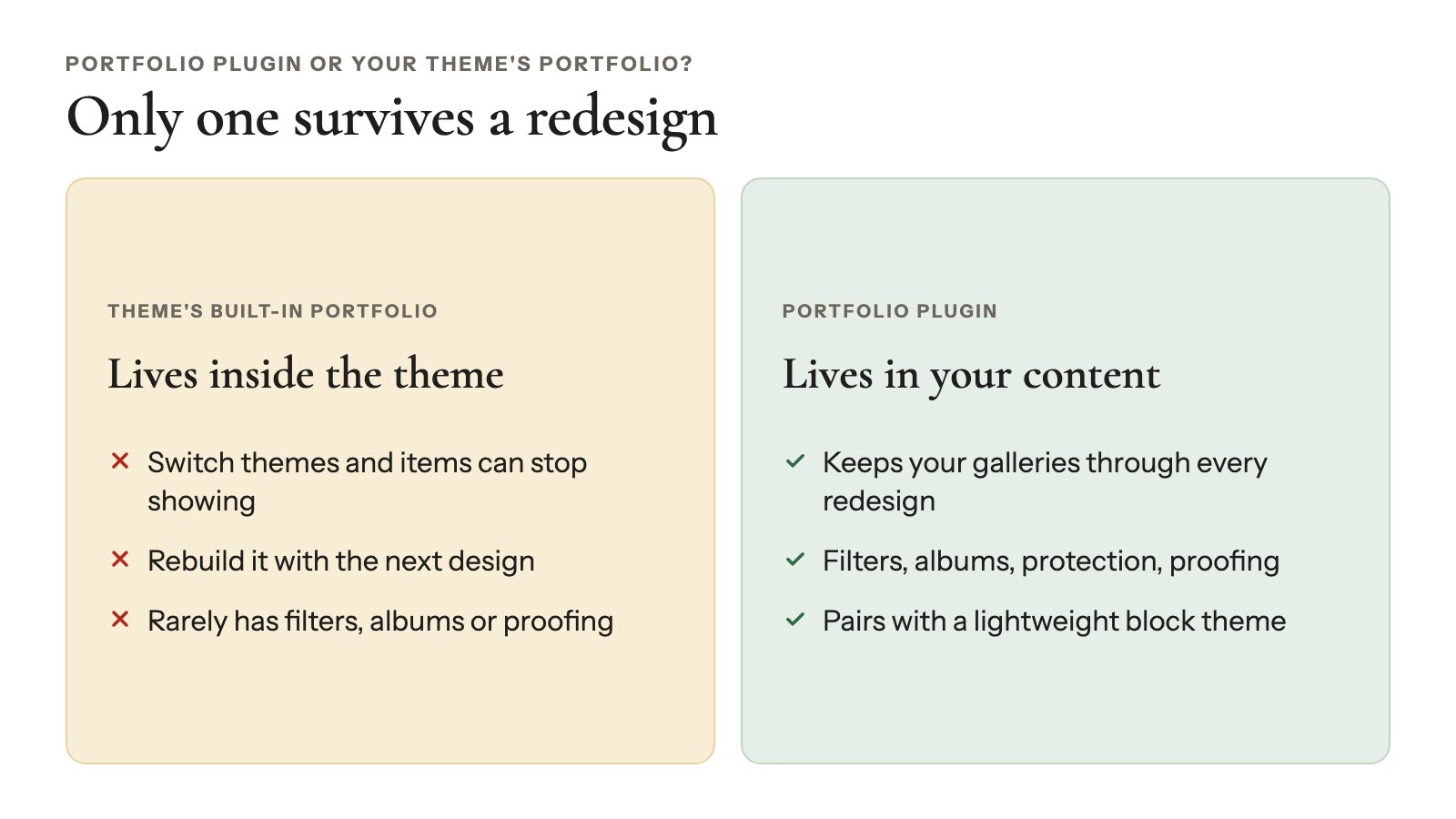
Design gets attention the first time someone lands on your site. Booking the client takes more than that: filters, albums, protection, proofing. Themes rarely go that far, and that’s where a plugin earns its keep.
A few themes and plugins register a “Portfolio” post type, so each project becomes its own post with its own page. Visual Portfolio does this, and so does the older Portfolio Post Type plugin. A post per project is handy for case studies, and the next section covers when you actually need it.
Themes listed on WordPress.org can’t do this at all. The directory’s theme rules (updated June 2026) say themes must not include custom post types, which is one more reason your portfolio belongs in a plugin.
The usual pairing today: a lightweight block theme for the site, and a gallery plugin for the photos.
One grid or a page per project?
Most photographers need one filterable grid, not a page per project. You need a page per project when each shoot tells its own story. Think of a wedding with getting ready, ceremony and reception, or a brand shoot you want to write up as a case study.
Your options, cheapest first
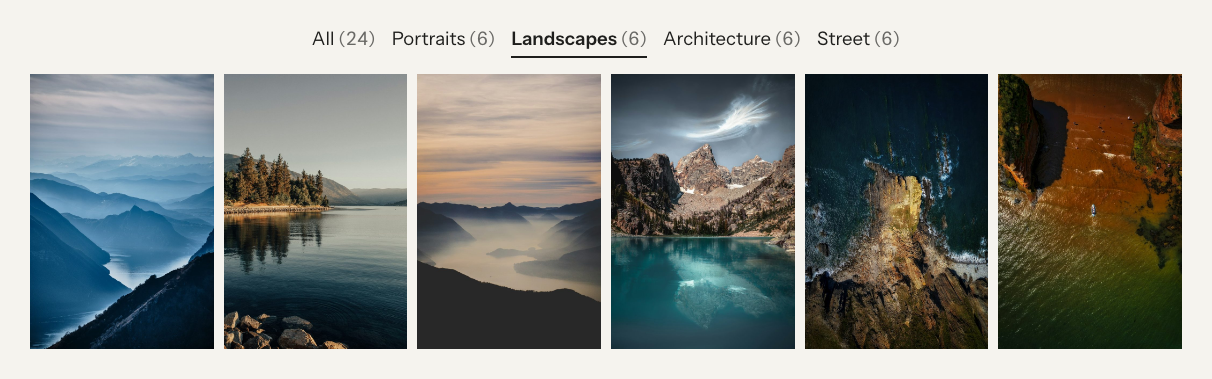
- One grid with filters. All your best photos live in one gallery, and filter buttons sort them. It’s free in Portfolio Filter Gallery, Visual Portfolio and WPZOOM Portfolio Lite. In Modula, Filters come with every paid plan, starting with Starter. A portrait photographer with 40 favorites across three styles needs nothing more.
- One gallery per project, grouped in an album. Each shoot is its own gallery, and an album shows a cover for each one. Modula’s Albums (Trio plan, from $69 for the first year) work this way. An album can hold other albums, so Weddings, then 2026, then a single wedding is three clicks. WPZOOM Portfolio PRO’s album galleries are the closest alternative.
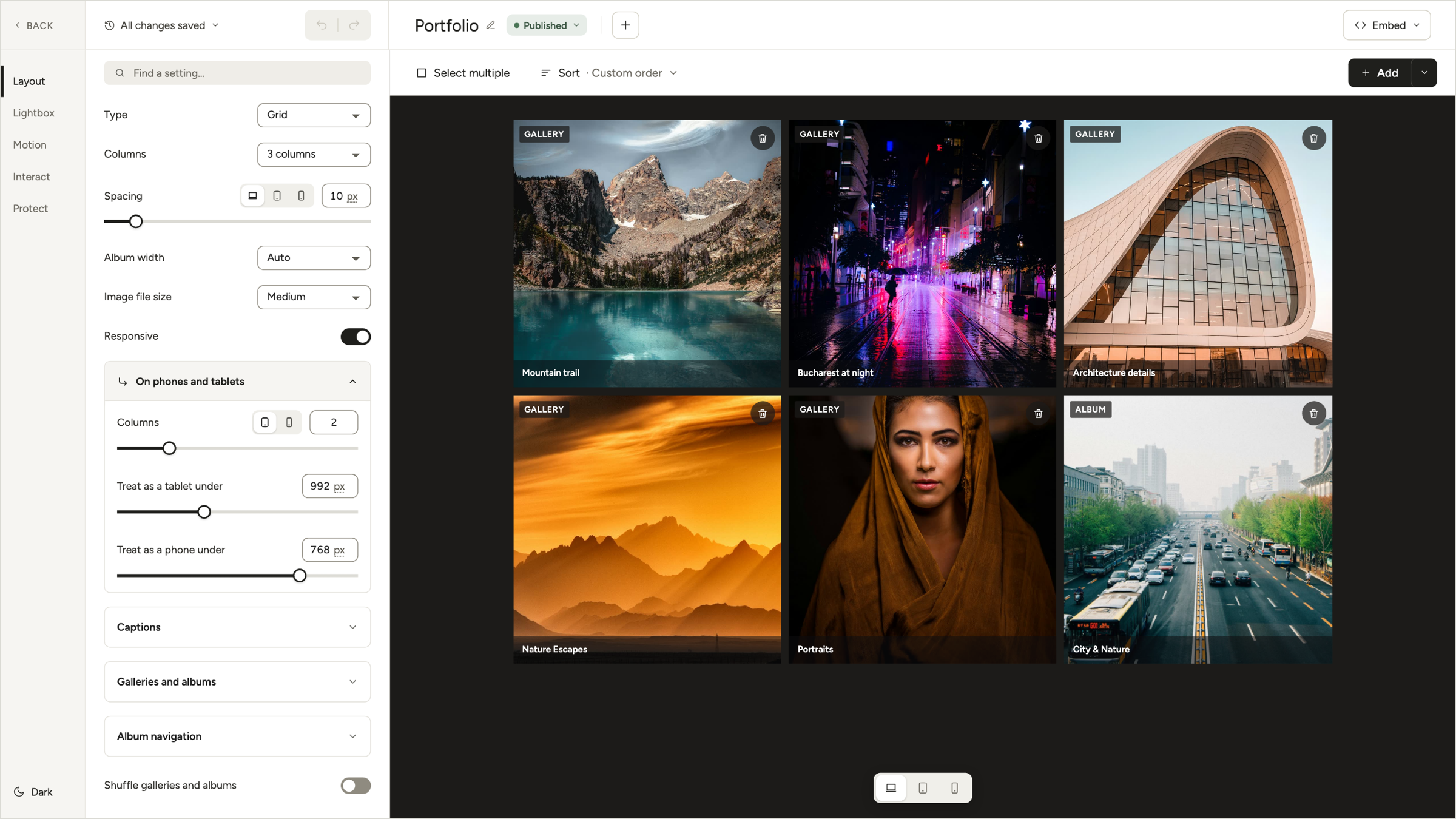
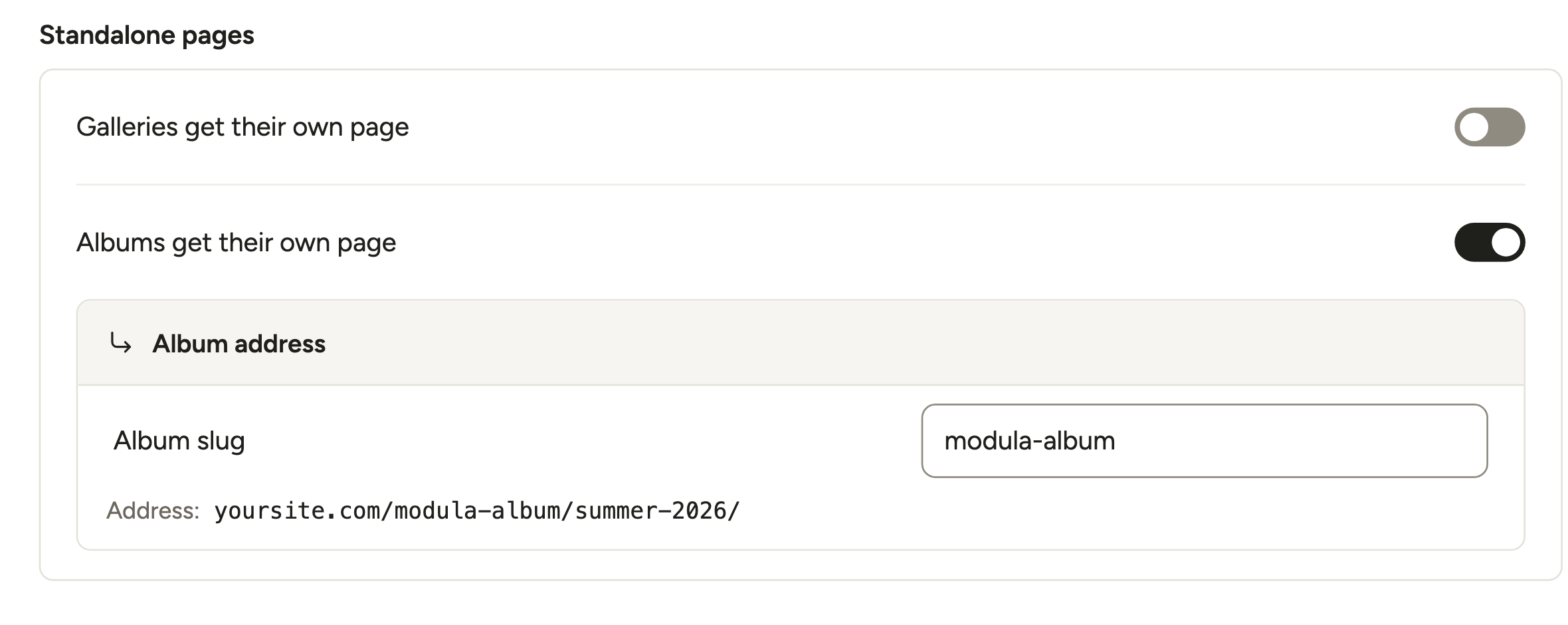
- Each gallery or album on its own URL. With Modula’s Standalone extension (Trio), a gallery gets its own page at /modula-gallery/your-gallery/ and an album at /modula-album/your-album/. You don’t have to create a WordPress page for each one. The Standalone guide has the setup.
- A grid of project posts. If you already write a blog post for every shoot, Modula’s Content Galleries (Trio) turns those posts into a gallery. Each post adds one image, with its title and caption, and each tile can link back to the post. Publish a new post and the gallery updates itself. Visual Portfolio’s free Portfolio post type is the alternative if you’d rather keep projects separate from your blog.
When a project needs its own case-study page
Watch out
The limit, said plainly: Modula doesn’t add a “Portfolio” post type with case-study pages. If you want a long write-up for every project, with its own template, use your theme’s portfolio, Visual Portfolio or a post type plugin. Then put a Modula gallery inside each of those pages.
For a worked example, see how to build a multi-level wedding portfolio with Modula, or read more about Modula albums.
The best WordPress portfolio plugins, reviewed
The seven best WordPress portfolio plugins for photographers in 2026 are Modula, Portfolio Filter Gallery, Final Tiles Grid, GridKit, Visual Portfolio, FooGallery and WP Portfolio, each reviewed with prices checked in October 2026. You’ll see what it is, what’s free, what the paid plans add, and an honest “best for” and “watch out for”.
Modula
Modula is a gallery plugin first, which makes it a natural fit if you work in visual arts and want your photos to do the talking. Version 3.0 has 14 gallery types. Seven are free: Masonry, Uniform grid, Fit grid, Justified grid, Custom grid, Creative and Polaroid. The paid ones include Slider, Story, Showcase and Canvas, a free-form layout you arrange by dragging tiles around.
It’s easy to pick up whatever your WordPress experience. The 3.0 editor saves as you go (you’ll see “All changes saved” at the top), so there’s no Update button to forget. And if you get stuck, the site is full of how-tos, starting with creating an image gallery and mixing photos with YouTube and Vimeo videos.
#### What you get for free
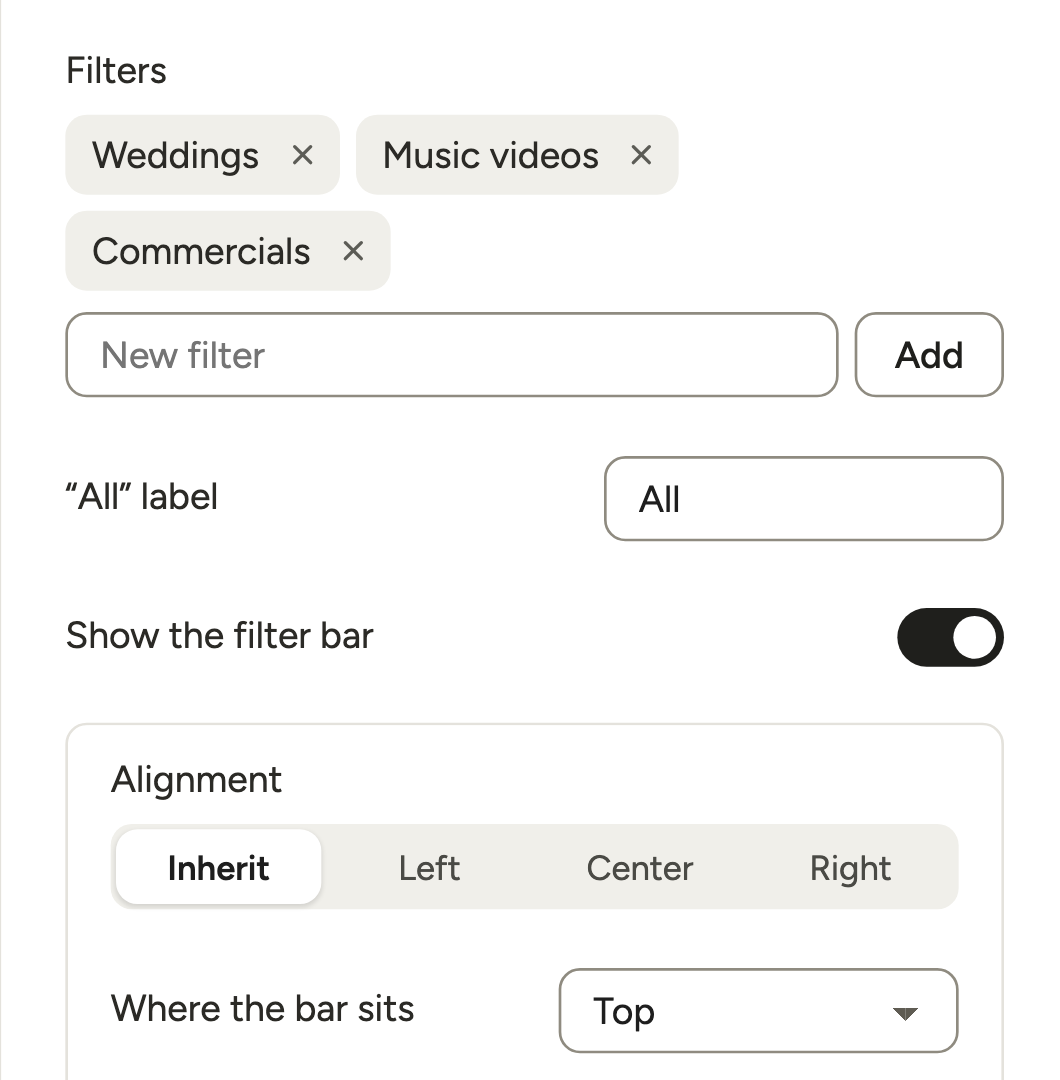
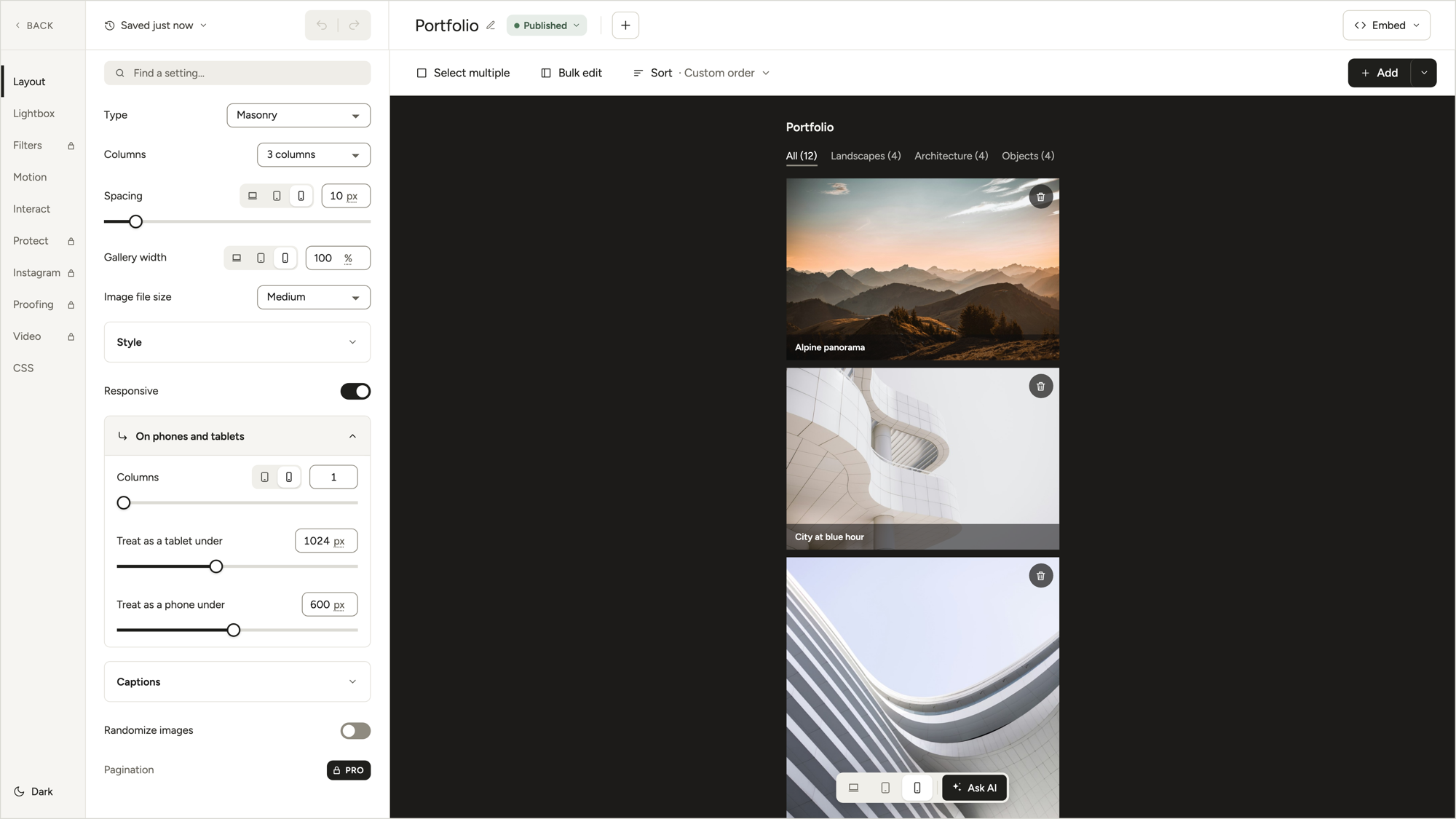
Modula Lite gives you the seven free gallery types, a lightbox and per-device columns. Under Layout, the Responsive switch (on by default) opens On phones and tablets, where you set Tablet and Mobile columns (1 to 6; the defaults are 2 and 1).
You also choose what counts as a tablet (Treat as a tablet under, 1,024 px by default) and a phone (Treat as a phone under, 600 px). The Desktop / Tablet / Mobile switch under the preview shows you the result before visitors see it.
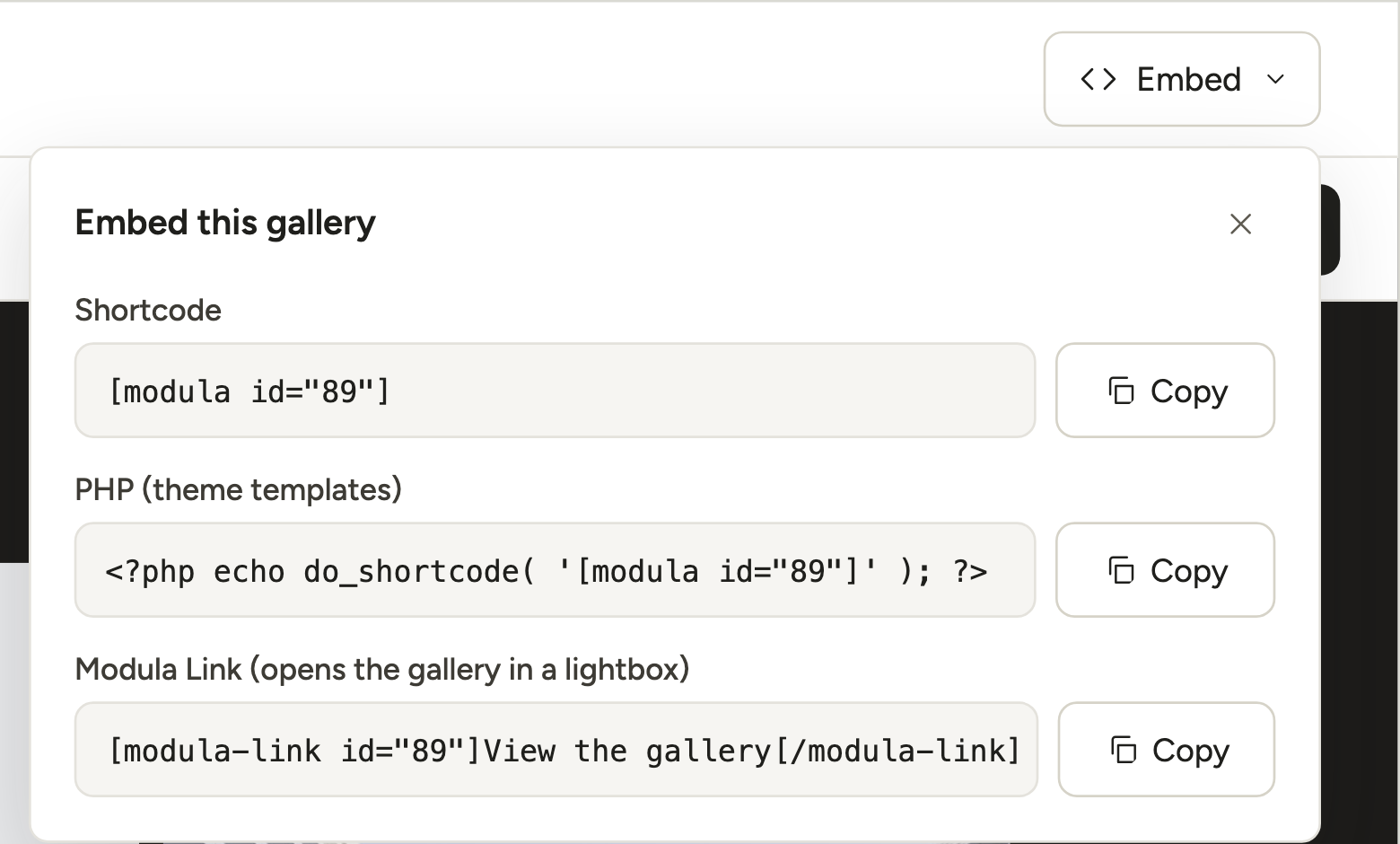
Lazy loading is free too (Load images as people scroll, on by default), and so are the WordPress block, Elementor widget, Divi module and Beaver Builder module. Anywhere else, the Embed button hands you the shortcode.
#### What the paid plans add
- Starter: Filters, sorting, video galleries, a lightbox slideshow and the Pro gallery types (Slider comes with Trio).
- Trio: Albums, Standalone, Content Galleries, Password Protect, Image Guardian (right-click protection and hidden image URLs), Image Licensing, Slider, Fullscreen, Instagram, and Speed Up for image compression and a CDN (servers that deliver images from close to each visitor).
- Business: Image Proofing, Watermark, EXIF (camera settings), Zoom, Download, Comments, Pagination, Presets, Roles, Whitelabel and Deep Link.
Proofing, the photographer’s feature. With Image Proofing you invite a client by email. They open the gallery from your invite, pick their favorites (you can set a minimum and a maximum) and submit.
You get an email with their selection. That’s how 300 proofs turn into a 60-photo album without a spreadsheet, and the Image Proofing guide walks through it.
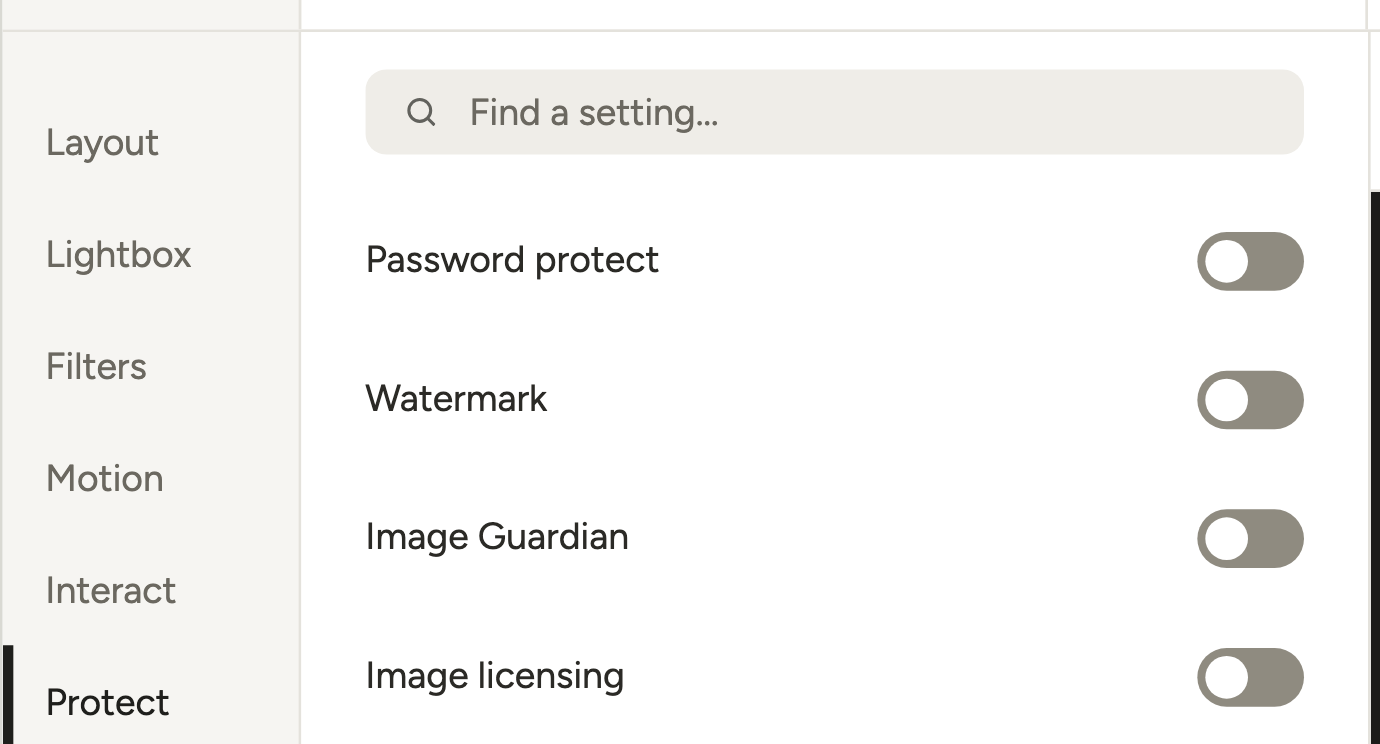
Protection lives in one place. The Protect section holds Password protect, Watermark, Image Guardian and Image licensing.
Image Licensing attaches a license to your images (also as structured data for search engines), so people know the terms. It doesn’t sell licenses. More in our image licensing guide.
There are no starter templates. What you get instead is Presets (Business), which save your settings so the next gallery starts the way you like it.
#### What it costs, and what it can’t do
Price (checked October 2026): Starter is $39 for the first year, then $78/year for one site. Trio is $69, then $138 (3 sites), and Business is $99, then $198 (5 sites).
Lifetime licenses cost $269, $479 and $689, and every plan has a 14-day money-back guarantee. See pricing or Free vs Pro.
Modula Lite has 160,000+ active installs and a 4.7/5 average from 600+ ratings on WordPress.org. Version 3.0.16 came out on October 22, 2026.
Best for: wedding, event and portrait photographers who want filters, albums, proofing and protection in one plugin.
Watch out for: there’s no built-in selling. Modula has no store or checkout, and the Download extension only lets visitors download images, not buy them. If you sell prints, you’ll run a shop (WooCommerce, for example) next to your galleries. Proofing and watermarks need the Business plan.
Portfolio Filter Gallery
Portfolio Filter Gallery by A WP Life does one job and does it well: a responsive grid of your work with filter buttons on top. It’s easy to set up, and you won’t need to touch code.
Free: Grid and Masonry layouts, four hover effects, two filter styles, a basic lightbox, 1 to 6 columns and lazy loading.
Premium: Justified and Packed layouts (four in total), 30+ hover effects, five filter styles, multi-level and multi-select filters, a watermark, WooCommerce product galleries and pagination. Multi-level filters mean Weddings can split into Ceremony and Reception.

Price (checked October 2026): $49, one time, with lifetime updates and a year of priority support. No subscription.
It has 20,000+ active installs, a 4.8/5 average from 348 ratings, and an update on October 21, 2026.
Best for: photographers early in their career who want a filterable grid and would rather pay once.
Watch out for: it’s built around one filterable grid. The feature list doesn’t mention client proofing, and priority support ends after the first year even though updates don’t.
Final Tiles Grid
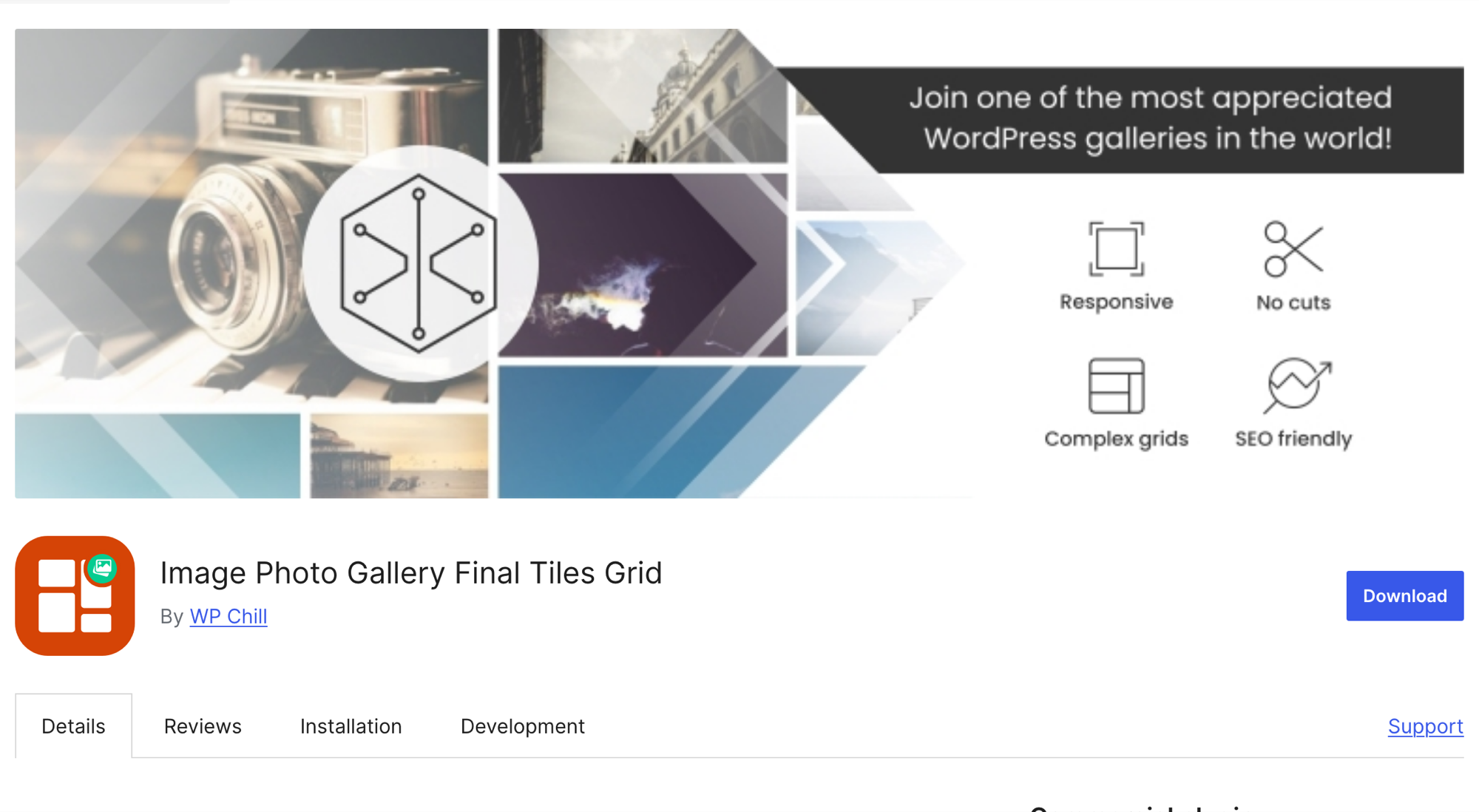
A close relative of Modula (WPChill makes both), Final Tiles Grid is built around one idea: don’t crop the photos. Its algorithm keeps each image at its original size where it can, and fits them together like tiles.
Think of it like a game of Tetris. A wide panorama, two tall portraits and a square detail shot lock into each other instead of being squeezed into identical boxes. You can even make a cover image bigger than the rest. The grid stays responsive and adapts with a smooth animation, on phones too, because it uses hardware-accelerated CSS3.
Free: two layouts (Final Tiles and Columns, a masonry layout), margin control, manual or random sorting, a lightbox plus support for EverlightBox, social sharing and video galleries.
PRO: filters and categories, seven lightboxes, a separate lightbox for mobile, caption, hover and image-loaded effects, WooCommerce support, and galleries built from recent posts or custom post types.
Price: we couldn’t check it. The Final Tiles Grid site returned an error on October 23 and 24, 2026, so see the current price on its pricing page.
It has 20,000+ active installs, a 4.7/5 average from 353 ratings, and an update on October 8, 2026.
Best for: fine-art and mixed-orientation work you don’t want cropped by a single pixel.
Watch out for: the Final Tiles layout can’t promise a straight bottom edge. If you need one, the plugin’s own advice is the Columns layout with images of the same height. Proofing isn’t listed.
GridKit
GridKit Portfolio Gallery by WPSofts builds more than photo grids: client and sponsor logos, sliders, product catalogs and team grids, all from a layout builder, without a lick of code. There are demos if you want to see it first, though most of them use Premium templates.
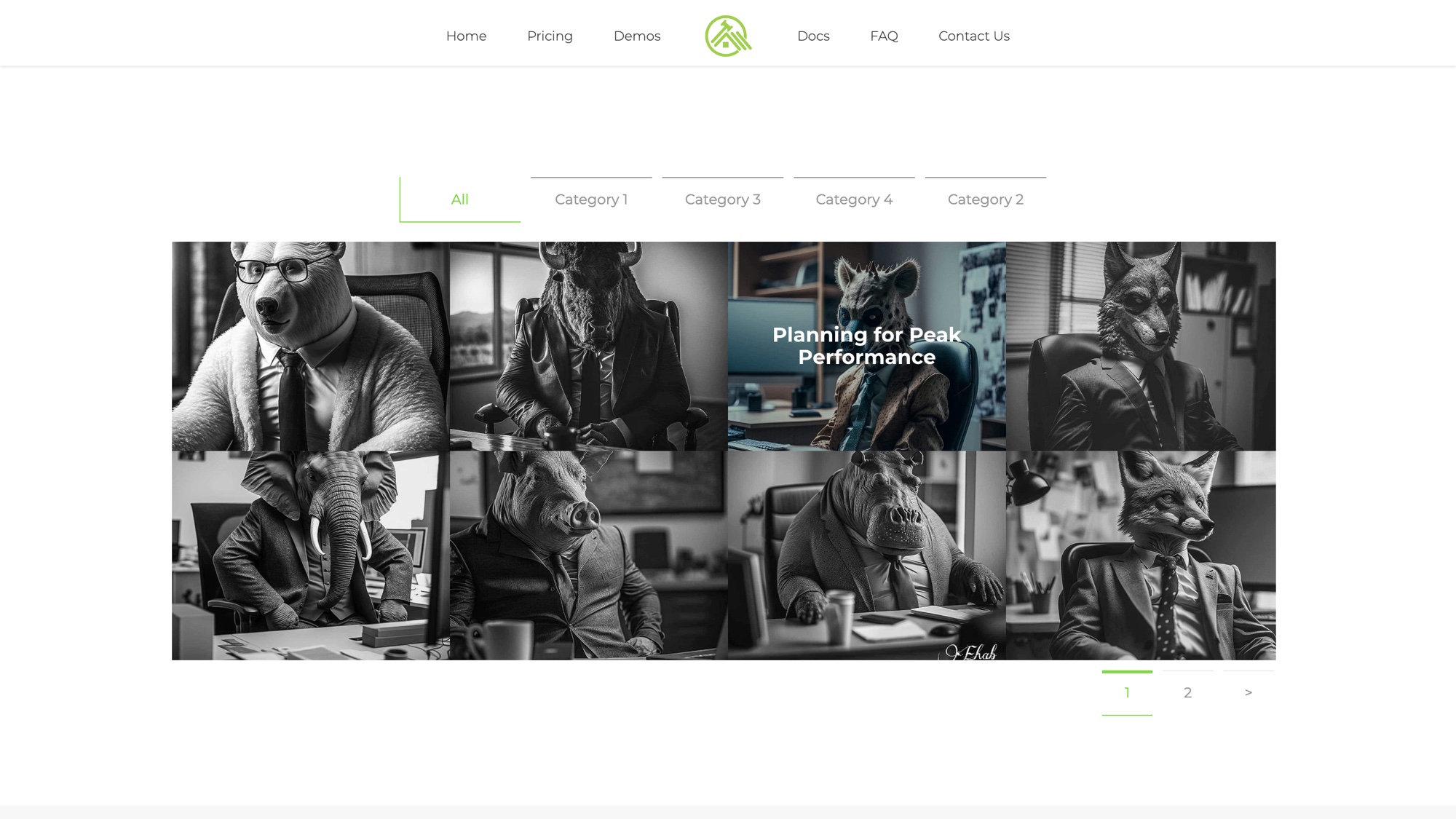
Free: the layout builder, a popup view and shortcodes. That’s plenty for a simple portfolio.
Premium: 12+ layouts, video, Instagram feeds, iFrame and Google Maps add-ons, 100+ hover, overlay, caption and animation effects, filters, pagination and social sharing.
Price (checked October 2026): Standard is $49 for one site and Extended is $99 for five. The pricing page mentions “unlimited updates per year” but doesn’t spell out the renewal, so check at checkout.
It has 6,000+ active installs and a 4.4/5 average from 300 ratings. Its last update on WordPress.org was on August 12, 2025, and it’s tested up to WordPress 6.8. The other plugins here on WordPress.org are tested with 7.1 or newer.
Best for: a studio portfolio that mixes shoots with client logos or a team grid.
Watch out for: more than a year without an update. Try it on a staging copy before you put it on a live site.
Visual Portfolio
Visual Portfolio by nK is built around blocks in the WordPress editor. If you remember it as the simple budget option, look again: today its free version is one of the most capable here.
Free: Tiles, Masonry, Grid, Justified and Carousel layouts, lazy loading, an AJAX filter (it sorts without reloading the page), and YouTube and Vimeo videos. It works as a block, an Elementor widget or in WPBakery. It also registers a Portfolio post type, so each project can be its own post.
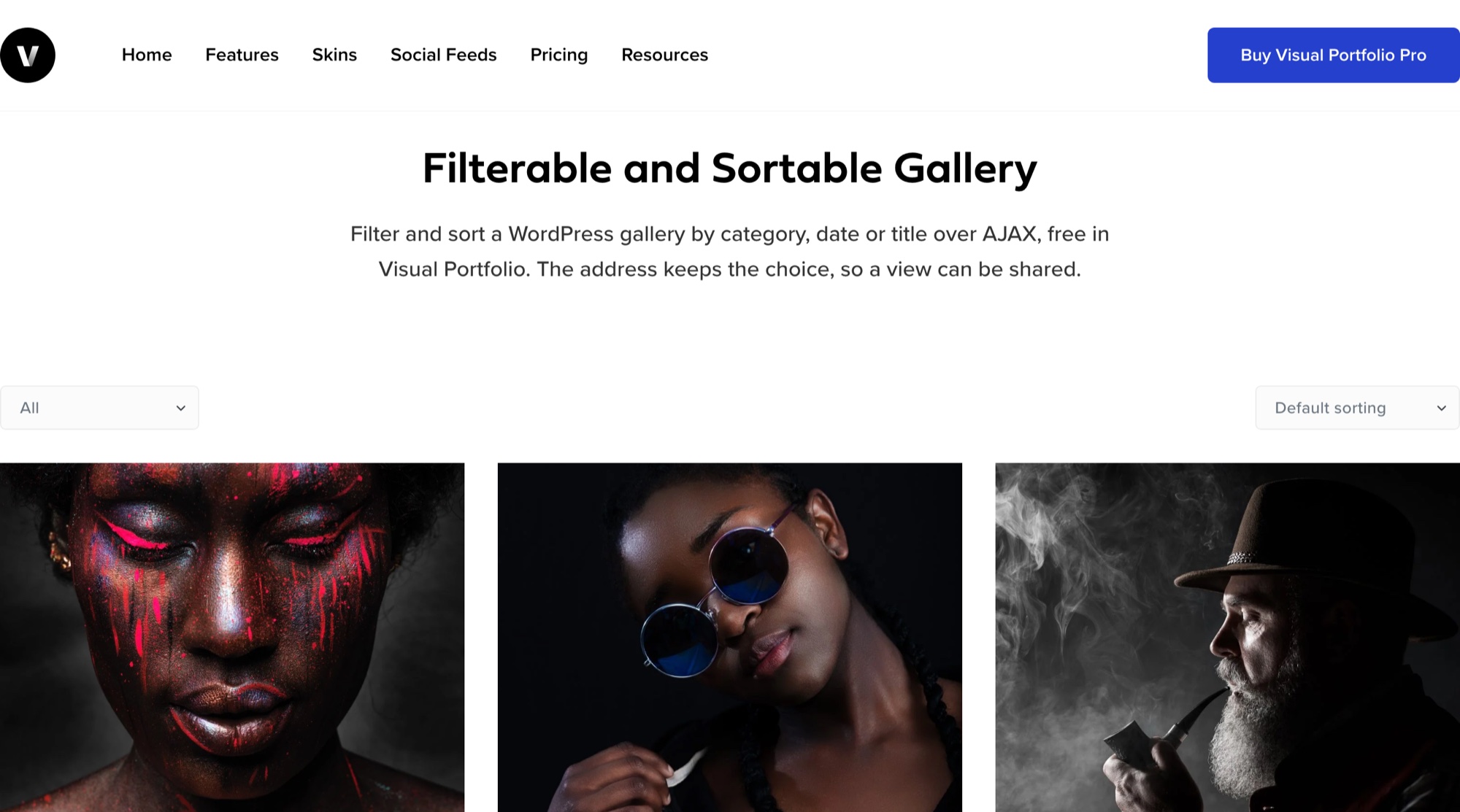
Pro: custom responsive breakpoints (the screen widths where columns change), watermarks, an age gate, right-click protection, proofing, white label, albums, local video, and Instagram and other feeds.
Price (checked October 2026): Personal is $49/year for one site, Freelancer $99 for 5, and Studio $249 for unlimited sites, with a 14-day refund.
It has 60,000+ active installs, a 4.8/5 average from 340 ratings, and an update on October 24, 2026.
Best for: block-editor or Elementor users who want each project as its own post.
Watch out for: there’s no lifetime license, and custom responsive breakpoints are Pro-only.
FooGallery
FooGallery has the most generous free version on this list, and with lazy loading built in, it copes well with image-heavy sites. The settings are clear enough that you won’t spend an evening in them.
Free: seven layouts, unlimited galleries and albums, a lightbox, lazy loading and password-protected galleries.
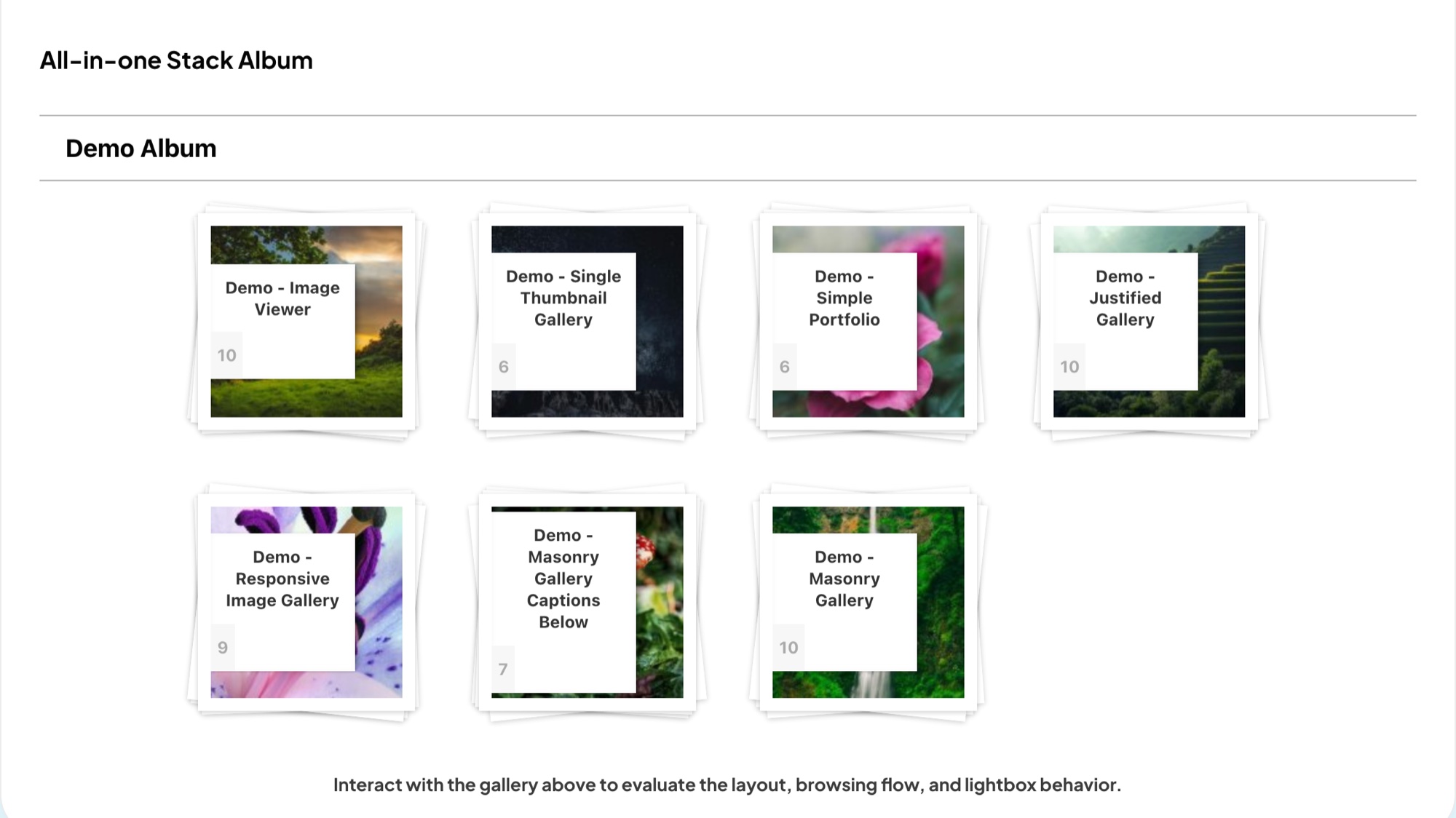
PRO: Starter adds Slider, Grid, Polaroid and Spotlight layouts, hover presets and Mobile Gallery Settings. Expert adds video, media folders, tag filtering and search, EXIF data and advanced pagination. Commerce adds WooCommerce, image selling, watermarking and protection.
Price (checked October 2026): Starter is $49.99/year, Expert $79.99 and Commerce $109.99, each for one site. There’s a 30-day money-back guarantee and a 7-day PRO trial with no card. Lifetime licenses exist, but the price isn’t listed.
Client proofing: a separate Client Proofing add-on, $39.99/year for one site, that works with the free version and every PRO plan (checked October 2026).
It has 100,000+ active installs, a 4.8/5 average from 994 ratings, and an update on October 19, 2026. See Modula vs FooGallery for a side-by-side look.
Best for: a free portfolio with albums and password-protected client galleries.
Watch out for: filtering by tag needs Expert ($79.99), so a filterable portfolio isn’t free here.
WP Portfolio
WP Portfolio shows three kinds of work in one place: websites, images and videos. There are demos for all three, so you might end up showing more than photos.

It comes with 48+ ready-made demo portfolio sites, handy if you don’t have a designer’s eye, and at checkout you pick an Elementor or Beaver Builder add-on.
Price (checked October 2026): $39 for the first year ($49 after), or $229 for a lifetime license, both for unlimited websites. There’s a 14-day money-back guarantee. It isn’t on WordPress.org, and its changelog lists the latest version, 1.13.6, on August 13, 2026.
Best for: web designers and agencies showing the websites they built.
Watch out for: there’s no free version to test with your own work, and it’s built around showing websites. Photographers have more photo-focused picks above.
Other portfolio plugins you’ll see recommended
WPZOOM Portfolio, Sunshine Photo Cart, Essential Grid, Go Portfolio and Portfolio Post Type also turn up on other portfolio plugin lists and in AI assistants’ answers. Here’s what each one costs in October 2026, and the catch that kept it out of our seven.
WPZOOM Portfolio
WPZOOM Portfolio is the strongest newcomer. WPZOOM Portfolio PRO adds photo proofing through a secret link, an album gallery per project, a video lightbox, video backgrounds on hover and a self-hosted video trimmer. It costs $49/year for one site, $79 for 3 and $99 for 10, with a 14-day refund (checked October 2026).
The free Lite version has 20,000+ active installs and gives you a block, a shortcode, an Elementor widget, grid and masonry layouts, category filters and a lightbox. Why it’s not in the seven: it joined WordPress.org in 2022 and has only 2 ratings there so far, too few to judge. Worth a look if you want proofing and project albums for $49 a year.
Sunshine Photo Cart
Sunshine Photo Cart is a WordPress plugin for photographers who deliver and sell client shoots. ChatGPT, Perplexity and Gemini all named it when we asked them about client proofing plugins in October 2026. Its free version already has proofing, favorites, watermarks and its own checkout, though Stripe and Square payments carry a 5% platform fee.
Sunshine Photo Cart Plus costs $149/year and Pro $249/year for one site (checked October 2026). It has 1,000+ active installs and a 4.7/5 average from 138 ratings. Why it’s not in the seven: it’s a client-gallery store rather than a portfolio, so pair it with one of the plugins above.

Essential Grid
Essential Grid has left CodeCanyon (its old item page returns 410 Gone). It’s now sold on its own site as yearly plans (“Licenses start from $39”), up to 250 sites for $299 a year, with 60+ grid templates. The buy-once plan is gone. If a list still quotes a one-time CodeCanyon price, it’s out of date.
Go Portfolio
Go Portfolio still sells on CodeCanyon for $27, with 8,646 sales and a 4.51/5 rating from 450 reviews. But its last update was on May 16, 2023, its page lists compatibility only up to WordPress 6.2, and it says “Granth does not support this item”. Skip it.
Portfolio Post Type
Portfolio Post Type is the plugin to know if you searched for a portfolio post type plugin: free, 40,000+ active installs and a 4.7/5 average from 14 ratings. The idea is right, but its last update came on August 29, 2020, and it’s tested only up to WordPress 5.5. Visual Portfolio’s post type is the maintained way to get the same thing.
Which portfolio plugin should you choose?
The best WordPress portfolio plugin depends on the job: Modula for filters, albums and proofing, FooGallery for a generous free version, and Portfolio Filter Gallery if you’d rather pay once. Find your situation:
- You shoot weddings or events and need filters, albums, proofing and protection: Modula. Trio covers albums and password-protected galleries; Business adds proofing and watermarks.
- You want to sell your photos: FooGallery Commerce, which sells through WooCommerce. Or keep the portfolio plugin you like and add Sunshine Photo Cart, which has its own checkout even in its free version.
- Your fine-art images come in every shape and you won’t crop a pixel: Final Tiles Grid.
- You’d rather pay once and get the job done quickly: Portfolio Filter Gallery, $49 one-time.
- You build in the block editor and want a post per project: Visual Portfolio.
- You’re a web designer showing websites: WP Portfolio.
- You want free and generous: Modula Lite for seven gallery types and phone and tablet columns, or FooGallery free for albums and passwords.
Whichever you pick, test the free version with 20 of your own photos, and look at the page on your phone before you pay. Then build out the rest of the site with our guide to a photo gallery website, or compare more options in the most-used WordPress gallery plugins. Shoot a lot of video? See the best WordPress video gallery plugins.
Frequently asked questions
Yes. Six of the seven plugins here have a free version on WordPress.org: Modula, Portfolio Filter Gallery, Final Tiles Grid, GridKit, Visual Portfolio and FooGallery. Only WP Portfolio is paid-only.
Modula Lite gives you seven gallery types with phone and tablet columns, FooGallery’s free version is the most generous on albums and passwords, and Visual Portfolio’s free version includes a Portfolio post type.
FooGallery Commerce sells your images through WooCommerce. Portfolio Filter Gallery Premium and Final Tiles Grid PRO can show WooCommerce products in a gallery. Sunshine Photo Cart, a client-gallery plugin, has its own cart even in its free version.
Modula doesn’t sell photos. There’s no store or checkout; its Download extension lets visitors download images, not buy them.
Yes, if the plugin has client proofing. Modula (Business), Visual Portfolio Pro and WPZOOM Portfolio PRO all have it, FooGallery sells it as an add-on, and Sunshine Photo Cart includes proofing in its free version.
In Modula, you invite the client by email, they select their favorites within the limits you set, and you get an email when they submit. See Image Proofing.
Stack a few layers. A watermark keeps your name on photos that get shared, right-click protection stops casual saving, and a password keeps client galleries private. Nothing stops a determined person from taking a screenshot, so the watermark is the layer that travels with the photo.
In Modula, Password Protect and Image Guardian come with Trio, and Watermark with Business. See how to watermark photos, password-protected galleries and how to protect images from theft.
Usually, yes. A portfolio plugin puts the gallery inside your page content, so it doesn’t depend on the theme, and it stays put when you switch themes.
Modula adds a block, an Elementor widget, a Divi module and a Beaver Builder module, and the Embed button gives you a shortcode for anywhere else. See how to add a gallery in Elementor, Divi or Beaver Builder.
It can: images make up about 42% of the median mobile page (Web Almanac 2025). Lazy loading, properly sized images and compression with a CDN fix most of it. Lazy loading is free in Modula, Visual Portfolio, FooGallery and Portfolio Filter Gallery; Modula’s Speed Up adds compression and a CDN on Trio.
The easiest win comes before you upload. Your 24-megapixel files are 6,000 pixels across, but a QHD monitor is only 2,560 wide, so export at display size.
It will if the plugin lets you set columns per device, and that matters: phones carried 58.99% of web traffic worldwide in September 2026 (StatCounter). In Modula, On phones and tablets under Layout sets separate Tablet and Mobile columns, and the Desktop / Tablet / Mobile switch under the preview shows each one. See optimizing galleries for mobile and tablet.
No. All seven portfolio plugins in this guide are set up from your WordPress dashboard, with menus and switches instead of code. The most technical step is pasting a shortcode, and a block or an Elementor widget, where a plugin has one, removes even that. Custom CSS is there if you want it, but you don’t need it.