Made in Europe, buy from Europe.

To add a WordPress image carousel, you need a block or plugin that can slide, because WordPress doesn’t come with one.
With Modula, you create a gallery and set its type to Slider. Then you choose how many photos show at once and drop the gallery into a page with a block or a shortcode.
We make Modula, so it’s the tool this guide uses. The whole job is four steps:
- Go to Modula → Content, click New gallery and add your photos.
- Open Layout and set Type to Slider.
- Set Visible at once to 1 for a classic slider, or 2 to 4 for a carousel row.
- Click Save, then Embed, and paste the shortcode into a page, or add the Modula Gallery block.
That takes five minutes. Whether anyone looks past the first slide depends on everything else below, and most of it holds for any carousel tool.
What is a WordPress image carousel?
A WordPress image carousel is a gallery that shows a few photos at once and slides sideways to bring in the rest. Visitors click arrows, tap dots or thumbnails, or swipe, and you can also let it move on its own.
People mix up “slider”, “carousel” and “slideshow”. The table shows the usual difference.
| Term | What visitors see | Typical use |
|---|---|---|
| Slider | One large image at a time | A portfolio’s featured work, a hero image |
| Carousel | Several images side by side, moving as a row | Products, portfolio previews, client logos |
| Slideshow | Images that change by themselves | An event recap, the highlights of a trip |
| Lightbox slideshow | Full-screen photos that play after a click | Big collections where the grid stays on the page |
So a slider shows one image and a carousel shows a row. And a carousel waits for the visitor, while a slideshow moves by itself.
In Modula, the first three are one gallery type, Slider. Visible at once (1 to 12 photos) and the Autoplay switch decide which one you get. The lightbox slideshow is a setting for grid layouts, covered further down.
When a slider helps (and when it doesn’t)
A slider helps when a few images belong together and space is short, and hurts when people need to see every photo, because few visitors get past the first slide.
Picture someone landing on a wedding photographer’s homepage, greeted by a slider of the year’s best couples. The first photo makes the impression. The fourth? Most visitors never get there.
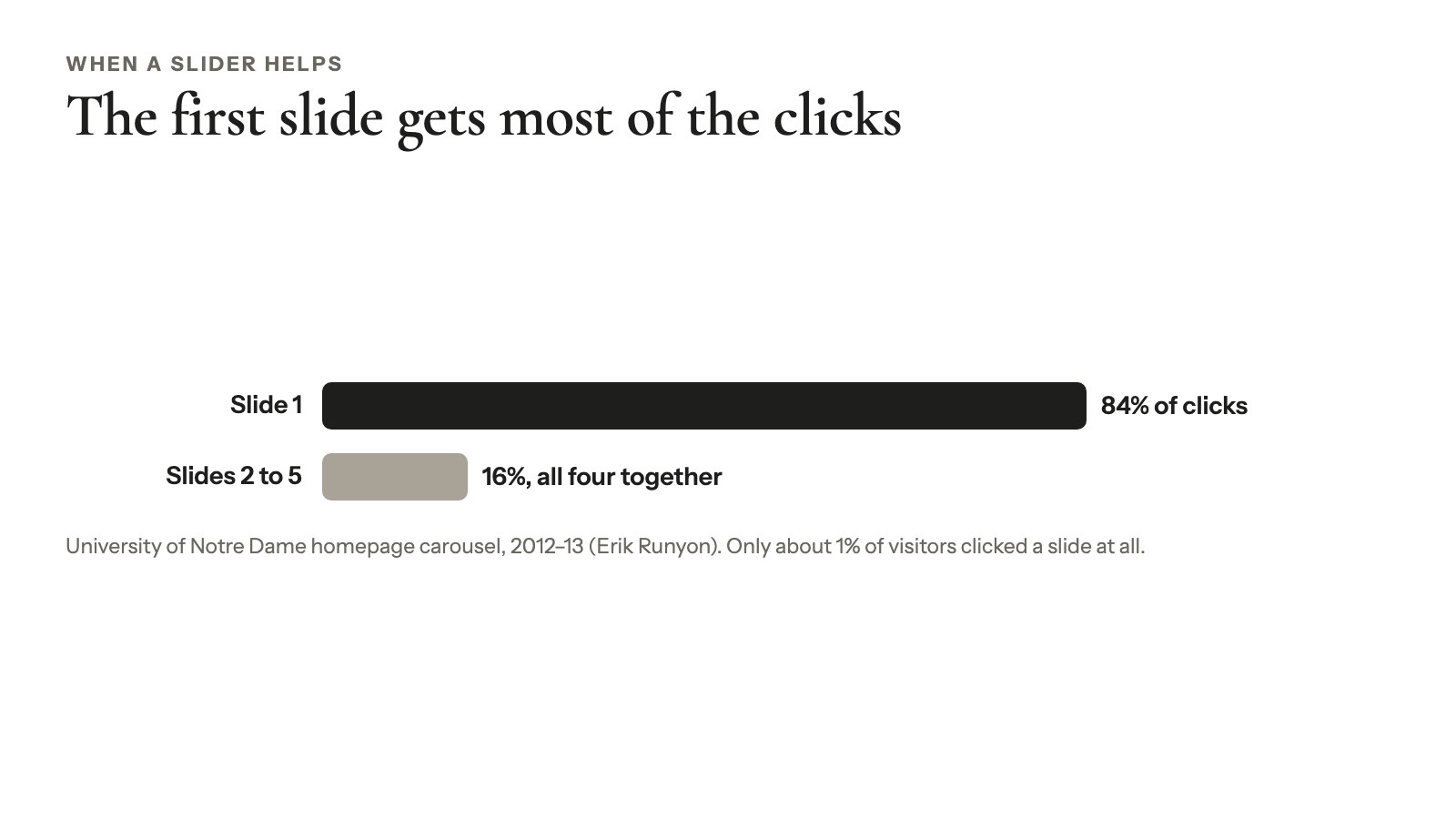
The University of Notre Dame tracked its homepage carousel in 2012–13. About 1% of visitors clicked a feature, and 84% of those clicks went to the first of five slides (Erik Runyon, Notre Dame).
It’s an old study, but the lesson holds: the first slide does most of the work.
A slider is a good fit for:
- Featured work. One strong image at a time keeps a portfolio homepage calm.
- A row of products. A potter with 12 product shots can show three mugs at a time instead of a grid four screens long.
- A story in order. Before and after shots of a kitchen remodel, or the days of a road trip, read well one slide at a time.
- An announcement. A new collection or an upcoming event fits in a slim carousel without pushing the page down.
Skip it when every image matters. That photographer’s 300 proofs for a couple don’t belong in a slider, because nobody clicks through 300 slides. A grid with a lightbox shows everything and lets people open any photo full size.
Nielsen Norman Group (NN/g) says in its carousel guidelines to use five frames or fewer. And if your hero is really one message, like “Now booking 2027 weddings,” one static image beats five rotating slides.
Ways to add a carousel in WordPress
There are five common ways to add a carousel in WordPress, and only three can show photos in a row (checked October 2026):
| Option | What you get | Cost | Good to know |
|---|---|---|---|
| WordPress Gallery block | A grid, no slider | Free, built in | Since WordPress 7.0, Enlarge on click opens a lightbox where visitors step through the photos |
| Jetpack Slideshow block | Slider, one image at a time | Free with Jetpack | Slide or fade, captions; with autoplay on, it adds a pause button |
| Page builder widgets | Slider or carousel | Depends on the builder | Elementor and others have image carousel widgets, only for pages built with them |
| Slider and carousel plugins such as Smart Slider 3 or MetaSlider | Slider or carousel | Free and paid versions | Often built for banners with text layers and buttons, not photo galleries |
| Modula Slider | 1 to 12 slides at once | Modula Pro, Trio plan and up | Thumbnails, autoplay, captions, separate slide counts for phones and tablets |
Can you add a carousel without a plugin?
Not really. As of WordPress 7.1 (August 2026), core still has no carousel or slider block.
Your options are the Gallery block’s click-through lightbox or a slider block from your theme or page builder. Developers can also hand-write one in HTML and CSS (scroll snapping does most of the work). Jetpack is free, but still a plugin.
How to create an image carousel with Modula
To create an image carousel with Modula, switch on the Slider extension, set a gallery’s Type to Slider, pick how many slides show and embed it.
The gallery slider is one of Modula’s 16 gallery types (8 of them free), and Modula has 160,000+ active installations.
Turn on the Slider extension
The Slider type is part of Modula Pro, from the Trio plan up. Trio covers 3 sites for $69 the first year, then $138 a year, with a 14-day money-back guarantee.
Install Modula Pro, activate your license key, then go to Modula → Extensions and switch on Slider (how to install extensions).
Create a gallery and pick the Slider type
- Go to Modula → Content and click New gallery.
- Give it a title, then click + Add to pick photos from the Media Library, or use its arrow → Upload files.
- Click Layout in the left rail and set Type to Slider (in the Slides & video group).
The preview turns into a slider right away. When you’re done, click Save in the top bar (or press Cmd/Ctrl+S).
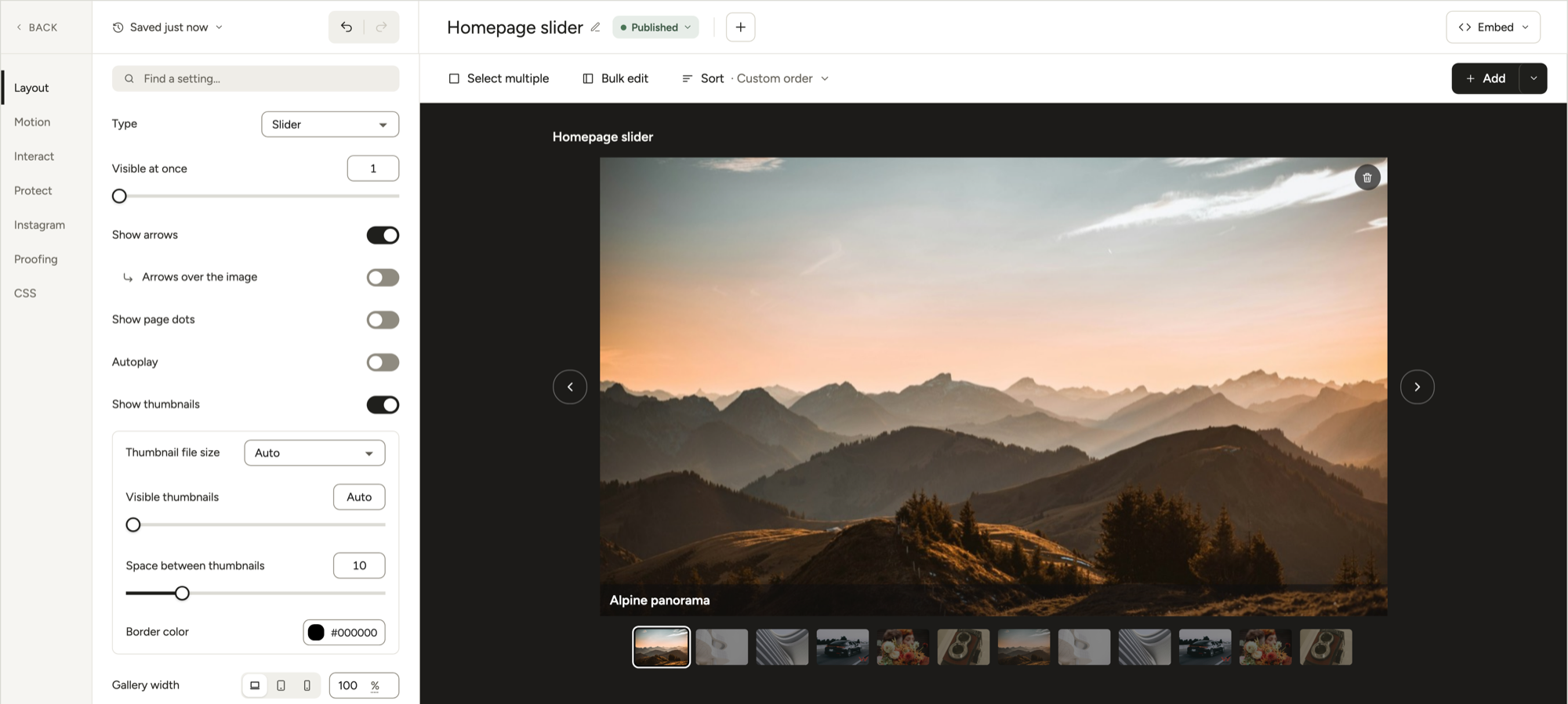
One slide at a time, with arrows and thumbnails.
Already have a gallery? Switch its Type to Slider. Titles, captions and alt text stay put, and you can switch back any time. Albums can use it too: open an album and set Album type to Slider.
Show one slide or several at once
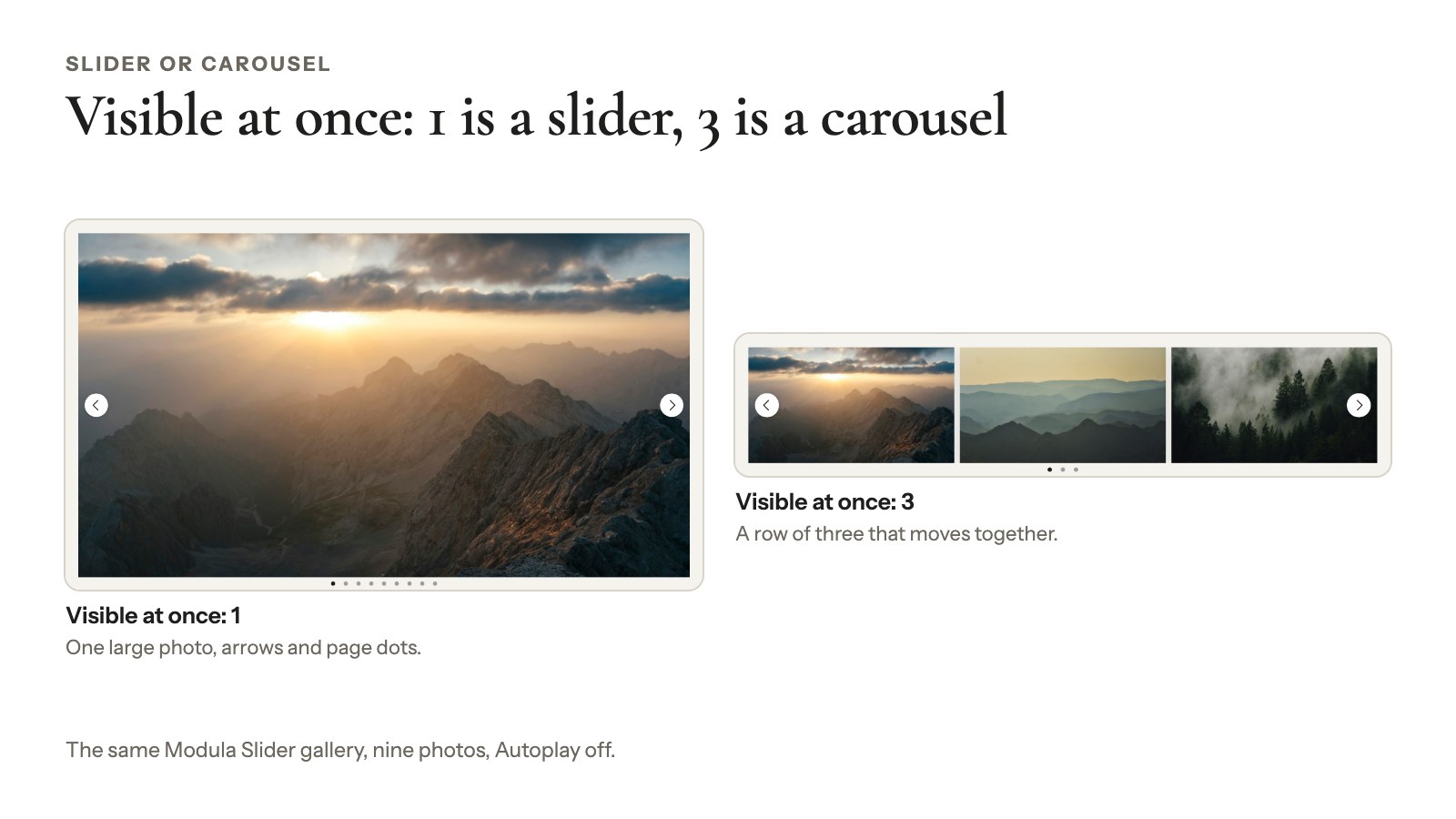
Visible at once turns a slider into a carousel. Leave it at 1 for one big image, or set 2 to 4 for a row. It goes up to 12, though you’ll rarely want more than four.
- Advance by sets how many slides move per click. The potter could show 3 mugs and advance by 3: four clean pages of 12.
- Peek side slides shows the edges of the next and previous slides, the clearest “there’s more” hint (NN/g recommends it). Side peek size sets how much.
- On phones and tablets (under Responsive, which is on by default) sets Visible at once and Advance by again for smaller screens, up to 6.
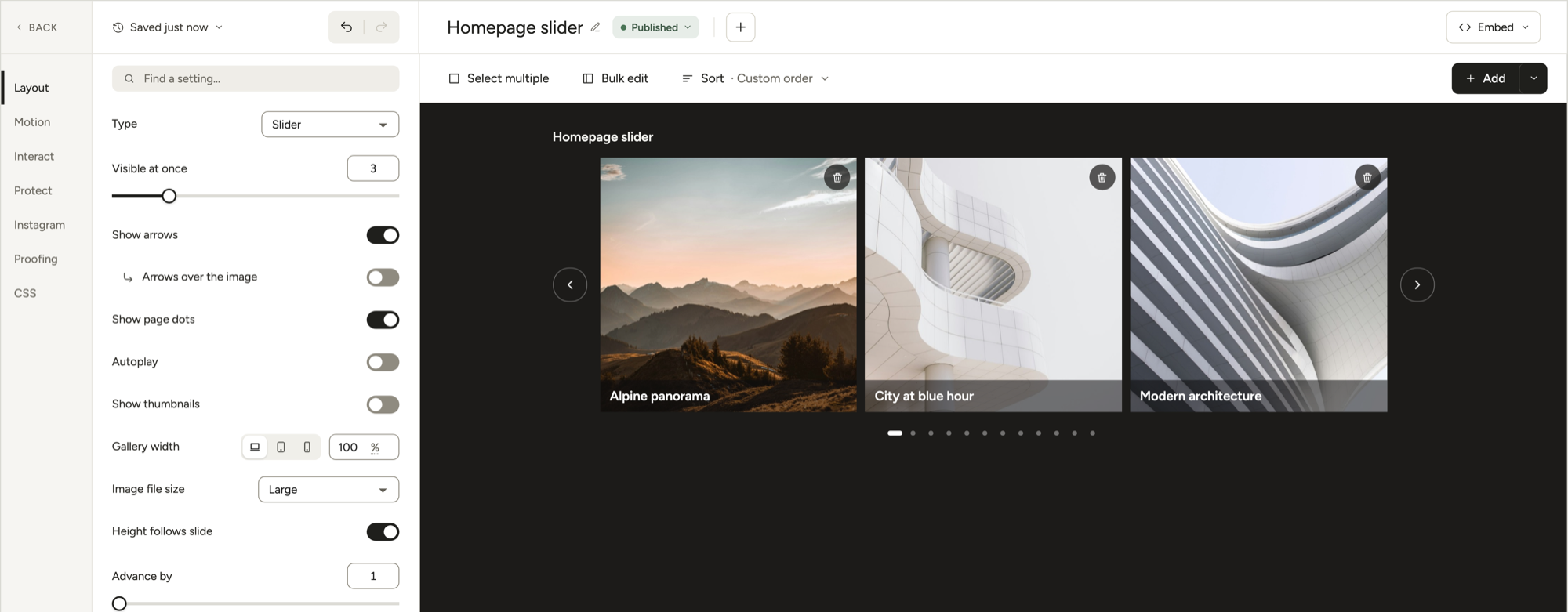
Visible at once: 3 makes it a carousel.
Add the carousel to a page (or Elementor)
Click Save, then Embed at the top right, copy the shortcode (a short tag WordPress swaps for the gallery), for example [modula id="89"], and paste it into any page or post.
In the block editor, you can add the Modula Gallery block and pick your gallery instead.
In Elementor, drag in the Modula widget and choose your gallery under Select/Search Gallery (only published galleries appear). See how to add a gallery in Elementor, and the gallery shortcode guide for Divi, Beaver Builder and theme templates.
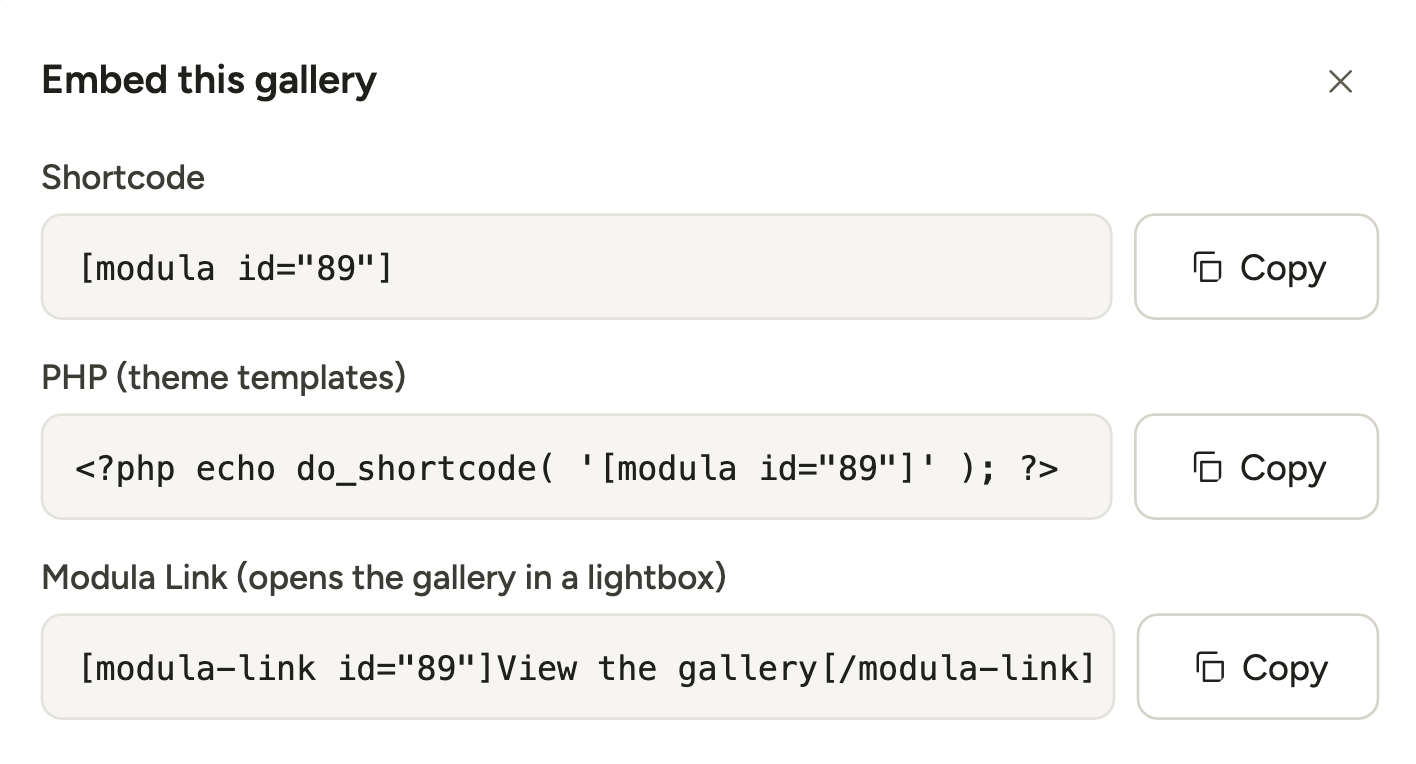
Embed gives you a shortcode, a PHP line and a Modula Link.
If the gallery doesn’t show up at all, check the status next to its title: a Draft stays hidden until you set it to Published.
Slider settings that matter
The Modula slider settings visitors notice most are autoplay timing, the arrows, dots and thumbnails, the motion between slides and share buttons. Sharing sits in Interact, the rest in Layout; the Slider article in our knowledge base lists every one.
Autoplay, timing and pause on hover
Autoplay is off by default, which is a good place to start. Switch it on and Time between slides sets how long each slide stays, from 1,000 to 15,000 ms (3,000 ms by default).
Three seconds is short for a photo someone wants to study; four to six suits most galleries. Text needs more. NN/g suggests about three words per second, so a 15-word caption needs five seconds for the words alone.
With autoplay on, also switch on Pause when hovering (off by default). Google’s web.dev carousel guide is blunt: “it’s rare that autoplay is a good choice,” and hovering should stop it.
Tip
Leave autoplay off on hero sliders and on sites most people visit from a phone. NN/g advises against auto-forwarding on mobile.
Under the Web Content Accessibility Guidelines (WCAG 2.2.2), content that moves by itself for more than five seconds next to other content needs a way to pause it.
Pause when hovering helps mouse users, but there’s no visible pause button, so where accessibility matters, let the arrows do the work.
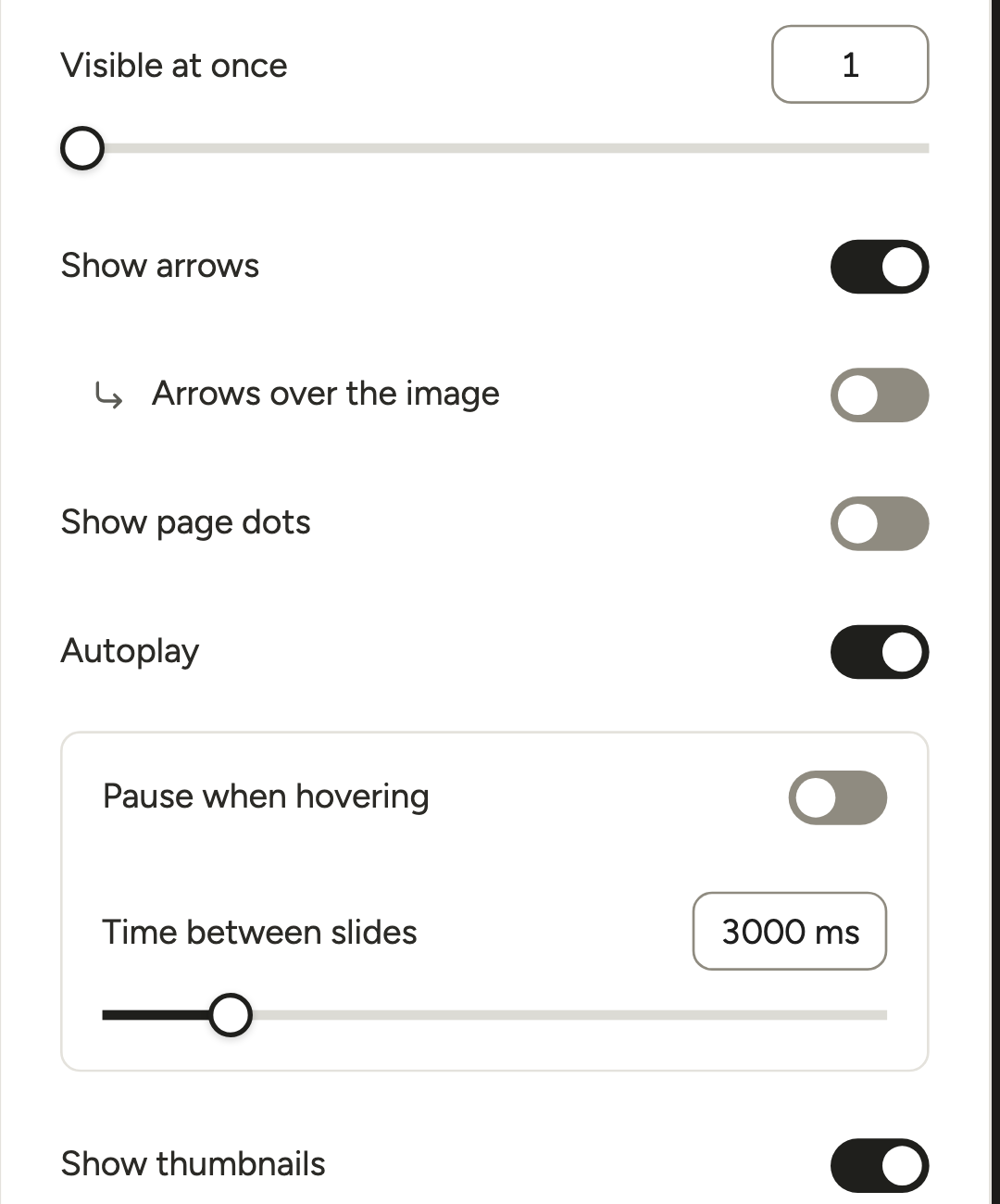
Autoplay opens Pause when hovering and Time between slides.
Arrows, dots and a thumbnail strip
- Show arrows (on by default) adds previous and next buttons. Arrows over the image puts them on the slide, handy for a full-width slider.
- Show page dots (off by default) adds one dot per page. NN/g calls dots “a particularly poor cue on mobile devices.”
- Show thumbnails (on by default) adds a strip of small images under the slider; a click jumps to that slide.
A thumbnail slider shines with one image at a time, like a product from six angles: people see what’s coming and jump to it.
With three or four slides in a row, the strip just repeats what’s on screen, so switch it off. For previews that open full size, see how to create an image gallery with thumbnails.
Motion, loop and height
- Fade between slides cross-fades instead of sliding, a calmer look for portraits and product shots.
- How fast slides change sets how long each move takes: 150 to 350 ms (300 by default).
- Loop endlessly (on by default) brings the first slide back after the last.
- Height follows slide (on by default) resizes the slider to each image. With photos of one shape, the page below doesn’t jump.
- Drag to move (on by default) lets visitors swipe. Keep it on: that’s how phone users expect a carousel to work.
Let visitors share a slide
Share buttons work on sliders and are free in Modula Lite. Click Interact in the left rail and, under Share, switch on Enable sharing. Visitors can then share the photo in front of them on X, Facebook, WhatsApp, LinkedIn, Pinterest or by email.
A florist’s carousel of spring bouquets is made for Pinterest. See Add share buttons to your gallery images.
Fill your carousel automatically (posts, products, Instagram)
If the images already live in your posts, shop or Instagram account, Modula can pull them into a gallery and keep it current. Content Galleries and Instagram are in Modula Pro from the Trio plan, like the Slider; switch them on in Modula → Extensions.
From your posts, pages or products
- In the gallery editor, click the arrow next to + Add and choose Content Galleries.
- Pick Posts, Pages or a custom post type (WooCommerce products count).
- Click Add images, then set Type to Slider.
Modula takes each published item’s featured image and title, and skips items without one. From then on, the gallery follows your content: new posts join, changed featured images swap in, posts deleted for good drop out.
A food blogger gets a “latest recipes” carousel that never needs touching. See Modula Content Galleries.
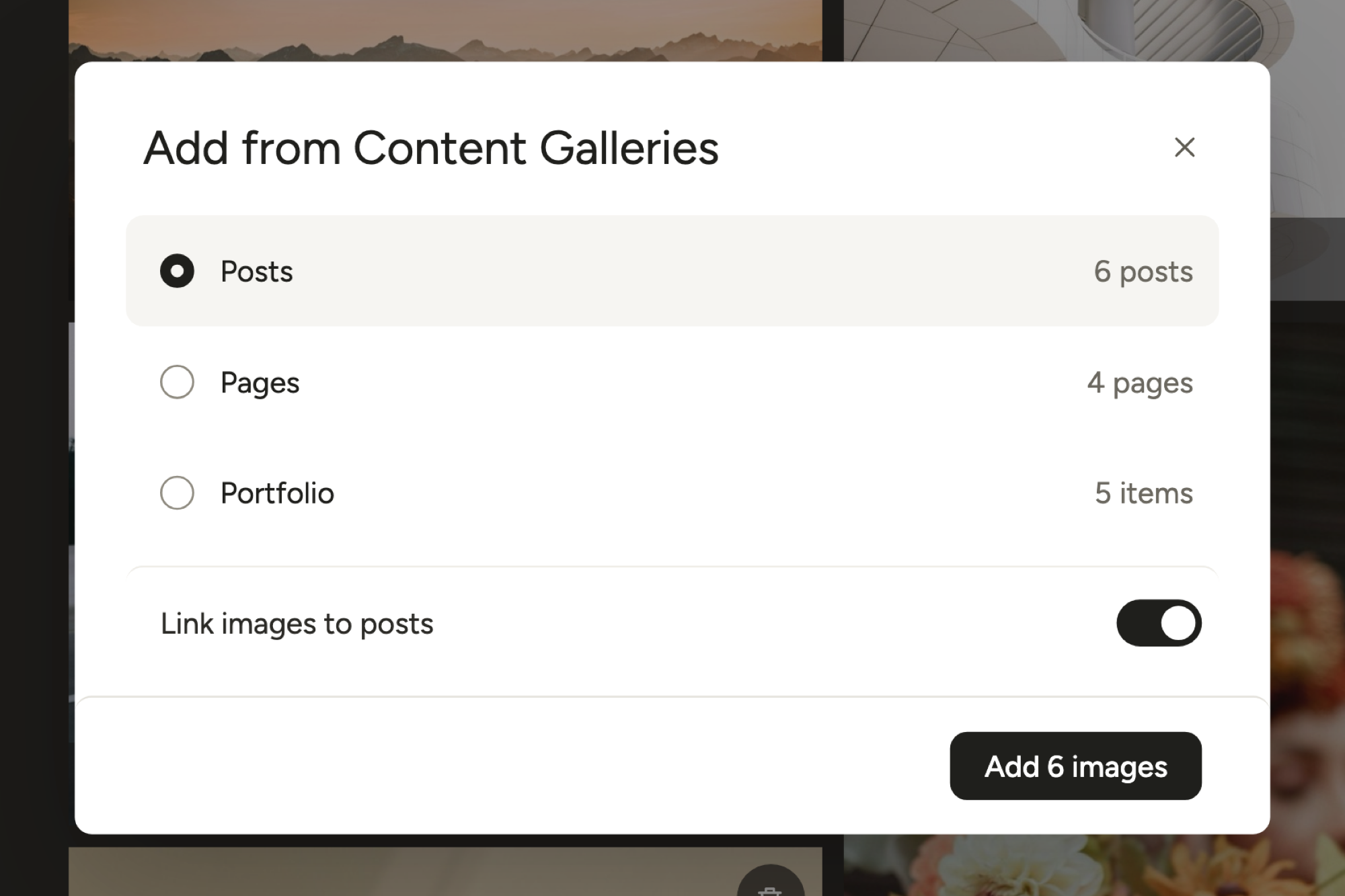
A WordPress Instagram carousel
- Go to Modula → Settings → Connections and click Connect next to Instagram (Instagram only allows Creator and Business accounts).
- In the gallery editor, click the arrow next to + Add and choose Instagram, or click Instagram in the left rail.
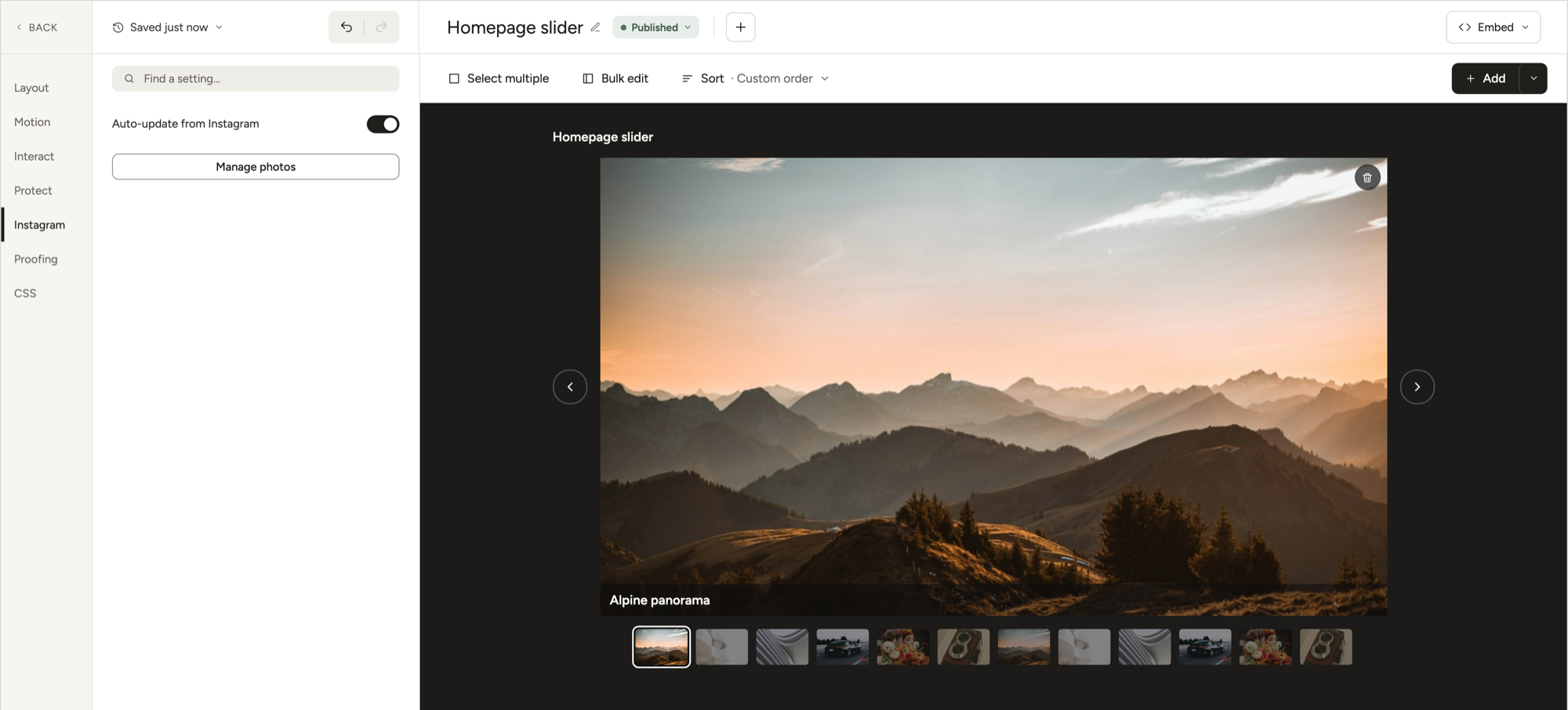
- Click Manage photos, pick your photos and click Import selected photos.
Switch on Auto-update from Instagram and Modula checks for new photos every six hours. Set Type to Slider, and a café’s latest latte art lands on its homepage without anyone opening WordPress. See How to integrate Instagram with Modula.
Watch out
The honest limit: a slide is still a photo with a title and caption, not a post card with a price or “Read more” button.
Clicking it does nothing by default, even with Link images to posts on in the Content Galleries window, so it won’t send people to your posts.
For a real post carousel, use a post carousel block from your theme or a plugin; for a product’s own photos, use WooCommerce’s product gallery.
Add text and captions to your slides
In Modula’s Slider, the text on each slide comes from the image’s title and caption, so a WordPress slider with text starts there. Click an image in the preview and fill in Title and Caption in the left panel.
Alt text sits there too. It isn’t shown on the slide, but screen readers and search engines rely on it. Captioning 20 photos? Click Select multiple and use Bulk edit to fill them in one table.
Then open the Captions card in Layout:
- Show title and caption turns the text on. It’s off by default, so this is the step people miss.
- Caption placement puts the text on the photo (Top or Bottom of the slide) or off it (Above the slide, or Below the slide, the default).
- Show image title and Show image caption each get their own color, size for desktop and mobile, and boldness. Show gallery title adds the gallery’s name above the slider.
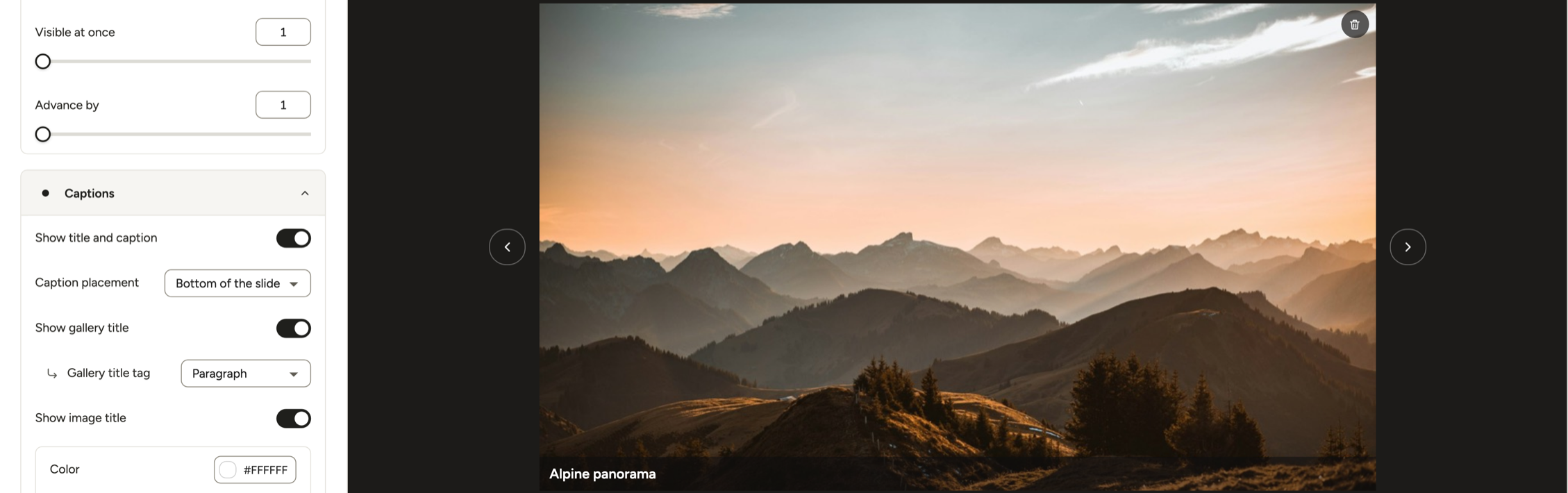
Bottom of the slide puts the title on the photo.
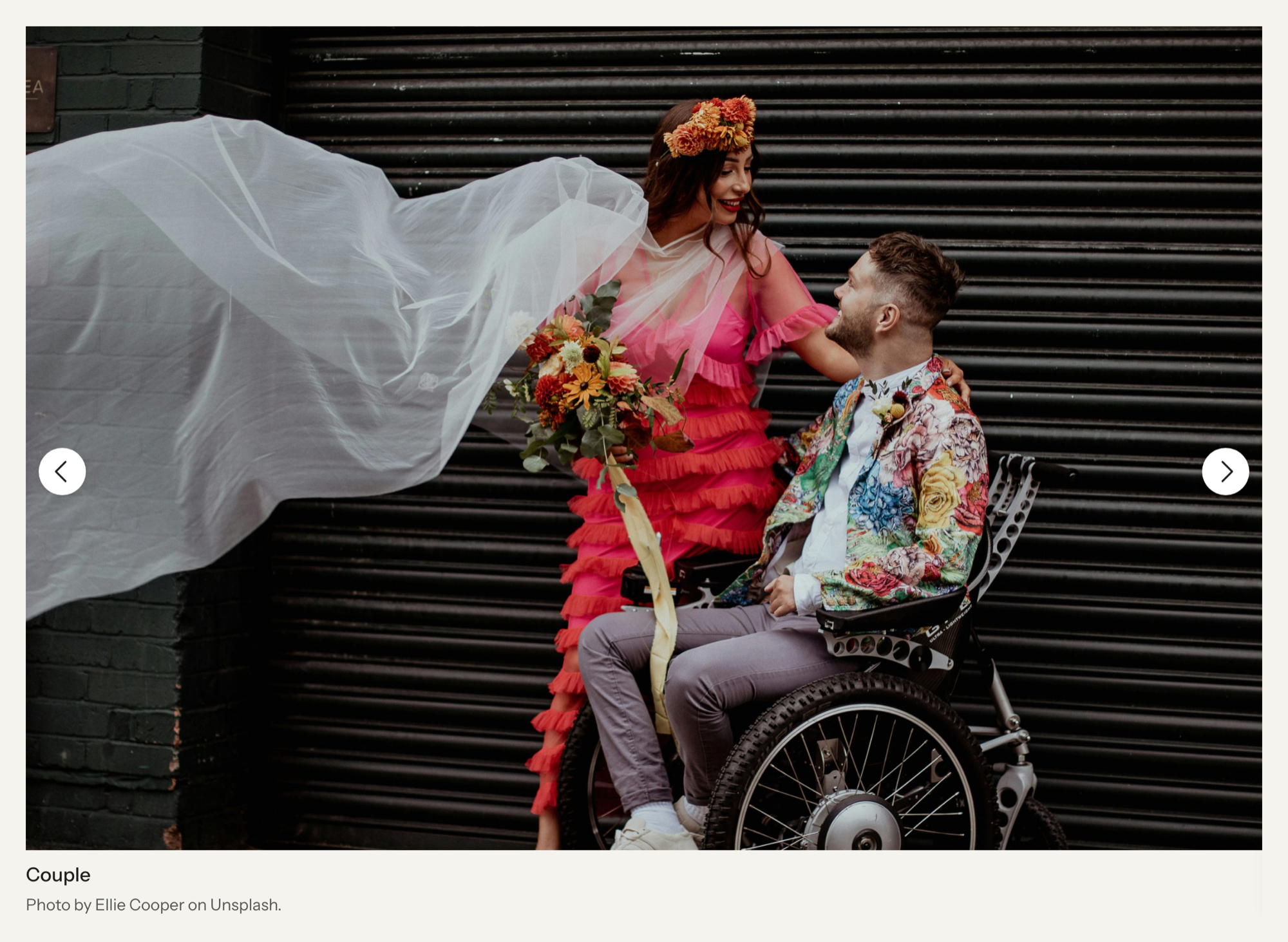
Slide text often gets only a few seconds, so:
- Keep it short. “Speckled mug, 12 oz” beats a paragraph nobody finishes before the slide moves.
- Say something useful. A product name and price, the place and date, or a photo credit.
- Watch the contrast. White text vanishes on a bright beach photo. On busy or light photos, put the text below the slide.
- Go smaller on phones. A smaller mobile size keeps a two-line caption from covering half the photo.
What the Slider doesn’t do: text layers, buttons or animated headlines. For a hero banner with a “Book now” button, use the core Cover block, a layered slider plugin or your builder’s slider widget.
For styling, see how to create an image gallery with titles and captions and the caption settings.
Add videos to your slider
A WordPress video carousel in Modula is a Slider gallery whose slides include YouTube, Vimeo or self-hosted videos. Videos use the Video extension, from the Starter plan up, so the Trio plan covers both.
A travel blogger’s photo carousel can mix in drone clips. Our guide to WordPress video sliders walks through it.
Other ways to build a WordPress slideshow gallery
A WordPress slideshow gallery doesn’t have to be a slider: Modula can also play photos one at a time in the lightbox, in a Showcase strip or as fullscreen Stories.
Lightbox slideshow
Keep a grid on the page and let the lightbox run a WordPress gallery slideshow. A visitor clicks any photo, it opens full screen and the photos move on by themselves. That’s the right home for 300 wedding proofs.
- In Modula → Extensions, switch on Slideshow (from the Starter plan: $39 for the first year, then $78 a year).
- Open a grid gallery, such as Masonry or Uniform grid, and click Lightbox in the left rail.
- Make sure On click is Open in lightbox (or Lightbox, or link when set).
- Switch on Enable slideshow, plus Autoplay, Pause when hovering and a Time between slides (5,000 ms by default).
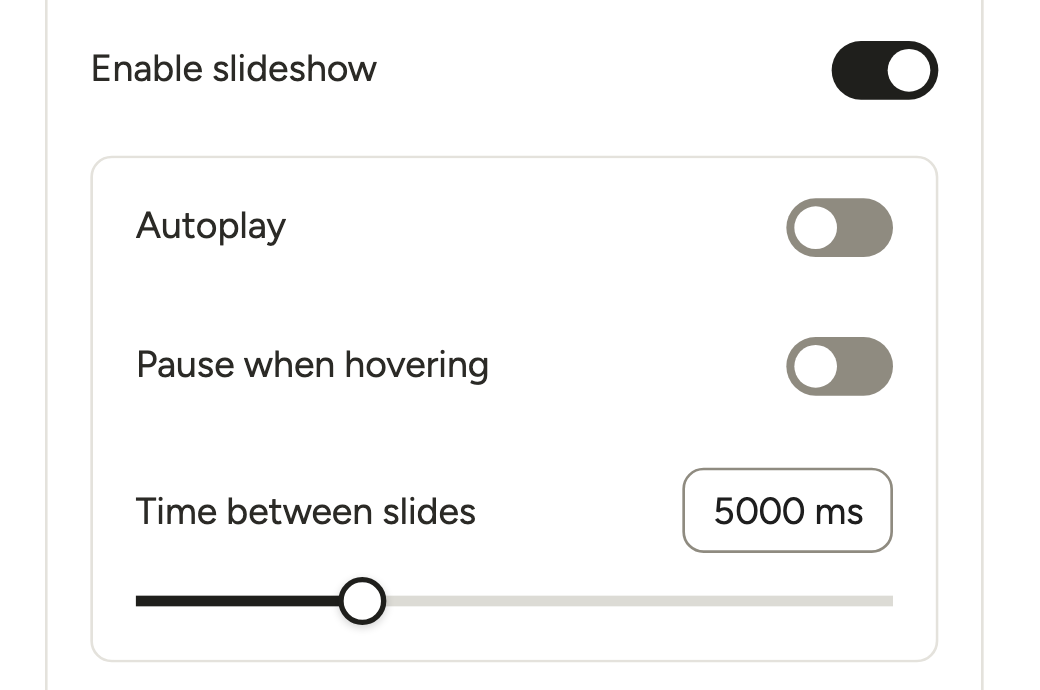
The slideshow settings in the Lightbox section.
Visitors get a play button in the lightbox toolbar and can pause any time; it stops at the last photo unless you turn on Loop images. See Lightbox slideshow.
Showcase: a strip that opens full size
Showcase is a horizontal strip where the center photo grows, each photo keeps its natural shape and the neighbors peek in on both sides. It has its own Autoplay (4,000 ms between photos by default).
Unlike Slider, Showcase has the Lightbox section, so a click can open the photo full size. It’s in Modula Pro, on any plan; Gallery types explained compares it with the rest.

Story and Modula Link
- Story (Modula Pro, any plan) plays photos as fullscreen vertical stories, like on social media.
- Modula Link (Modula Pro) turns a word or button into a link that opens the gallery in the lightbox, such as [modula-link id="89"]View the gallery[/modula-link].
Keep your carousel fast and mobile-friendly
Google’s web.dev notes that a large carousel at the top of a page often holds its Largest Contentful Paint (LCP) element, one of the numbers Google uses to judge loading speed.
And in September 2026, 49.1% of US web traffic came from phones, 48.47% from desktops and 2.42% from tablets (StatCounter).
- Use one image shape. Crop to one ratio, say 3:2. web.dev recommends same-size slides to keep LCP steady.
- Load the right size. Image file size picks which WordPress size loads: Large for most sliders in a post, Full only for full-width ones.
- Upload sensible files. About 1,200 px wide is plenty in a post, 1,600 to 2,000 px for full width. A 6,000 px camera original only loads slower.
- Check it on a phone. Use the Mobile preview, set Visible at once to 1 for phones and keep Drag to move on.
- Compress before you upload. Or let Modula do it: the Trio plan and up include image compression and an image CDN, which serves photos from servers near each visitor.
More in our guide to improving the loading speed of gallery images.
Frequently asked questions
A slider usually shows one large image at a time, while a carousel shows several side by side and moves them as a row. In Modula, both are the Slider type: Visible at once goes from 1 to 12, with up to 6 on phones and tablets.
A carousel waits for the visitor to click, tap or swipe; a slideshow plays by itself. In Modula, a Slider with Autoplay on works as a slideshow, and the lightbox slideshow plays full screen after a click on a grid photo.
With Modula, set a gallery’s Type to Slider and switch on Autoplay in Layout (Trio plan and up). To keep a grid on the page instead, switch on the Slideshow extension, then Enable slideshow under Lightbox (Starter plan and up). The photos then play full screen after a click.
Yes, but not with WordPress alone: core has no carousel block as of WordPress 7.1. Jetpack’s free Slideshow block shows one image at a time with autoplay and captions, and some themes and page builders include a slider. Modula Lite covers grid layouts, the lightbox and share buttons; the Slider type needs Modula Pro on the Trio plan or higher.
Not much, if the images are sized right. A few properly sized slides load fine; 6,000 px camera originals are what slow a slider down. Compress images first, or use the compression and image CDN included from the Trio plan.
Not with the Slider type. By default, a click on a slide does nothing, and the Slider has no lightbox, zoom or fullscreen. For photos that open full size, use the Showcase type or a grid gallery with a lightbox slideshow.
Yes, with Content Galleries (featured images of posts, pages or products) or the Instagram extension, both from the Trio plan. Both can keep the gallery current as your content changes. Slides show the image, title and caption, not prices or “Read more” buttons.
Yes. Fill in each image’s Title and Caption, then turn on Show title and caption in Layout. To put the text on the photo, choose Top of the slide or Bottom of the slide. There are no text layers or buttons, though.
Start with five photos and a pair of arrows
A WordPress image carousel works best with restraint: five or fewer photos of one shape (NN/g’s limit), your strongest first, and arrows instead of a timer.
Build that first, check it on your phone and add autoplay or more slides only when they help. See the Slider in action on the Modula Slider page, or compare plans on the pricing page.