Made in Europe, buy from Europe.
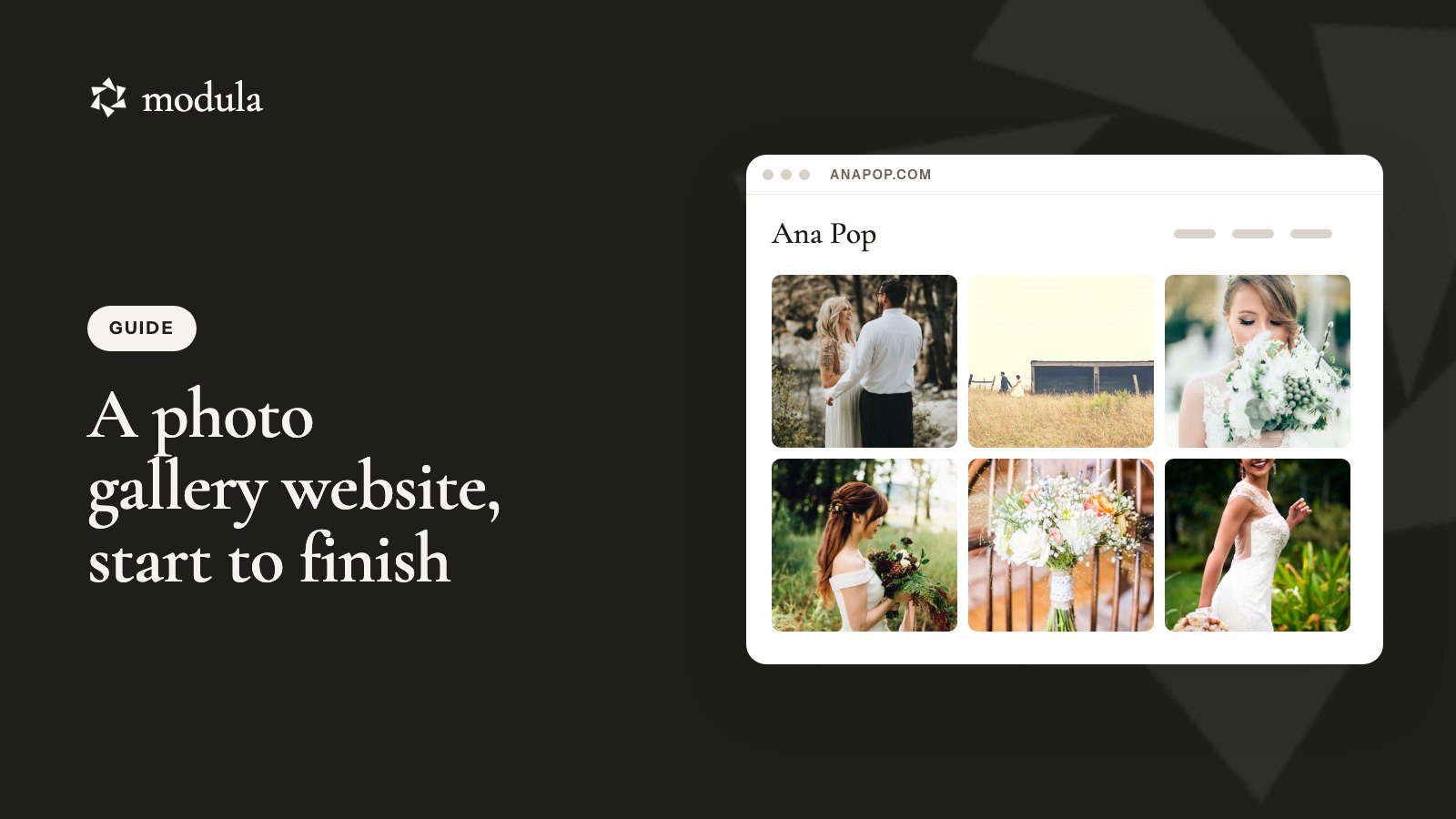
Wondering how to create a photography website without hiring a designer? Good news: you can build a photography website in five steps, and none needs code. Whether you call it a portfolio, an online photo gallery or a website photo gallery, the recipe is the same:
- Choose where to build it.
- Get a domain, hosting and a simple theme.
- Plan your pages and pick 15 to 30 photos per gallery.
- Install Modula, create a gallery and choose a layout.
- Put the gallery on a page, check it on your phone and launch.
Let’s start with where to build it.
Where to build your photography website
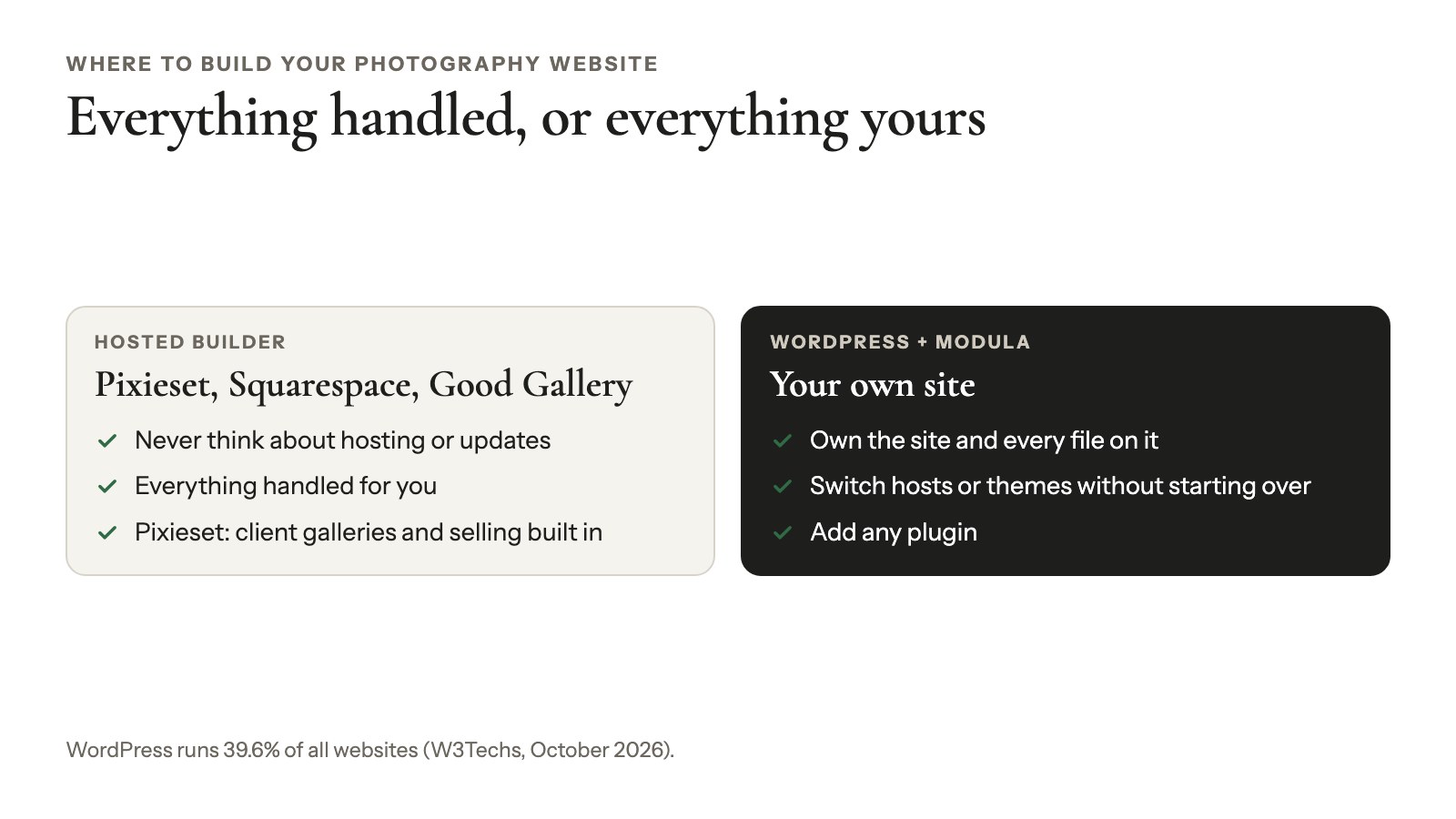
Build your photography website on WordPress if you want to own the site and every file on it. Pick a hosted builder if you’d rather never think about hosting or updates. Here’s how the options compare (prices checked October 2026):
| Platform | What it costs | Best for | Watch out for |
|---|---|---|---|
| WordPress + Modula | Free; you pay for a domain and hosting. Modula Pro from $39 the first year | Owning your site and files, any theme, a blog | You handle hosting and updates. Modula has no store |
| Pixieset | Website: free plan. Client Gallery: free with 3 GB of storage, paid plans $10–$50/month | Client galleries and selling, in one place | Your site lives on their platform |
| Squarespace | Free trial, then paid plans | Polished templates, hosting included | No free plan |
| Good Gallery | $25/month, 30-day money-back guarantee | Wedding photographers | A monthly fee while the site is up |
| Adobe Portfolio | Comes with Creative Cloud plans | Photographers already on Creative Cloud | Tied to your subscription |
| Flickr, 500px | Free to join, paid upgrades | Feedback from other photographers | A profile on their site, not your own website |
Pick a hosted builder if you want everything handled for you. Pixieset in particular has client galleries and selling built in, and if selling is the heart of your business, that’s hard to beat.
Pick WordPress if you want freedom: switch hosts or themes without starting over, add any plugin, and keep every file on your own hosting account. WordPress runs 39.6% of all websites (W3Techs, October 2026), so themes and help are everywhere.
That’s the route this guide takes, with Modula, the free gallery plugin we make. Coming from Flickr? Move your photos over.
What you need to create a photography website
A photography website needs five things, and only two cost money from day one:
- A domain. A .com’s wholesale price is $10.97 a year from November 1, 2026 (Domain Name Wire), so expect to pay a little more than that.
- Hosting. Prices vary a lot, so check your host’s plans. Many install WordPress for you.
- WordPress. Free.
- A photography WordPress theme. Look for a wide content area, a simple menu and nothing competing with the photos. The free Twenty Twenty-Five ships a Portfolio homepage pattern and Photo blog templates.
- A gallery plugin. The built-in Gallery block has no filters, albums or protection. Modula is free; Pro starts at $39 for the first year ($78/year after), with a 14-day money-back guarantee (pricing).
Plan your pages and pick your best photos
Here’s how to make a photography portfolio: do most of the work before you upload anything. Start with the pages:
- Home: a short selection and one line on what you shoot.
- Portfolio: one gallery per body of work, such as Weddings, Portraits and Travel.
- About: with a photo of you. People hire people.
- Services and Contact: your prices, and a working form, not just an email address.
- Blog (optional): every post is one more way to be found.
Then the photos. Start from your 100 or so favorites and cut until 15 to 30 per gallery remain. A wedding photographer with 300 proofs from one day shows the 20 that tell the story. Mix horizontal and vertical shots so the grid has rhythm.
Good to know
Cut harder than feels comfortable. One weak photo drags down the strong ones next to it.
Export at about 2,000 pixels on the long side; a 6,000-pixel original is far bigger than any screen needs. And name files for what’s in them: lake-bled-sunrise.jpg tells Google something, DSC_0412.jpg doesn’t.
How to create a photo gallery website with WordPress and Modula
A Modula gallery takes six steps, all in the Modula 3.0 editor. Prefer to watch? Here’s the whole flow:
<video controls preload=”metadata” poster=”https://wp-modula.com/wp-content/uploads/2026/11/kb3-4556-walkthrough-poster.jpg” src=”https://wp-modula.com/wp-content/uploads/2026/11/kb3-4556-walkthrough.mp4″></video>
Step 1: Install Modula
Go to Plugins → Add Plugin, search for Modula, click Install Now, then Activate. Bought Pro? Upload it, enter your license key and switch on extensions in Modula → Extensions (install guide).
Step 2: Create a gallery and add your photos
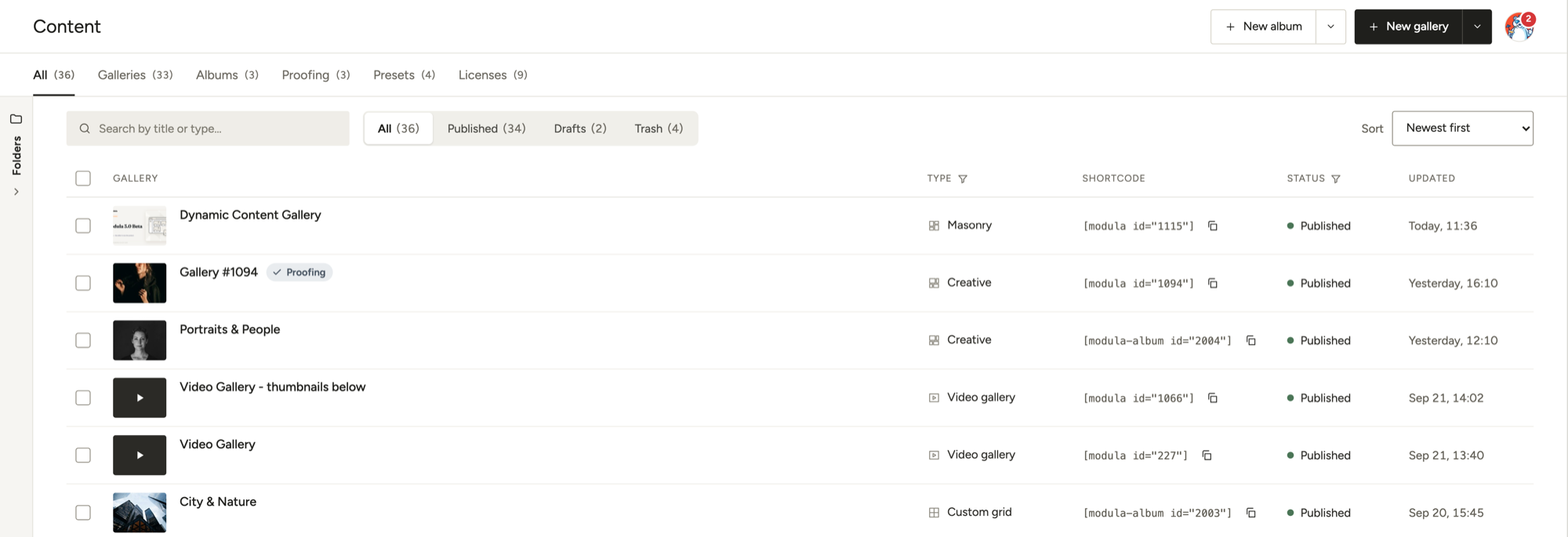
Go to Modula → Content, click New gallery and, if asked, Try the new editor. Click the pencil to name it, say “Weddings 2026”.
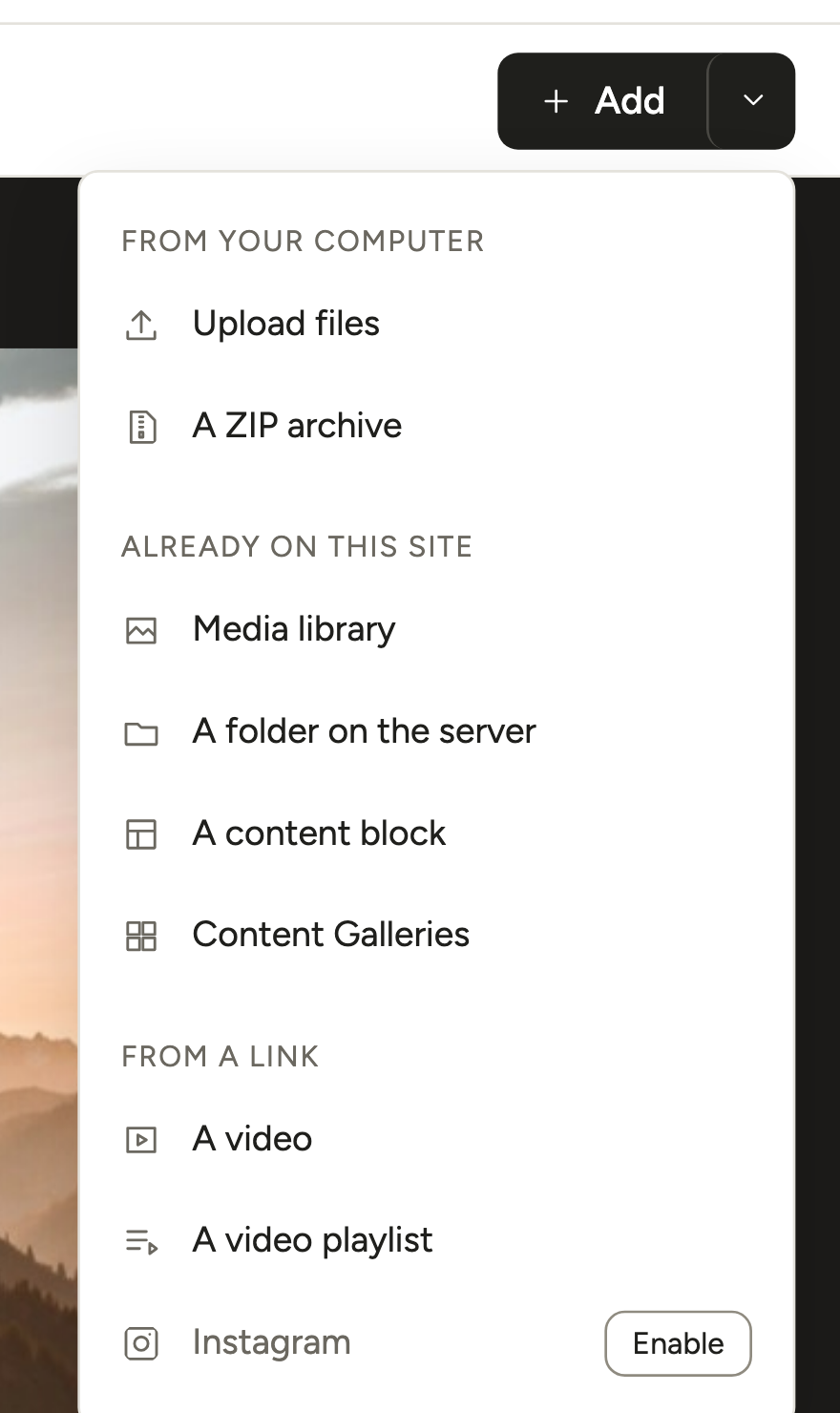
+ Add opens your Media library. The arrow next to it has Upload files, plus a ZIP archive or a server folder, handy when a whole shoot sits in one folder. To drag photos into order, use Sort (Pro). There’s no Save button: the editor saves as you go and shows All changes saved.
Step 3: Add alt text, titles and captions
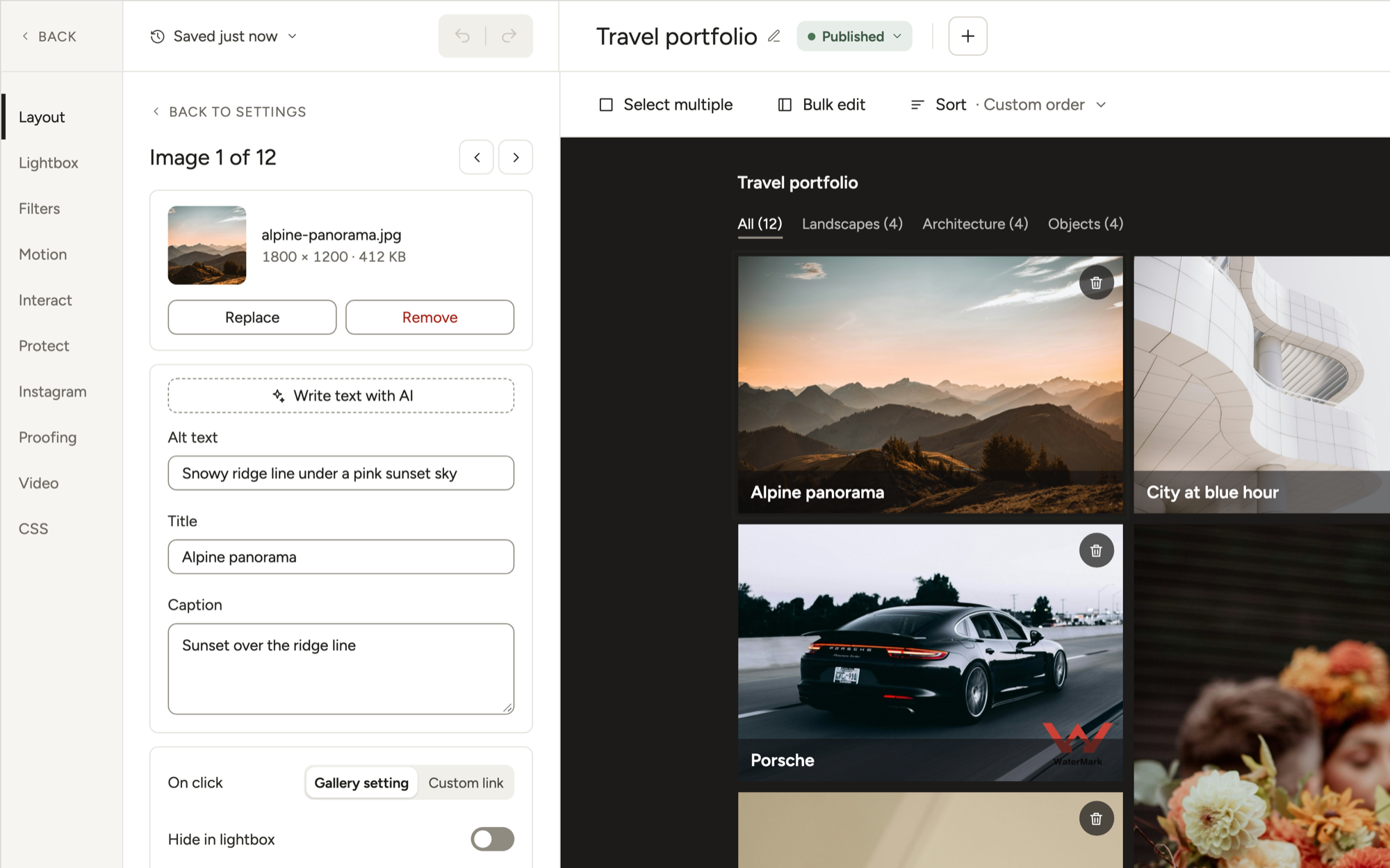
Click a photo in the preview to open its settings. Fill in the Alt text (what the photo shows), a Title and, if there’s a story, a Caption. The arrows at the top jump to the next photo, so 30 photos go quickly. On Pro, Write text with AI can draft them.
Step 4: Pick a layout
Click Layout and choose a Type. Modula has 14 gallery types, 7 of them free. For photography, I reach for these:
- Masonry (free): photos at their natural height, nothing cropped. The safe default for mixed orientations.
- Justified grid (free): tidy rows across the full width. Lovely for a travel set.
- Custom grid (free): drag a tile’s corner to resize it. I like resizing my images, so I use it when one hero shot deserves more room.
- Slider (Trio and up): one photo, or a few, at a time.
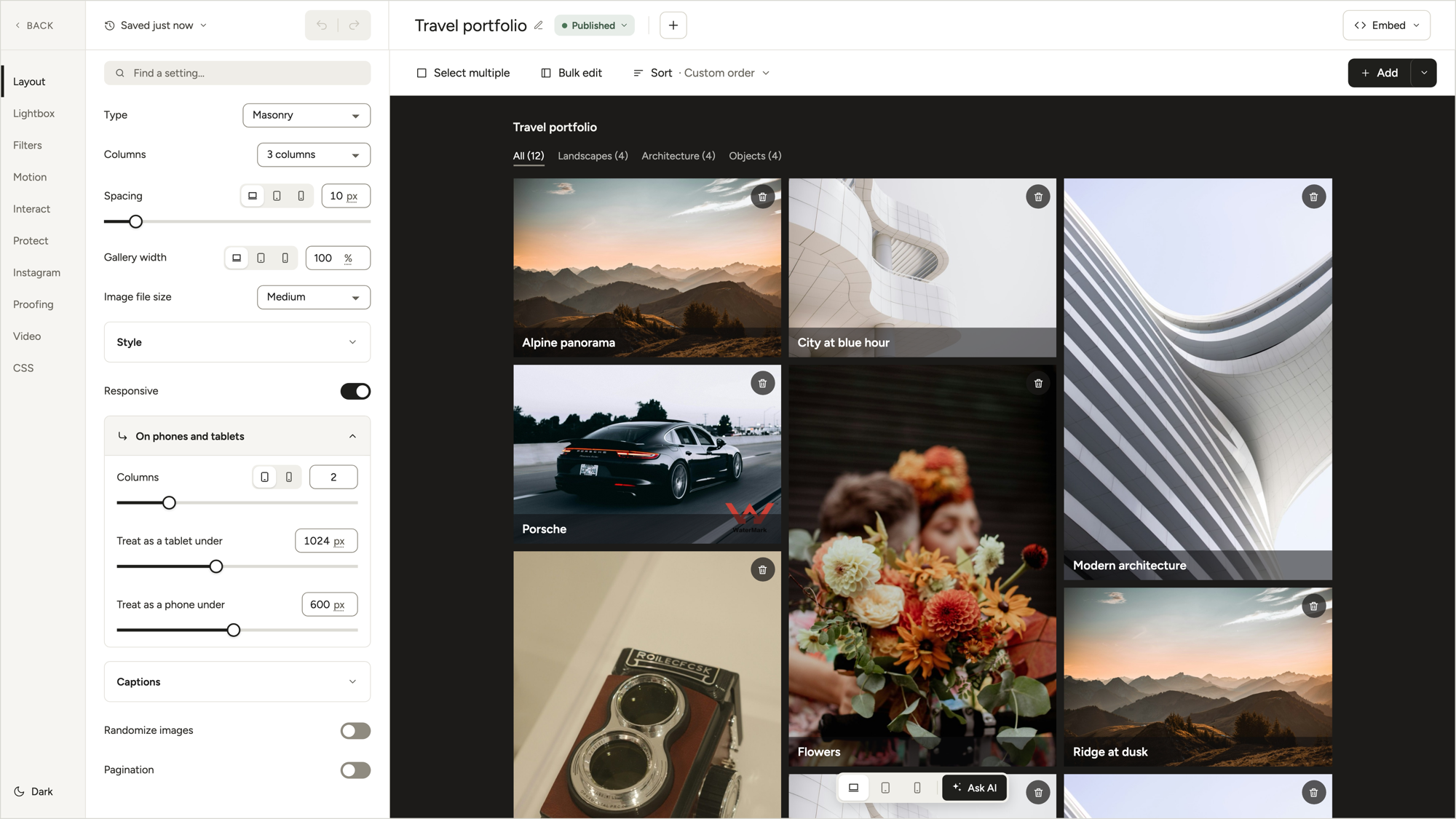
Keep Responsive on and set fewer columns under On phones and tablets. Gallery types explained covers all 14.
Step 5: Set up the lightbox
Click Lightbox and set On click to Open in lightbox, so photos open full size. Choose arrows, looping and captions. It’s free; Pro adds a slideshow, fullscreen (Trio and up) and zoom (Business). To send a photo to your print lab instead, give it a Custom link (custom links).
Step 6: Put the gallery on a page
Check that the gallery says Published, click Embed and paste the shortcode, for example [modula id="89"], into any page; WordPress swaps it for the gallery. Or, in the block editor, add the Modula Gallery block and pick your gallery: the quickest way to put a photo gallery on any page of your website. Elementor, Divi and Beaver Builder have their own Modula widget or module (how to insert galleries).
Shoot video too? A video gallery (Starter and up) puts clips next to stills; see the video portfolio guide.
Make the galleries feel like yours
Motion, captions, sharing and shooting data make a Modula gallery look like yours:
- Motion: a subtle Hover effect, like a slight zoom, and a gentle Entrance animation. With photos, less is more (hover effects).
- Captions: set them in Layout → Captions. If your photos speak for themselves, leave them off in the grid and show them only in the lightbox.
- Sharing: Interact → Enable sharing adds share buttons, free.
- Shooting data: Show shooting data, in Lightbox → More settings → EXIF (Business), shows the camera, lens, shutter speed, aperture and ISO. Modula reads it from your files, so keep the metadata when you export (EXIF).
Protect your photos and work with clients
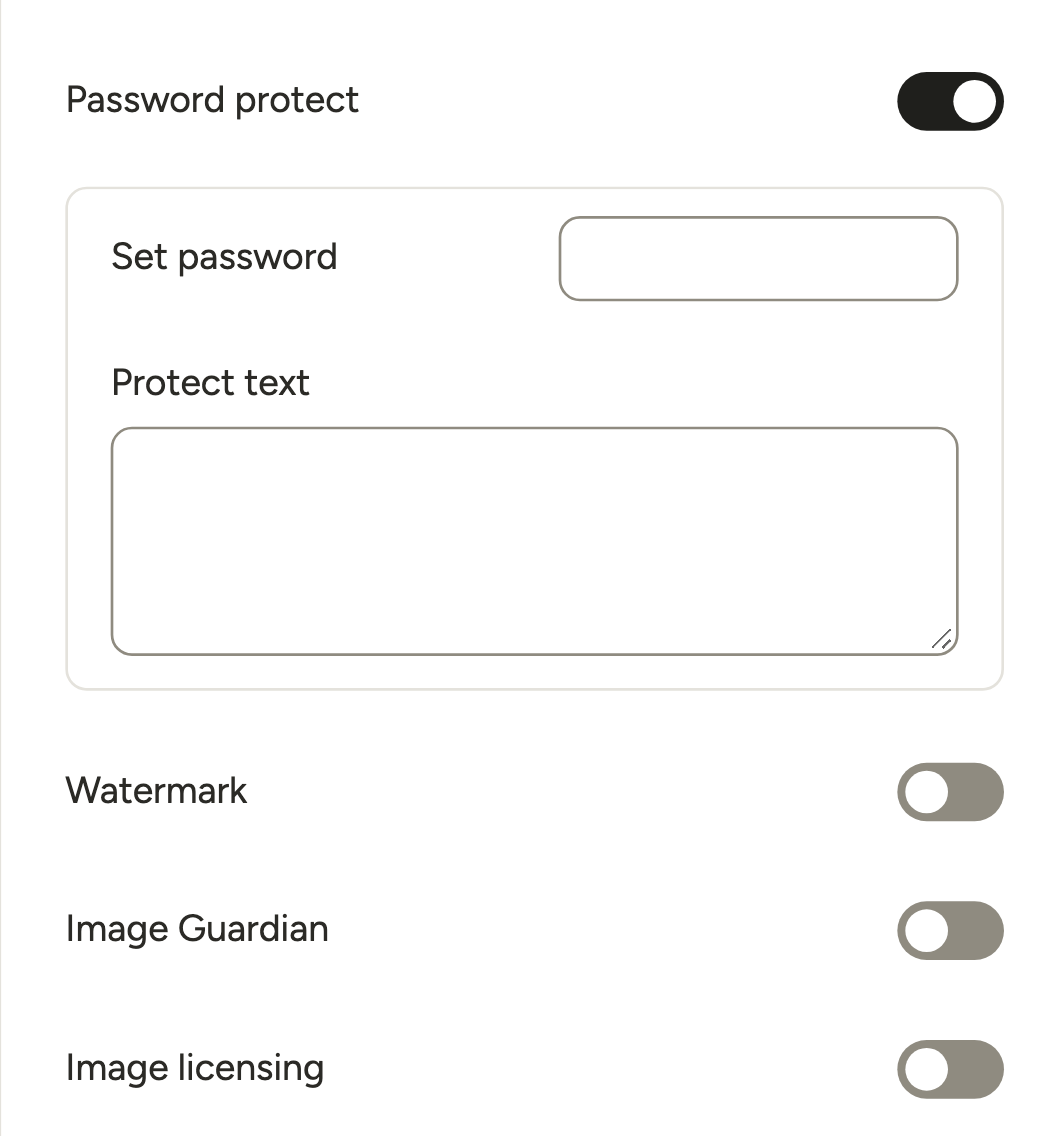
You can’t stop a screenshot, but you can make copying harder and keep private work private. Modula’s Protect section has:
- Password protect (Trio and up): for a client preview or a family album.
- Image Guardian (Trio and up): turns off right-click and dragging.
- Watermark (Business): adds your logo to the photos.
- Image licensing (Trio and up): shows your license, such as all rights reserved, also as structured data. It doesn’t sell licenses.
Let clients pick their favorites
Client galleries are a big reason photographers choose Pixieset. You can run them on your own domain with Image Proofing (Business). Lock a gallery for proofing and send each client a private invite link. They tick the photos they want, add notes and submit, within the minimum and maximum you set.
Picture a couple going through 300 engagement shots and choosing the 40 you’ll edit, no account needed. Switch it on in Modula → Extensions, then open Proofing in the editor (how it works, demo). To deliver the final set, turn on Enable download in Interact (Business) (downloadable galleries).
Organize a larger portfolio
Past a handful of galleries, visitors need a way around. Three Modula features help:
- Filters (Starter and up): tabs like Portraits, Travel and Street above one gallery (filterable portfolio).
- Albums (Trio and up): galleries behind cover images, one album per year or per client (online photo albums).
- Pagination and Load more (Business): so a page doesn’t load 200 photos at once.
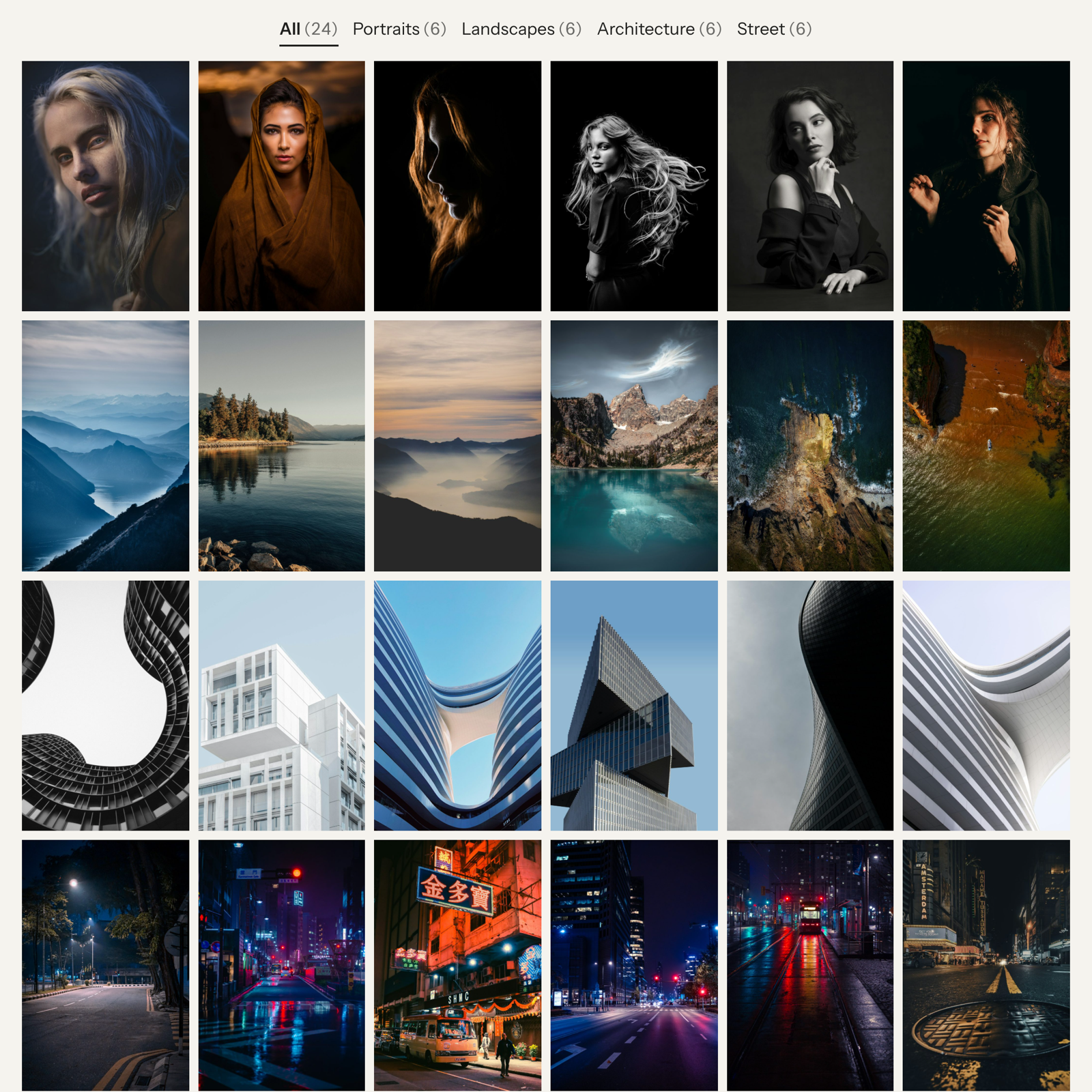
Shooting weddings? Here’s a multi-level wedding portfolio.
Help people find your site and keep it fast
Search engines understand words far better than pixels, so give them words:
- Alt text and file names. Say what’s in each picture, in both.
- A sentence or two on every gallery page. “Wedding photos from a vineyard ceremony in Napa” beats 30 images and no text.
- Local keywords. Use the phrase a client near you would type, such as “wedding photographer in Austin”.
- A sitemap. With Yoast SEO, Rank Math or SEOPress, free Modula adds gallery images to the XML sitemap that search engines read (how).
For speed, pick a sensible Image file size in Layout; the lightbox still opens the full photo. On Trio and Business, Modula compresses images and serves them from CDN servers near your visitors (Speed Up).
Photo gallery website ideas to borrow
Here are six photography website examples, each built from a Modula layout or feature in this guide. Demo links go to our own galleries, not customer sites.
- Wedding: an album per wedding, plus a proofing gallery per couple (Albums demo).
- Portraits: Masonry, so tall portraits never get cropped (masonry galleries).
- Travel: a full-width Justified grid per trip (tiled galleries).
- Street or mixed work: one gallery, a filter per theme (Filtering demo).
- Product photography: a Uniform grid, so 12 shots of a potter’s bowls line up like a shelf.
- Homepage hero: a Slider with your ten best shots (Slider demo).
Before you launch
A photography website is ready to launch when it passes these seven checks:
- The homepage shows a short selection, not everything you’ve shot.
- The contact form works. Send yourself a test.
- The menu shows on every page.
- Your About page has your face on it.
- Every gallery looks right on your phone or in the editor’s Mobile preview: 49.1% of US web traffic is mobile (StatCounter, September 2026).
- Your social profiles are linked.
- A friend has clicked through and told you what confused them.
Frequently asked questions
The best platform for a photography website depends on what you want handled for you. WordPress with a gallery plugin gives you full ownership for the price of a domain and hosting. Pixieset is strongest on client galleries and selling, Squarespace on all-in-one hosting, and Adobe Portfolio comes with Creative Cloud.
Almost. WordPress, Twenty Twenty-Five and the free version of Modula cost nothing, and free Modula already gives you 7 gallery types, the lightbox and share buttons. The domain and hosting are the only bills. Pixieset’s free plan is another $0 route, with your work on their platform.
15 to 30 per gallery, or 15 to 20 for a core portfolio. Start from your favorite 100 and cut. Give each kind of work, such as weddings or street, its own gallery. A tight set looks more confident than 200 near-duplicates.
Masonry, for most photographers, because it shows every photo whole, tall or wide. Justified grid gives tidy rows for sets with similar shapes. Custom grid, or Canvas in Modula Pro, is for arranging by hand. All but Canvas are free.
You can’t stop it completely: anyone can screenshot what’s on their screen. You can make it harder with smaller grid images, Image Guardian (Trio and up) to block right-click and dragging, a watermark (Business) and a password on private sets.
Not with Modula: it has no store or checkout. Add a store plugin such as WooCommerce, or link each photo to your print lab. Image licensing only shows the license, and Enable download only delivers files. If selling is your main goal, Pixieset’s built-in store is worth a look.
Start your photography website with one gallery
Your photography website can go live before every page is finished. Install the free version of Modula (160,000+ active installations), put your 20 strongest photos in one Masonry gallery and publish it on your homepage. Add proofing, protection or albums when a client or a growing archive asks for them.