Made in Europe, buy from Europe.
A WordPress gallery plugin takes the photos sitting in your Media Library and turns them into something people want to look through. Think a masonry wall, justified rows, a slider or an album where every shot opens full screen in a lightbox. The built-in Gallery block covers a simple grid. A plugin takes over when you need more than that.
So which is the best WordPress gallery plugin? It depends on what you’re doing with your photos:
- You want a grid you shape yourself, built right inside the preview, with photos and videos in one gallery: Modula.
- You sell your photos: FooGallery. Its PRO Commerce plan sells them through WooCommerce.
- You won’t pay a cent: FooGallery or Photo Gallery by 10Web give you the most for free.
- You only want a nicer lightbox: Responsive Lightbox & Gallery, on top of the Gallery block you already use.
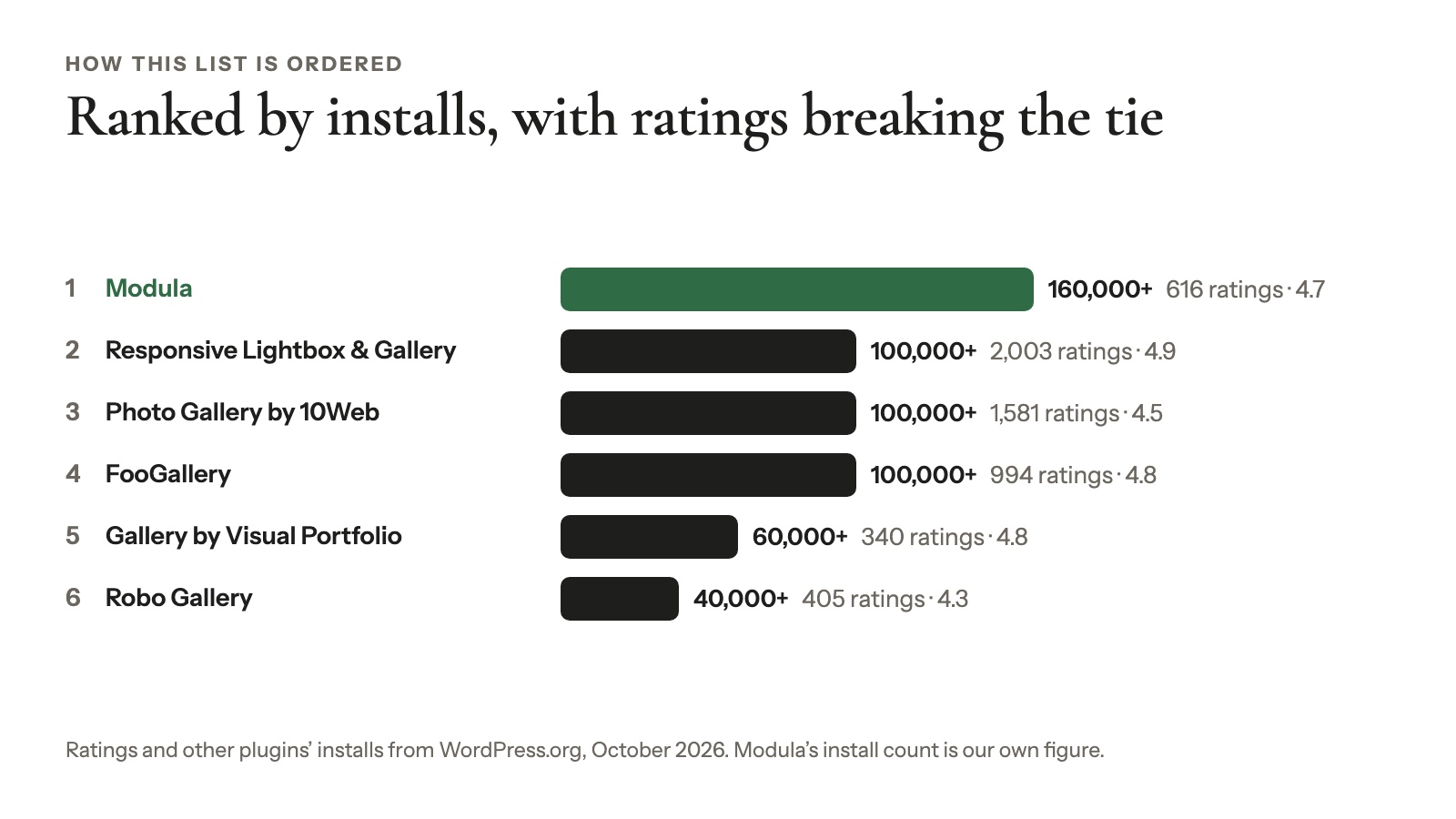
Full disclosure: we make Modula. That’s exactly why this list isn’t ranked by our opinion. We ordered it by active installs, with the number of ratings breaking ties, and at 160,000+ (our own count) that puts ours first.
For each one you’ll see what the free version really does, what you’ll pay in year two (not just the first-year discount) and where it falls short.
The best WordPress gallery plugins at a glance
Four of these six plugins have 100,000+ active installs. Here they are side by side. “Paid from” is the cheapest plan for one site: the first-year price, then what it renews at.
| Plugin | Installs | Rating | Free version | Paid from (1 site) | Best for |
|---|---|---|---|---|---|
| Modula | 160,000+ | 4.7 (600+) | 7 of its 14 gallery types, incl. Masonry and Custom grid, lightbox, mobile columns | $39 the first year, then $78/yr | Custom grids in a live editor, photos and videos together |
| Responsive Lightbox & Gallery | 100,000+ | 4.9 (2,003) | Grid, slider and masonry galleries, 8 lightbox scripts | Extensions $29 each, bundle $69 | A better lightbox on the galleries you have |
| Photo Gallery by 10Web | 100,000+ | 4.5 (1,581) | 9 gallery and album views, watermarks, right-click protection | $30 (6 months of updates) | The most free features on a budget |
| FooGallery | 100,000+ | 4.8 (994) | 7 layouts, albums, lightbox, lazy loading | $49.99/yr, same price at renewal | A generous free start, then WooCommerce selling |
| Gallery by Visual Portfolio | 60,000+ | 4.8 (340) | Gallery and portfolio blocks, lightbox, lazy loading | $49/yr | Portfolios on block themes |
| Robo Gallery | 40,000+ | 4.3 (405) | 6 layouts, 3 albums, a basic YouTube gallery | $30 once (6 months of updates) | Paying once |
Installs and ratings come from WordPress.org (Modula’s install count is our own figure), and prices from each vendor’s pricing page, all checked October 2026. When a vendor discounts the first year, you see both numbers, because the second one is the bill you’ll get every year after.
The best free WordPress gallery plugins
Start with Modula: its free version has 7 gallery types, including masonry and Custom grid, and sets separate columns for tablets and phones. FooGallery’s free version has 7 layouts, including masonry, plus albums, lazy loading and password-protected galleries. 10Web’s gives you 9 gallery and album views, watermarks and right-click protection.
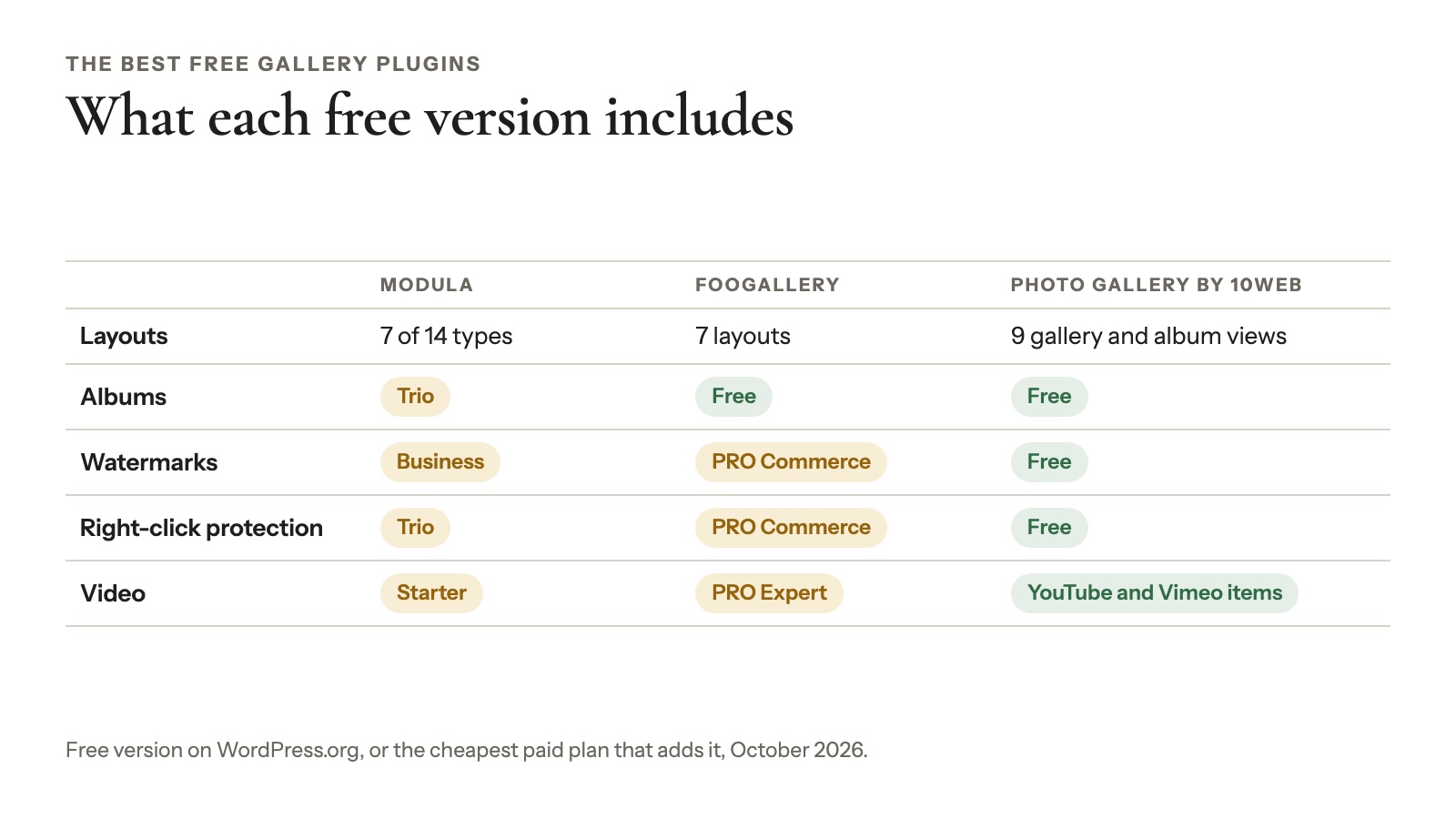
FooGallery and 10Web have the longest free feature lists, so start there if albums or free watermarks matter most. FooGallery’s free version sets phone columns on its Responsive layout and keeps its other mobile settings for PRO Starter.
All six have a free version on WordPress.org, so check what sits behind the paywall before you commit. Video needs a paid plan in FooGallery and Modula, while Robo Gallery’s free version includes a basic YouTube gallery and 10Web’s WordPress.org listing mentions YouTube and Vimeo items.
How we picked and checked these plugins
Every number on this list comes from a public source you can check: WordPress.org for installs and ratings, and each vendor’s own pricing page for prices. The one exception is Modula’s install count, which is our own figure.
- Gallery plugins only. Sliders like MetaSlider, social feed plugins and page-builder add-ons are out, even when they have more installs.
- Ranked by installs. Active installs set the order. WordPress.org rounds them down, so three plugins sit at “100,000+”, and the number of ratings breaks that tie.
- Still installable and maintained. Every plugin here is open on WordPress.org and got an update in October 2026.
- One-site prices, first year and renewal, so you compare like with like.
- No lab tests. We didn’t benchmark page speed for this roundup. What each plugin is like to use comes from its WordPress.org listing and the vendor’s own pages, so you won’t find “we tested” claims or speed scores below.
Two plugins you may have seen on older lists are missing on purpose. Gallery Bank was on an earlier version of this very list, and WordPress.org closed it in December 2021 for a security issue. Essential Grid’s WordPress.org listing was closed in 2019, so there’s no public install count to rank it by.
Do you need a gallery plugin, or is the Gallery block enough?
WordPress has had a built-in photo gallery, the Gallery block, since version 5.0 in December 2018. For a handful of photos in a blog post it’s all you need: you don’t need a plugin to show a potter’s 12 product shots in a tidy three-column grid.
Here’s the whole process. Type /gallery in a post or page and press Enter, pick your images from the Media Library and set the number of columns. Set Link to Enlarge on click and visitors can tap any photo to see it bigger.

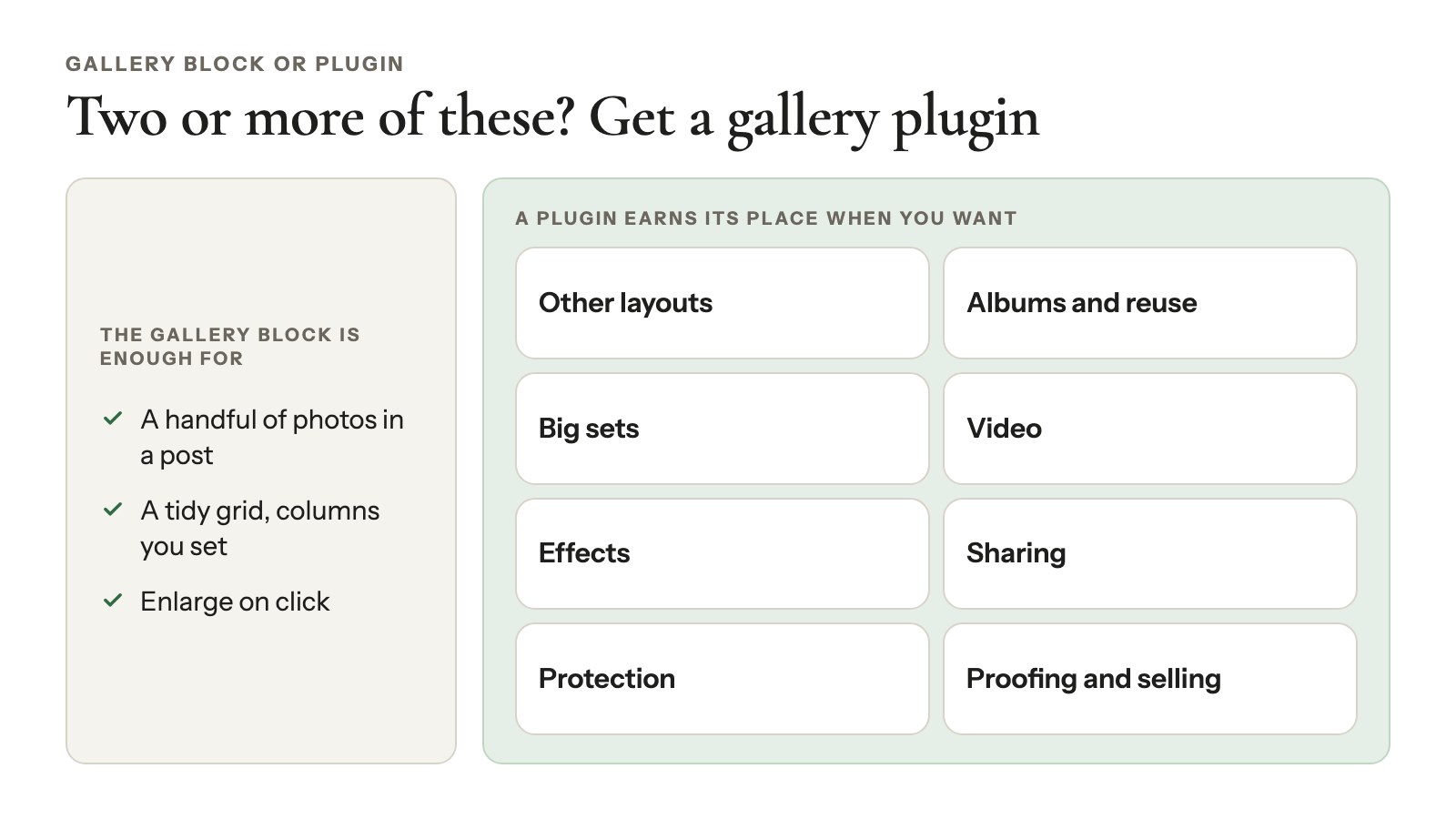
The block stops short once you want any of these:
- Other layouts. Masonry, justified rows, a slider, or a grid where some photos are bigger than others.
- Albums and reuse. Galleries grouped into albums, or one gallery you edit once and every page that shows it updates.
- Big sets. Filters, pagination or a Load more button, so 200 photos don’t all load at once.
- Video. YouTube, Vimeo or your own MP4 clips in the same grid as your photos.
- Effects. Hover and loading effects that give the grid a bit of life.
- Sharing. Social buttons so visitors can pass your work on.
- Protection. Passwords, watermarks and right-click blocking.
- Proofing and selling. Think of a wedding photographer sending 300 proofs for the couple to pick from.
A plugin also doubles as a portfolio. The same tool can show your ten best shots on the homepage and a client’s full set on a private page.
If the block is all you need, our guide on how to create an image gallery in WordPress walks you through it. If you nodded at two or more of those bullets, an image gallery plugin will earn its place, so read on.
How to choose a WordPress gallery plugin
To choose a WordPress photo gallery plugin, compare how easy the builder is, how fast it loads, what the free version includes and what you’ll pay in year two. Every plugin on this list makes a grid and opens photos in a lightbox, so those basics won’t separate them. Run through these before you install anything:
- Ease of use. You’ll be uploading dozens of photos at a time, so the builder matters. Modula and FooGallery show a live preview while you work, Visual Portfolio previews right in the block editor, and 10Web keeps a more classic settings-page admin.
- Speed. Photos are usually the heaviest thing on the page. Look for lazy loading (photos load only as visitors scroll to them), sensible image sizes and, for big collections, compression or a CDN (a network of servers that delivers each image from close to the visitor).
- The free version. Some free versions are enough for a small site (10Web, FooGallery). Others are a starting point: Visual Portfolio, for example, keeps albums and protection for Pro.
- The layouts you’ll really use. Masonry (columns where each photo keeps its own shape) and justified rows (rows of equal height that fill the width) are everywhere. A grid you shape yourself, Polaroid cards or a slider are not.
- Video. Most plugins keep video galleries in a paid plan, and which plan varies a lot. Our video gallery plugins roundup goes deeper if video comes first.
- Protection. Check where right-click blocking, password-protected galleries and watermarks sit. A few plugins give them away free; others save them for the top plan.
- Selling and proofing. FooGallery can take payments through WooCommerce on its top plan, PRO Commerce. Modula has no built-in selling, so you’d add a store yourself.
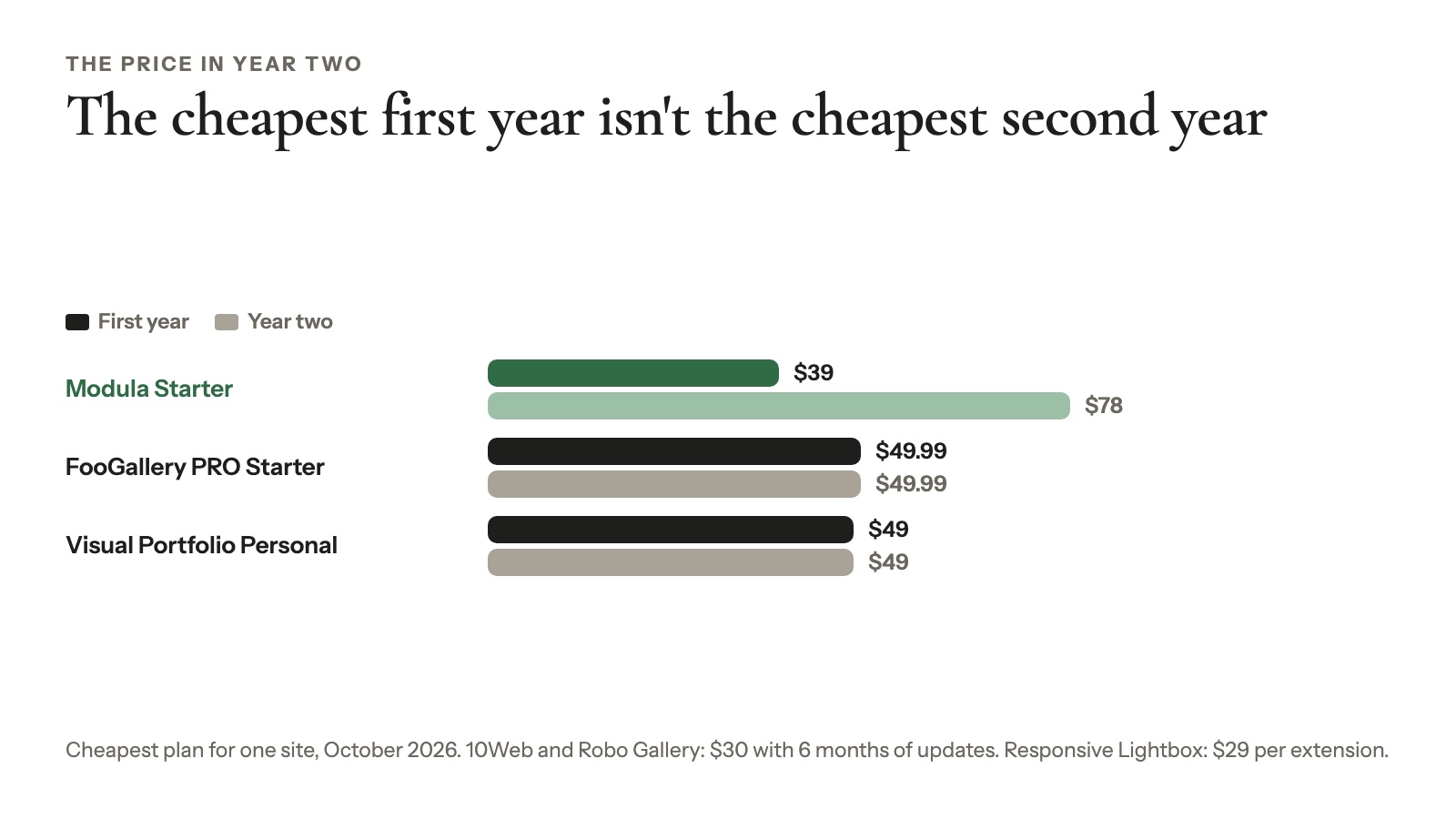
- The price in year two. Some vendors discount the first year; Modula takes 50% off. Compare the renewal price, because that’s what you’ll pay from then on.
Check it on a phone
A lot of your visitors will see your gallery on a phone, so check it there before you publish. A grid that looks great at four columns on your laptop can shrink to tiles under 100 pixels wide on a phone screen that’s around 390 pixels across. That’s postage-stamp territory.
So look for two things: separate column counts for tablets and phones, and a way to preview each size while you build. FooGallery’s free version previews all three sizes and sets phone columns on its Responsive layout, but the rest of its mobile settings need PRO Starter. In Modula they’re all free: galleries drop to 2 columns on tablets and 1 on phones by default, and you can change both.

Our guide to mobile-responsive galleries shows what else changes on small screens.
Know where your galleries live
This sounds dull until you move hosts or switch plugins. Modula and FooGallery store each gallery as a custom post type, in the same place WordPress keeps your posts and pages. Some plugins keep galleries in their own database tables instead, so make sure your backup or migration tool includes them.
And plan your way out. If you switch later, an importer saves you from rebuilding every gallery by hand. There’s more on that in the switching section below.
Popular WordPress gallery plugins, reviewed
In order of active installs, the six plugins reviewed here are Modula, Responsive Lightbox & Gallery, Photo Gallery by 10Web, FooGallery, Gallery by Visual Portfolio and Robo Gallery. Each one gets the numbers, what it’s like to use, what’s free and what’s paid, plus three quick calls: what’s good, what to watch out for, and who it suits.
Modula
160,000+ installs · WordPress.org: 4.7/5 from 600+ ratings · updated October 2026
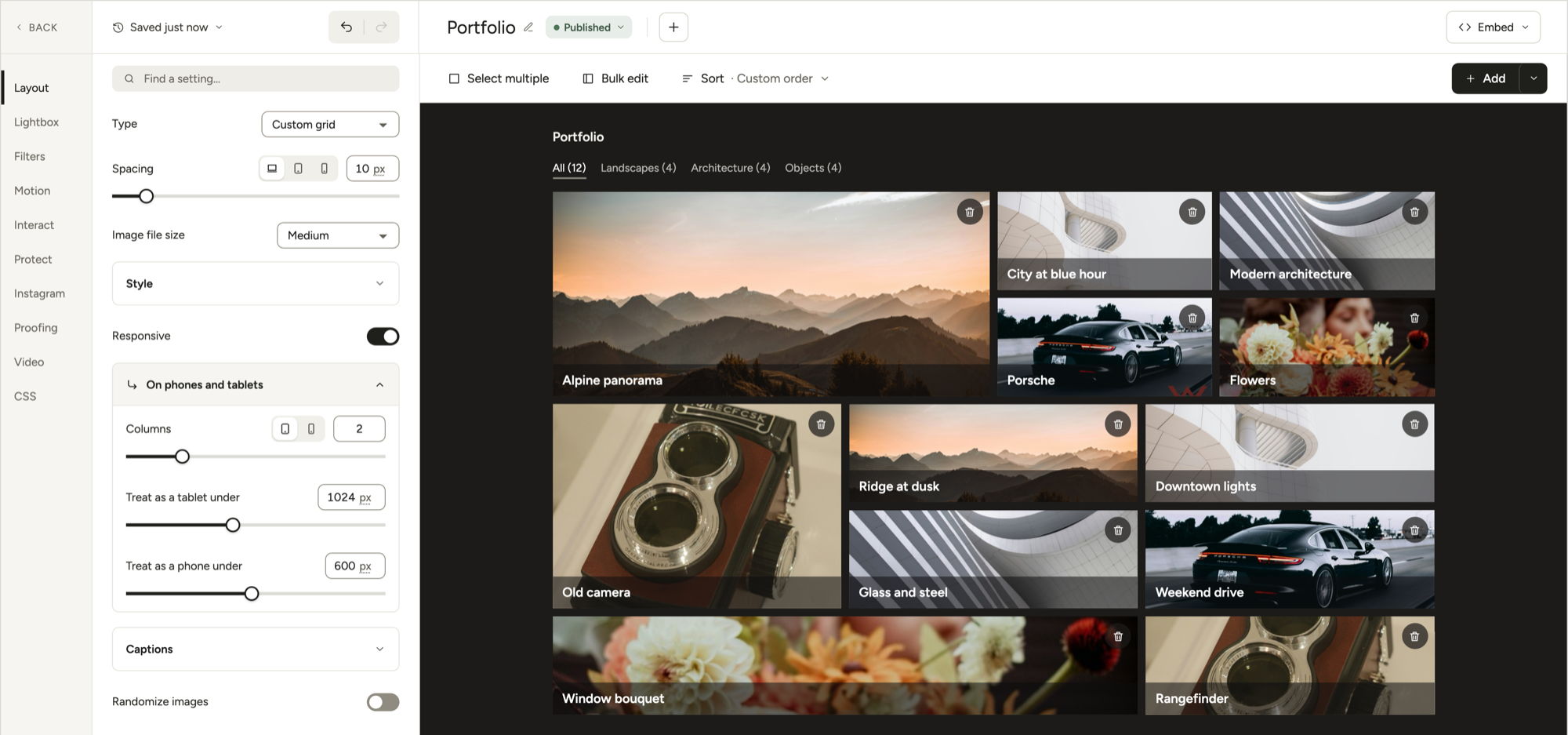
Modula 3.0 rebuilt the gallery editor around one idea: the gallery you’re building is the preview. Change a setting on the left and the photos on the right rearrange on the spot. There’s no Save button; it saves as you go and shows All changes saved.
<video controls preload=”none” poster=”https://wp-modula.com/wp-content/uploads/2026/11/kb3-4556-walkthrough-poster.jpg” src=”https://wp-modula.com/wp-content/uploads/2026/11/kb3-4556-walkthrough.mp4″></video>
A Desktop / Tablet / Mobile switch under the preview lets you check the phone version before anyone else does. Our guide to the gallery types shows all 14.
Free version: 7 of Modula’s 14 gallery types (Masonry, Uniform grid, Fit grid, Justified grid, Custom grid, Creative and Polaroid), a lightbox, lazy loading and separate columns for tablets and phones. In Custom grid you resize each tile yourself. Galleries go in with the Embed shortcode, the block, the Elementor widget, or the Divi and Beaver Builder modules.
Paid plans (Modula pricing):
- Starter: $39 the first year, then $78/year (1 site). Adds video galleries, filters, sorting, a lightbox slideshow and the Pro types: Canvas, Parallax, BnB, Showcase and Story.
- Trio: $69, then $138 (3 sites). Adds albums, password protection, Image Guardian right-click protection, the Slider, Instagram, image compression and an image CDN.
- Business: $99, then $198 (5 sites). Adds watermarks, proofing, downloads, EXIF, zoom, comments, pagination and Load more.
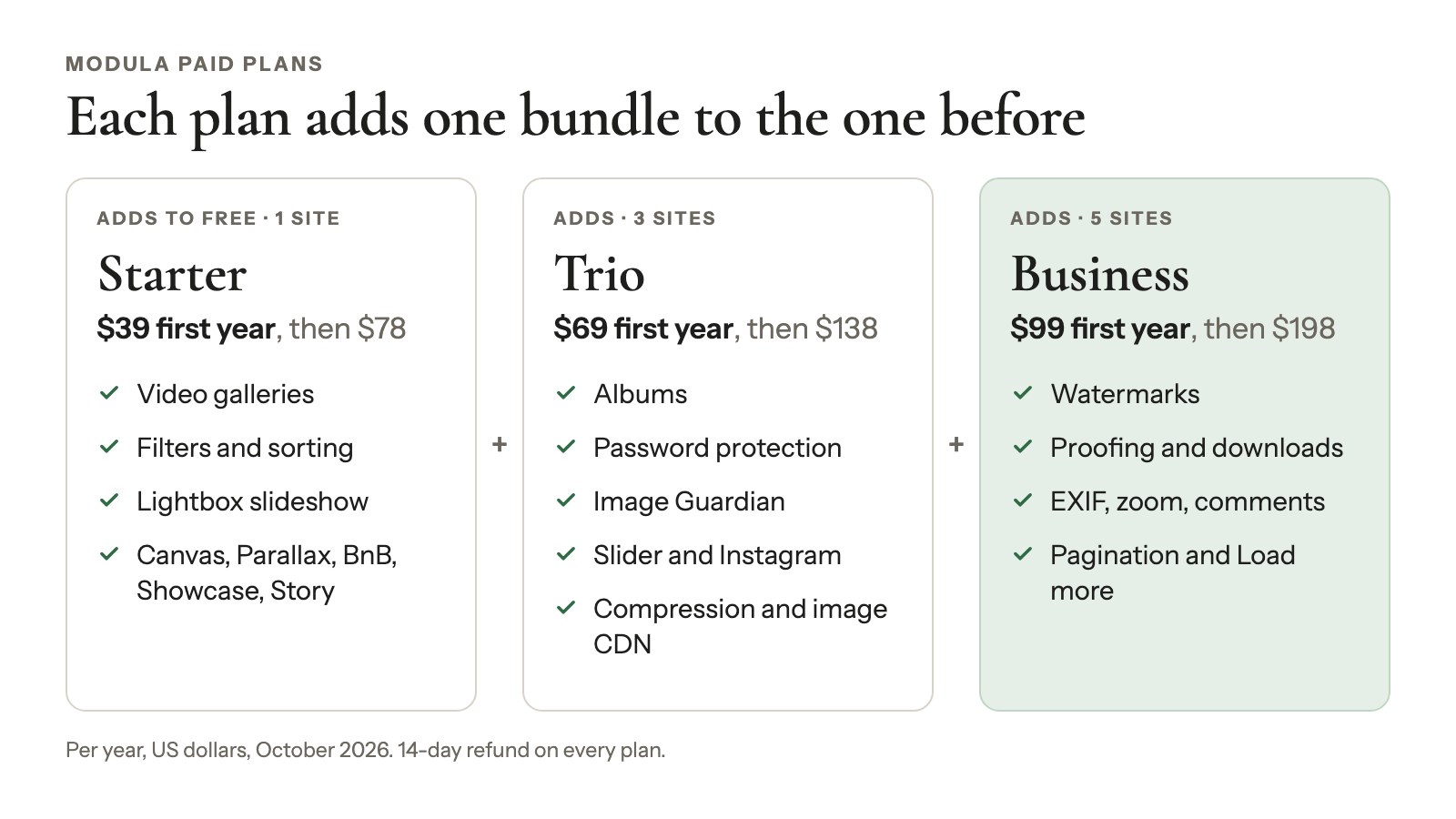
Lifetime plans cost $269, $479 or $689. Every plan includes Modula AI credits (250, 1,000 or 2,500) for alt text, titles and captions, and a 14-day refund.
- Good: the live editor, a grid you shape yourself, photos and videos in one gallery, free mobile columns, lifetime plans and free importers.
- Watch out: $39 is a first-year price; it renews at $78. Video needs a paid plan, albums need Trio and watermarks need Business. There’s no built-in selling, and it has fewer ratings than the next three plugins.
- Best for: anyone who wants to watch the gallery take shape as they build, or mix photos and videos in one grid.
Responsive Lightbox & Gallery
WordPress.org: 100,000+ installs · 4.9/5 from 2,003 ratings · updated October 2026
Made by dFactory, this one is a lightbox first, as the name says, and that’s still what it does best. Install it and the WordPress galleries and image links you already have open in a proper lightbox, with 8 lightbox scripts to choose from. It does the same for YouTube and Vimeo links and for WooCommerce product images.
It has its own gallery builder too, if you want more than the Gallery block.
Free version: grid, slider and masonry gallery templates, 8 lightbox scripts, AJAX pagination with infinite scroll, an automatic lightbox for WordPress galleries, and lightbox support for WooCommerce product galleries.
Paid: there are no plans, only extensions at $29 each or $69 for the Photo & Art bundle (dFactory, checked October 2026).
- Good: the highest rating on this list, and it upgrades the galleries you already have without rebuilding them.
- Watch out: albums, watermarks and selling aren’t on its feature list.
- Best for: sites that are happy with the Gallery block and only want a better lightbox on top.
Photo Gallery by 10Web
WordPress.org: 100,000+ installs · 4.5/5 from 1,581 ratings · updated October 2026
Photo Gallery gives away more than almost anyone, inside a more classic, settings-page style admin. If your budget is zero, that’s a trade worth considering.
Free version: 9 gallery and album views, watermarks, right-click protection and Instagram. Its WordPress.org listing also mentions YouTube and Vimeo items inside galleries.
Paid plans (10Web, checked October 2026): Basic is $30 (1 site), Pro $60 (5 sites) and the Plugin Bundle $100 (30 sites). Each comes with 6 months of updates and support. The page doesn’t say what you pay after that, and it doesn’t state a refund policy.
- Good: the longest free feature list here, watermarks and protection included.
- Watch out: WordPress.org lists it as tested only up to WordPress 6.6, while the others are tested with 7.1 or later. It still gets updates, but try it on a staging site first.
- Best for: budget sites that want lots of features without paying.
FooGallery
WordPress.org: 100,000+ installs · 4.8/5 from 994 ratings · updated October 2026
FooGallery, from FooPlugins, pairs a generous free version with three paid tiers that each add a clear bundle of features. Its builder has a live preview with a desktop, tablet and phone switcher, and PRO Starter adds more settings for small screens. It’s also the only plugin of the six with a Live Preview button on WordPress.org, so you can try it in your browser before you install anything.
Free version: 7 layouts (Responsive, Image Viewer, Masonry, Portfolio, Justified, Single Thumbnail and Carousel), albums, a lightbox, lazy loading and password-protected galleries. A free migrator imports galleries from other plugins, Modula’s included.
Paid plans (FooGallery plans, checked October 2026), per site, per year:
- PRO Starter: $49.99 (normally $59.99). Adds Grid, Slider, Polaroid and Spotlight layouts.
- PRO Expert: $79.99. Adds video, filtering and search, EXIF and advanced pagination.
- PRO Commerce: $109.99. Adds WooCommerce selling, watermarks and right-click protection.
FooPlugins says renewals stay at the price you first paid, as long as auto-renewal is on. Lifetime licenses exist too, and there’s a 30-day refund.
- Good: free albums and passwords, an easy way in from other plugins, and renewals that don’t jump.
- Watch out: watermarks and right-click protection only come with the top plan, and most mobile settings need PRO Starter or higher.
- Best for: starting free with a generous feature list, then selling photos through WooCommerce when you’re ready.
Gallery by Visual Portfolio
WordPress.org: 60,000+ installs · 4.8/5 from 340 ratings · updated October 2026
Visual Portfolio builds galleries and portfolios as blocks, with a live preview right in the block editor. It can also pull your posts into a filterable grid, so it’s as much a portfolio tool as a gallery plugin. The vendor says it loads its scripts only on the pages that need them.
Free version: gallery and portfolio blocks with masonry, justified, tiles, grid, slider and carousel layouts, skins, a lightbox and lazy loading.
Paid plans (Visual Portfolio pricing, checked October 2026): Personal is $49/year (1 site), Freelancer $99 (5 sites) and Studio $249 (unlimited sites). Pro adds albums, social feeds, proofing and protection (watermarks, right-click blocking and an age gate). There’s a 14-day refund.
- Good: feels native in the block editor, and it has an Elementor widget and a WPBakery shortcode too.
- Watch out: albums, social feeds and protection are Pro features, and it has far fewer ratings than the bigger names.
- Best for: portfolios on block themes that mix projects and photos.
Robo Gallery
WordPress.org: 40,000+ installs · 4.3/5 from 405 ratings · updated October 2026
Robo Gallery has been on WordPress.org since 2015, and its paid plans are one-time payments, not subscriptions.
Free version: 6 layouts, 11 themes, 8 hover effects, up to 3 albums and a basic YouTube gallery.
Paid plans (Robo Gallery, checked October 2026): PRO is $30 once (1 site, 6 months of updates), EXT $65 (3 sites, 12 months) and EXT+ $95 (unlimited sites, 12 months). They raise the count to 12 layouts and 55 themes, with unlimited albums and YouTube playlists, channels and Shorts. When the update period ends, your galleries keep working, and renewing is optional.
- Good: you pay once, and you get albums plus a YouTube gallery even in the free version.
- Watch out: updates stop after 6 or 12 months unless you pay again, and its 4.3 rating is the lowest here.
- Best for: buyers who’d rather pay once and be done with it.
Other gallery plugins worth a look
Jetpack, SimpLy Gallery, Supsystic, Gmedia and MetaSlider can all show your photos, but they didn’t make the main list, either because they have fewer installs or because a gallery isn’t their main job:
- Jetpack (3,000,000+ installs). Its free Tiled Gallery block gives you Tiled Mosaic, Circles, Square Tiles and Tiled columns, with images served through Jetpack’s image CDN. It doesn’t do captions yet. It’s worth it if you already run Jetpack; our tiled galleries guide shows other ways to get the look.
- SimpLy Gallery (40,000+). Gallery blocks that mix images, self-hosted video, YouTube and Vimeo. It ties Robo Gallery on installs but has fewer ratings (118).
- Photo Gallery by Supsystic (20,000+). Four free grid layouts, Gallery Groups (its albums) and a lightbox. Pro is $59 the first year for one site ($79/year after), $149 for 3 years or $199 lifetime, with a 30-day refund (checked October 2026). It adds mosaic layouts, video, watermarks, lazy loading, image optimization and a CDN.
- Gmedia Photo Gallery (7,000+). A media manager with its own gallery modules. It still gets updates (the latest in October 2026), but its user base is much smaller than anything above.
- MetaSlider (500,000+). A slider and carousel plugin rather than a gallery plugin, which is why it isn’t ranked. If a slideshow is all you need, start there.
Tips for a fast, good-looking gallery with any plugin
A fast, good-looking gallery depends as much on how you prepare your photos as on the plugin you pick. These tips work whatever you install, and where Modula has a setting for it, you’ll find the name too.
Before you upload
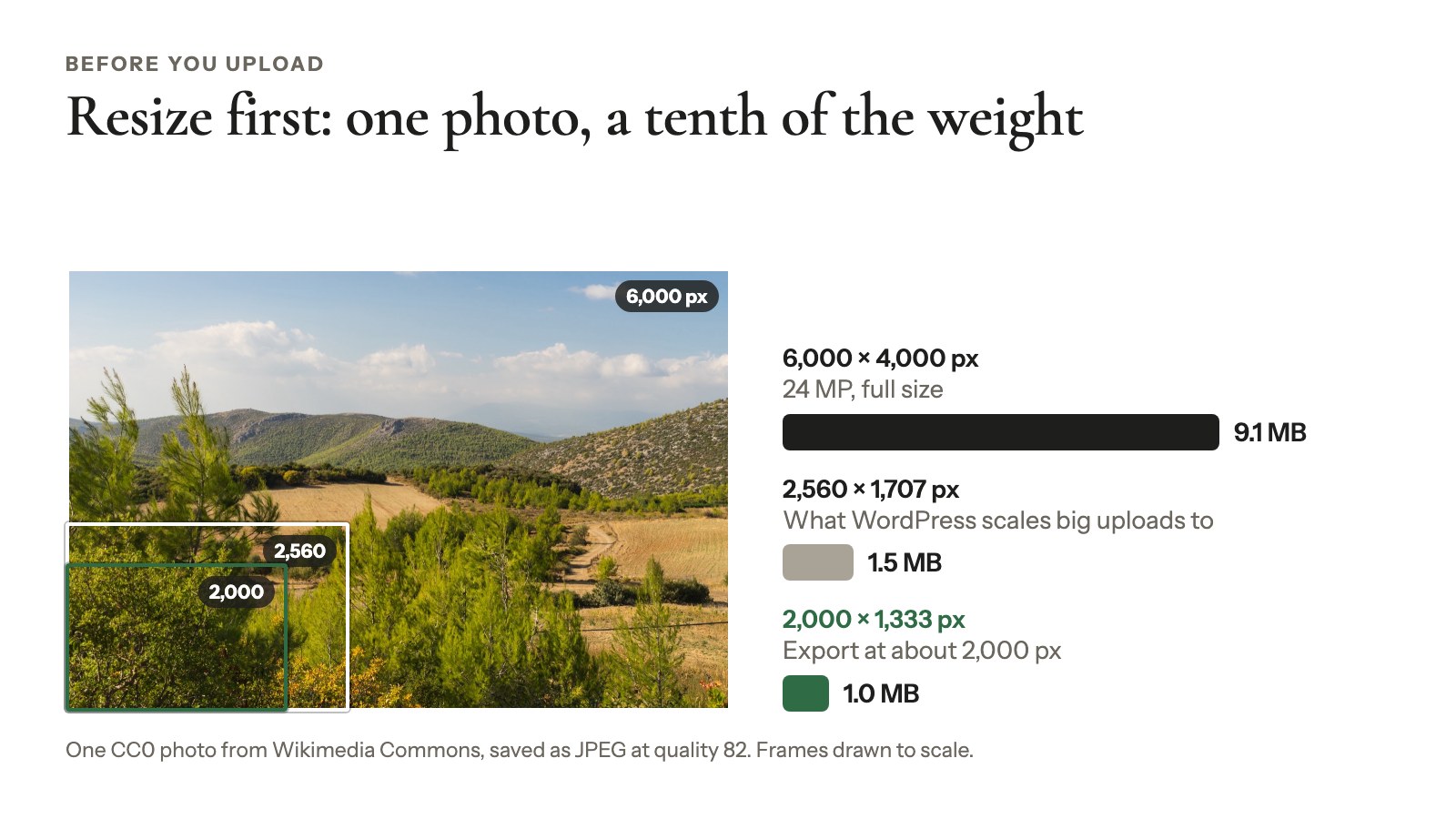
- Resize first. A 24-megapixel camera shoots 6,000 × 4,000 pixels, far more than a gallery tile needs. WordPress already scales anything over 2,560 pixels down to 2,560, but exporting at around 2,000 pixels on the long edge keeps your Media Library lighter. In Modula, Trio and Business add image compression and an image CDN on top.
- Write alt text for every image. It helps visitors who use screen readers and tells search engines what’s in the photo. “Bride and groom under an oak tree at sunset” beats “IMG_4821.” In Modula, click a photo in the preview to edit its alt text, or let Modula AI write alt text, titles and captions with the credits in each paid plan.
While you build
- Keep lazy loading on. Photos further down the page load only when someone scrolls to them. In Modula it’s free and on by default: Layout → More settings → Speed Up → Load images as people scroll.
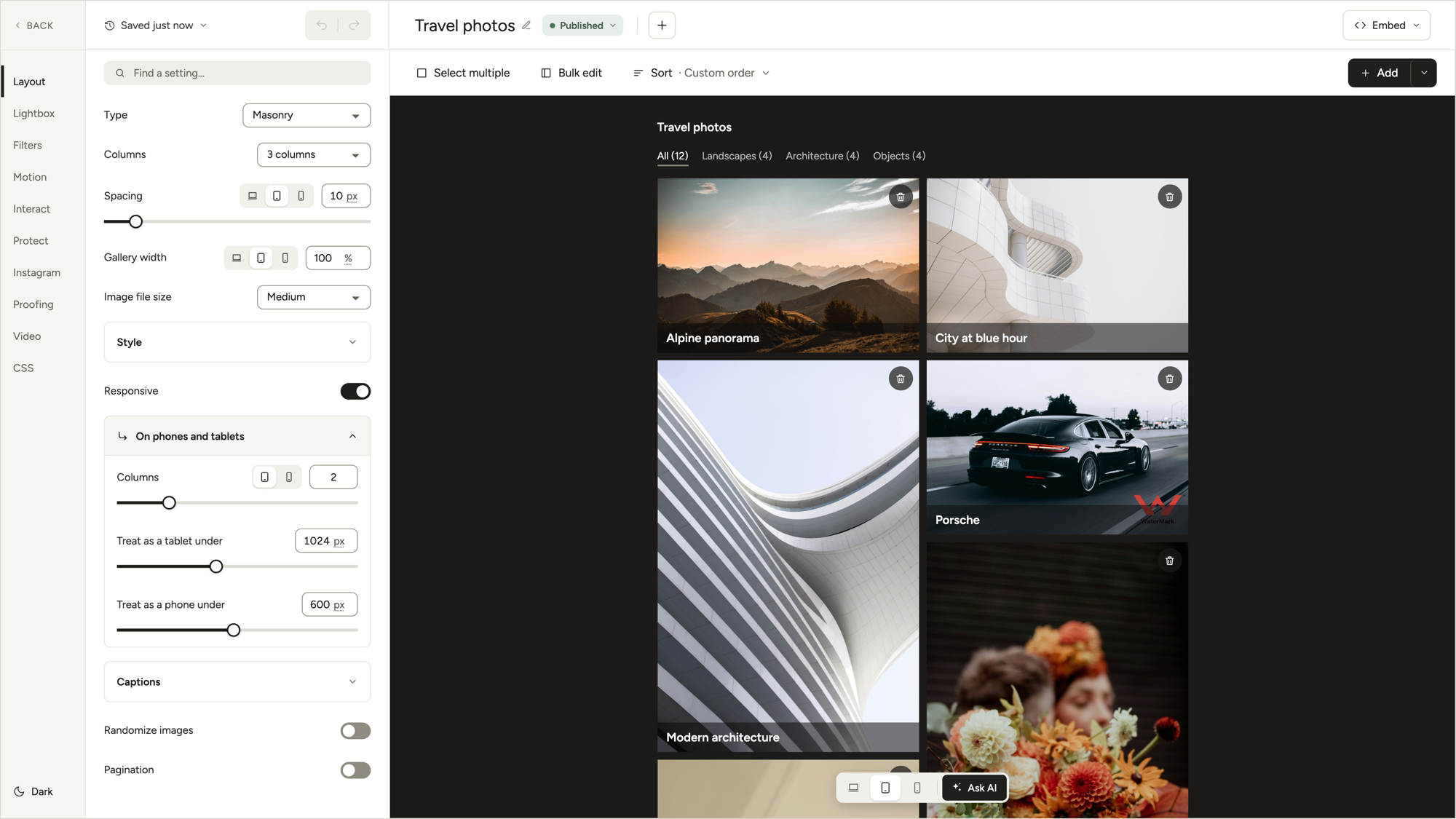
- Preview on tablet and phone. Set columns per device rather than trusting one grid to shrink nicely. In Modula, use the Desktop / Tablet / Mobile switch under the preview, then open On phones and tablets in Layout to set the Tablet and Mobile columns.
- Split big galleries. 300 wedding proofs on one page is a lot to load and a lot to scroll. Add pagination or a Load more button (Modula Business; Responsive Lightbox even has free infinite scroll), or split the day into albums: getting ready, ceremony, party.
- Turn on only what you use. Every effect, filter bar and share button is one more thing for the page to load and for visitors to look at. Start plain and add.
After you publish
Good to know
One site, one gallery plugin. Two gallery plugins mean two lightboxes, two sets of scripts and styles, and settings that can trip over each other. If you’re switching, import your galleries, check them, then deactivate the old plugin.
- Retest after big uploads. A gallery that loads fast with 20 photos may not with 120. Open the page on your phone again after you add a batch.
- Check the plugin now and then. On its WordPress.org page, look at the last update and the WordPress version it’s tested up to. A plugin that’s gone quiet for a year is a plugin to plan your way out of.
Which WordPress gallery plugin should you choose?
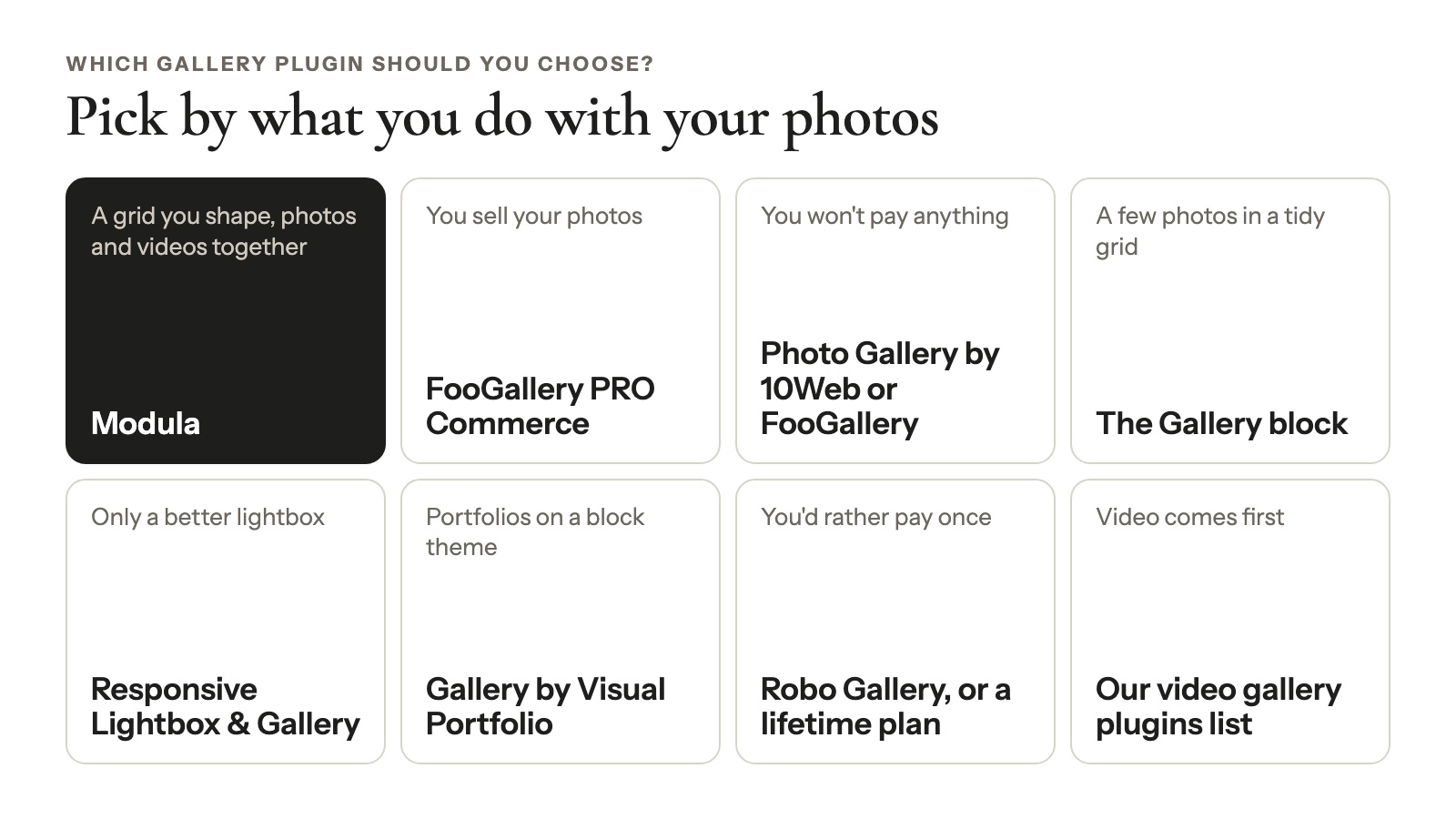
The right WordPress gallery plugin depends on what you do with your photos: Modula for a grid you shape in a live editor, Photo Gallery by 10Web or FooGallery for the most free features, with FooGallery PRO Commerce ($109.99/year, checked October 2026) when you’re ready to sell through WooCommerce, and Responsive Lightbox & Gallery for a better lightbox. Find your situation:
- You want a grid you shape yourself, a live editor, or photos and videos in one gallery: Modula. The free vs Pro comparison shows exactly where each feature sits, and Modula vs FooGallery compares the two feature by feature.
- You sell your photos: FooGallery PRO Commerce. It sells through WooCommerce, so it’s a natural fit if your shop already runs on it.
- You won’t pay anything: Photo Gallery by 10Web, with free watermarks, or FooGallery, with free albums and password-protected galleries.
- You only need a few photos in a tidy grid: the Gallery block that’s already in WordPress, no plugin needed.
- You only want a better lightbox: Responsive Lightbox & Gallery, on top of the Gallery block.
- You build portfolios on a block theme: Gallery by Visual Portfolio. Our list of portfolio plugins for photographers has more options.
- You’d rather pay once: Robo Gallery, or a lifetime plan from Modula or FooGallery.
- Video comes first: start with our video gallery plugins list and the photo and video gallery tutorial.
How to switch gallery plugins without rebuilding your galleries
You can switch WordPress gallery plugins without rebuilding every gallery by hand, because Modula and FooGallery can both import galleries from other plugins:
- Modula imports from FooGallery, Final Tiles and Photoblocks, plus WordPress core galleries.
- FooGallery has a free migrator for galleries from other plugins, Modula’s included.
Here’s how it works in Modula:
- Keep the old gallery plugin active and open Modula → Content. When Modula finds galleries from another plugin, it adds Galleries from another plugin detected to the notifications at the top right.
- Click Install & go to Migrate. Modula installs the free migrator for that plugin and opens Settings → Migrate.
- Pick the plugin under Gallery source, tick the galleries under Galleries to import and click Import. Leave Delete source galleries after import off until you’ve checked the results.
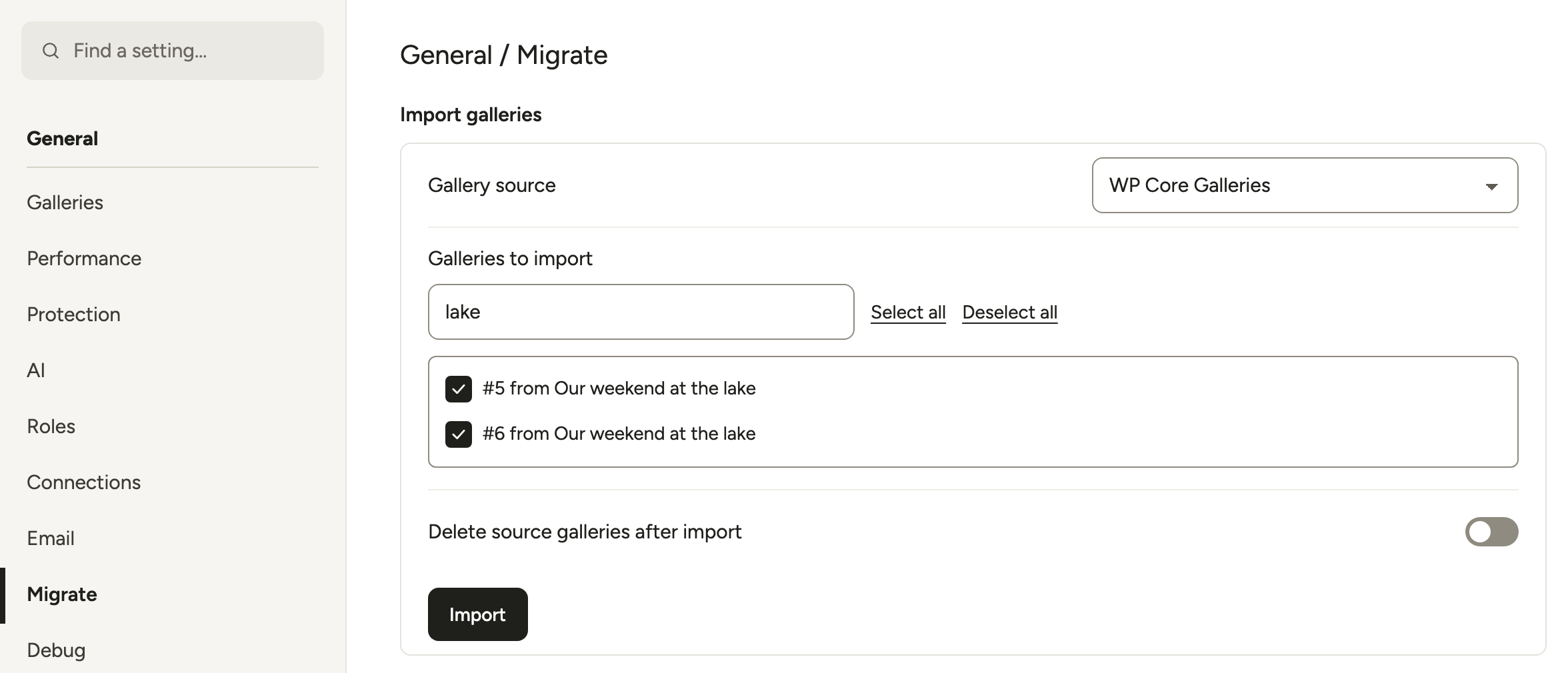
The imported galleries show up in Modula → Content. The full steps are in Export, import and migrate Modula galleries. For galleries made with the Gallery block, see how to move WordPress galleries to Modula.
Frequently asked questions
Modula, the plugin we make, comes first on our list: at 160,000+ active installs (our own count) it leads our ranking, and you shape the grid yourself in a live editor, with photos and videos in one gallery.
For other jobs, FooGallery and Photo Gallery by 10Web give you the most for free, and FooGallery’s PRO Commerce plan can sell your photos through WooCommerce. If you only want a better lightbox, Responsive Lightbox & Gallery is the pick.
Yes. All six plugins here have a free version on WordPress.org. Modula’s free version has 7 gallery types, including masonry and Custom grid, plus separate columns for tablets and phones, and Photo Gallery by 10Web and FooGallery have the longest free feature lists. Pick one that’s still maintained: WordPress.org closed Gallery Bank in 2021 for a security issue.
Yes. The free version has 7 layouts, albums, a lightbox, lazy loading and password-protected galleries. PRO Starter ($49.99/year) adds Grid, Slider, Polaroid and Spotlight layouts. Video, filtering and EXIF need PRO Expert ($79.99/year), and WooCommerce, watermarks and right-click protection need PRO Commerce ($109.99/year), checked October 2026.
Add a Gallery block to a post or page, pick your images and choose the columns. With a plugin, you build the gallery once in its own editor and place it with a block, a shortcode or a page-builder module. Our guide on creating an image gallery covers both, and Create your first gallery shows the Modula steps.
Yes, the Gallery block, which has been part of WordPress since version 5.0 (December 2018). It shows your images in a grid and can open them larger on click. It has no albums, filters, video, watermarks or protection, which is where a WordPress gallery plugin comes in.
In your dashboard, go to Plugins → Add Plugin, search for the plugin’s name, click Install Now and then Activate. The plugin shows up in your admin menu, ready for its first gallery. For a paid version, you usually download a zip file from the vendor, upload it with Upload Plugin on the same screen and enter your license key.