Made in Europe, buy from Europe.
You came back from Lisbon with 60 keepers: wide street scenes, tall doorways, close-ups of those blue tiles. Put them in a plain grid and half get cropped into awkward squares. Stack them one per row and nobody scrolls past the tenth.
A tiled gallery fixes both: wide shots stay wide, tall ones stay tall, and the whole set fits on a few screens.
WordPress doesn’t have one built in, and most tutorials send you to Jetpack. You don’t need it. Here’s how to pick the right tiled layout for your photos and build it free with Modula, the gallery plugin we make.
In a hurry? Skip to the steps.
What is a tiled gallery?
A tiled gallery is a photo layout where images of different sizes and shapes fit together like tiles on a wall, with an even gap between them. Each photo is scaled or cropped so its row or column lines up. You’ll also hear it called a mosaic gallery.
The layout resizes every photo for you. Talk about smart.
The short version with Modula
- Install and activate the free Modula plugin.
- Go to Modula → Content, click New gallery and add your photos.
- Under Layout, set Type to Justified grid, Masonry, Custom grid or another tiled layout.
- Set the Spacing, publish, and add the gallery to a page.
Before you start:
- Find the photo-count sweet spot. Too few and a mosaic looks empty; too many and visitors bail. A wedding photographer with 300 proofs should show the best 30 and link to the rest.
- Keep the files consistent. Export everything at a similar size, say 2,000 px on the long edge, so no tile looks softer than its neighbor.
Tiled vs masonry vs justified vs grid: which layout to pick
Neat squares, an artsy mosaic or classic columns? Modula has no gallery type called “tiled”. The look comes from six free layouts and two Pro ones, and each treats your photos’ shape differently, so start from your photos:
| Layout | What it does | Pick it when | Plan |
|---|---|---|---|
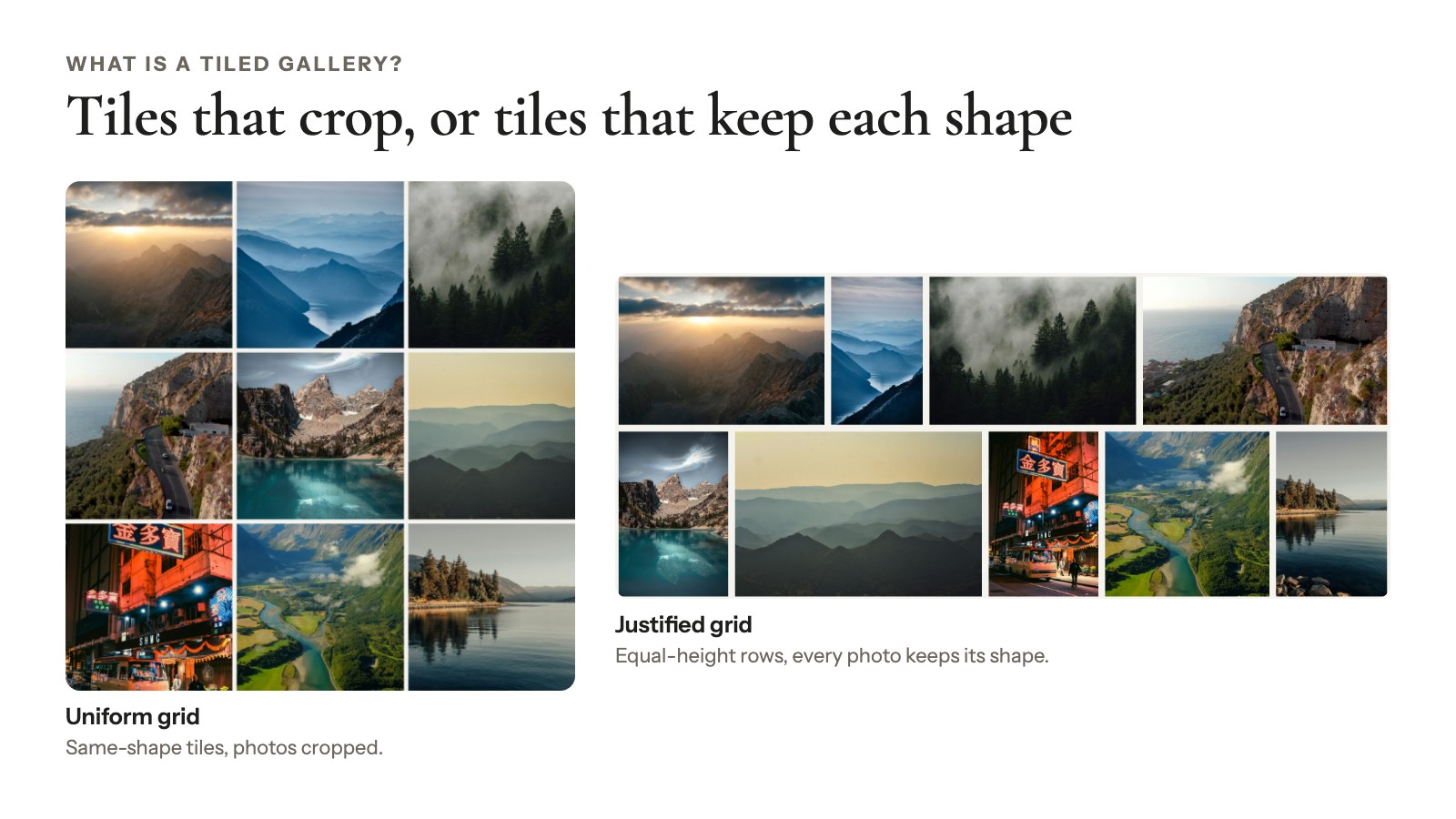
| Justified grid | Equal-height rows, shapes kept | Portrait and landscape shots are mixed | Free |
| Masonry | Columns, photos at natural height | Nothing can be cropped | Free |
| Uniform grid | Same-shape tiles, photos cropped | Products, team photos | Free |
| Fit grid | Same even grid, photos shown whole | Artwork or logos | Free |
| Custom grid | You drag each tile’s size | One hero shot should stand out | Free |
| Creative | Modula picks the tile sizes | You want a mosaic, fast | Free |
| Canvas | Tiles anywhere, or a preset | Editorial and landing pages | Pro |
| Parallax | Masonry columns that move as you scroll | A portfolio with motion | Pro |
Modula has 14 gallery types in all, 7 of them free; the gallery types guide covers each one.
Do you need Jetpack for a tiled gallery?
No, a tiled gallery doesn’t need Jetpack: Jetpack’s Tiled Gallery block is one option, and a gallery plugin is another.
The block is free, but it only works on sites connected to Jetpack. It has four styles (Tiled Mosaic, Circles, Square Tiles and Tiled Columns) and fills your theme’s content width, or Wide or Full if you align it. The catch: Jetpack’s own docs say it doesn’t support captions yet.
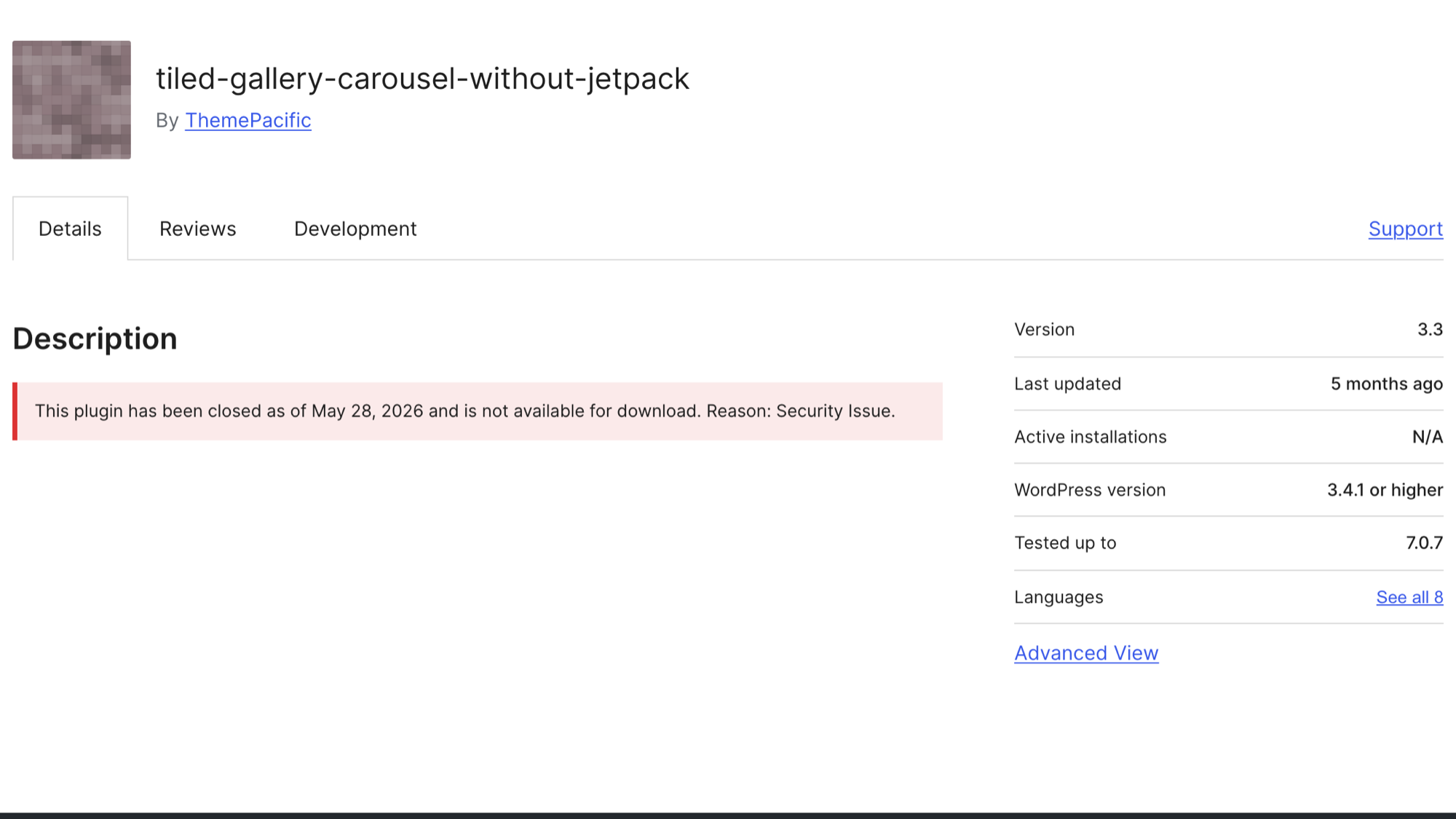
And the plugin with “without Jetpack” in its name? Tiled Gallery Carousel Without Jetpack was closed on wordpress.org on May 28, 2026, for a security issue. Don’t build on it.
The Jetpack block next to free Modula (checked October 2026):
| Jetpack Tiled Gallery block | Modula (free) | |
|---|---|---|
| What you need | Jetpack, connected to WordPress.com | Only the Modula plugin |
| Tiled styles | 4 | 6 |
| Captions | Not supported | On or under each photo |
| Phones and tablets | Not covered in the docs | Columns and spacing per device |
| Active installs | 3+ million (all of Jetpack) | 160,000+ |
Already run Jetpack and don’t need captions? Its block does the job. Want captions, phone columns or a hand-made mosaic? Use a gallery plugin.
How to create a tiled gallery in WordPress
A tiled gallery in WordPress takes five steps in the new Modula 3.0 editor, and all of them work in the free version.
Step 1: Install Modula
In your dashboard, go to Plugins → Add Plugin and search for “Modula”. Click Install Now on Modula Image Gallery, then Activate. A Modula menu shows up in the sidebar.
Step 2: Create a gallery and add your photos
Go to Modula → Content and click New gallery. If Modula asks which editor you want, click Try the new editor.
Click the pencil next to the gallery name and pick one you’ll recognize in six months. “Lisbon street, May 2026” beats “Gallery 7”.
+ Add opens your Media library; the arrow next to it has Upload files and more sources. Modula Pro adds Sort, with drag-and-drop reordering.
Want a clip in the mix? Use the arrow next to + Add → A video to drop in a YouTube, Vimeo or MP4 video as a tile. That needs the Video Gallery feature (Starter plan and up); see the video guide.
No Save button to hunt for: the editor saves as you go and shows “All changes saved”.
Step 3: Pick a tiled layout
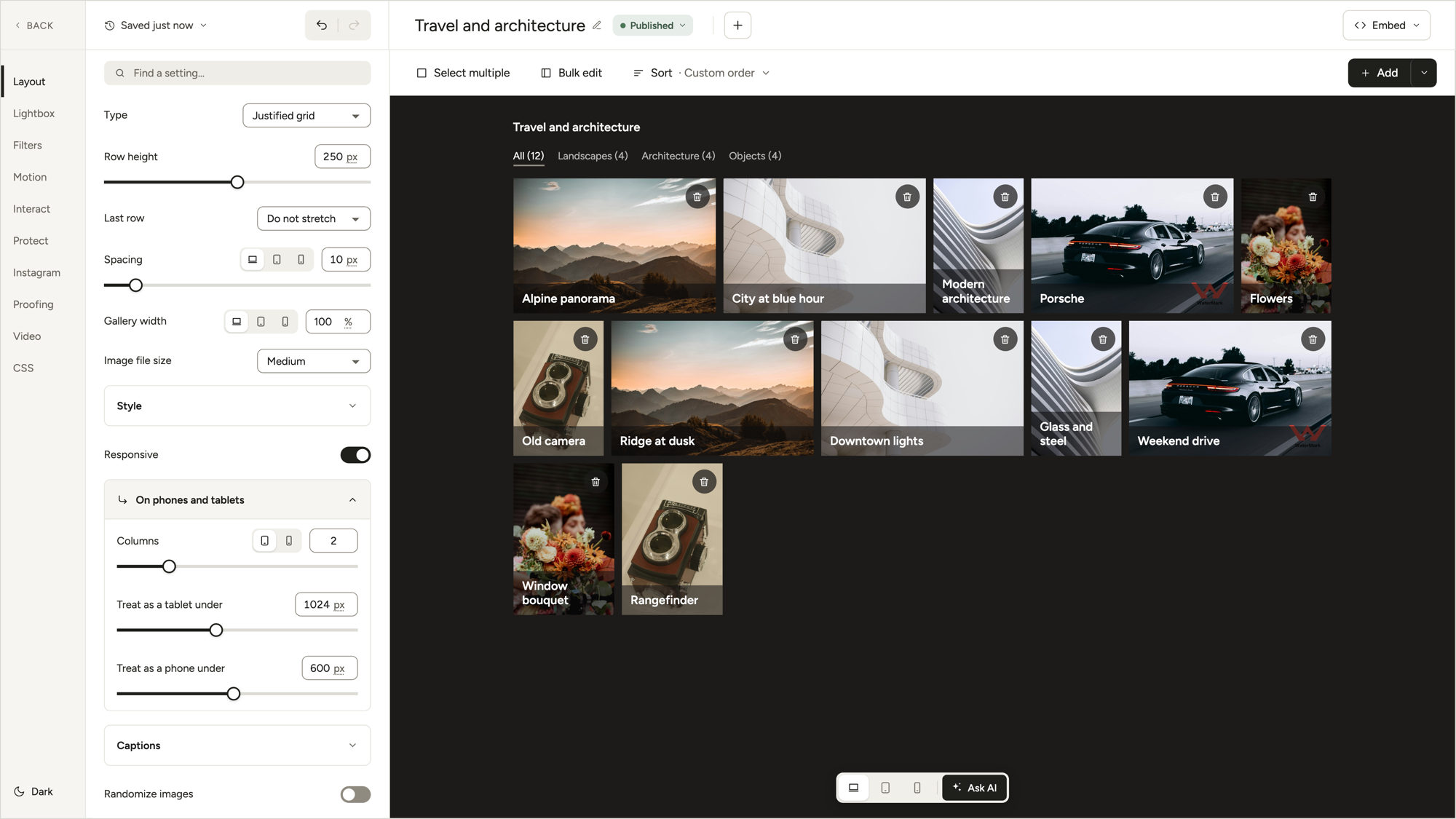
Click Layout in the left rail and open the Type list. The tiled layouts sit under Grid layouts and Creative layouts. The preview updates on the spot, so try three or four before you commit.
Not sure? Start with Justified grid: it keeps every photo’s shape.
Step 4: Set the spacing and image size
Spacing is the gap between tiles: 0 to 100 px, 10 px by default, with its own value per device. Use 0 for tiles that touch, or 4–6 px for a tight gallery-wall feel.
Gallery width is how much of the page the gallery takes up (100% by default).
Image file size picks which WordPress image size fills the tiles. The default, Medium, is 300 px on its longest side in a standard install: fine for small tiles. For bigger ones, like a 600 px hero in a Custom grid, pick Large or the photo will look soft.
Step 5: Publish and add it to a page
Check that the status next to the gallery name says Published. A Draft gallery won’t show up, wherever you paste it.
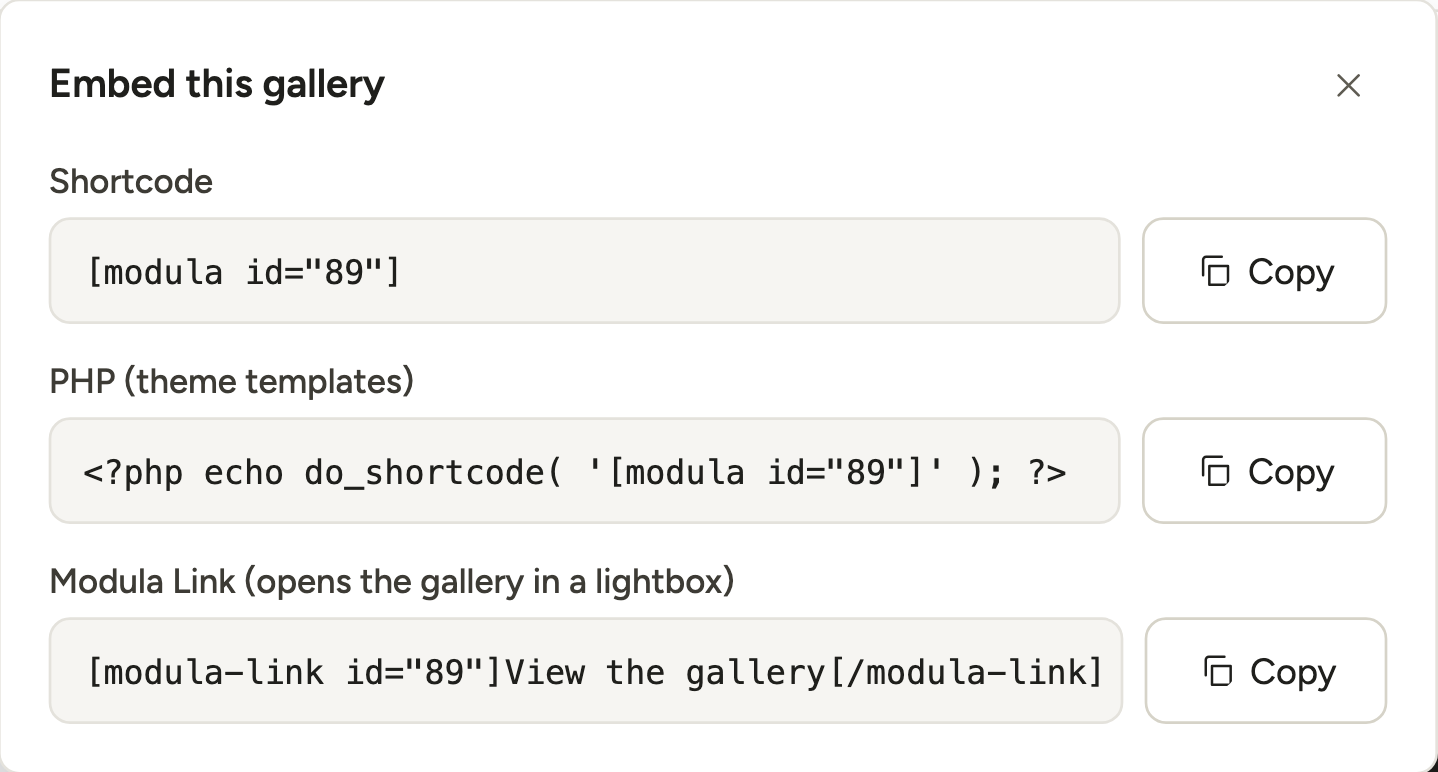
Click Embed at the top right and copy the shortcode. It looks like [modula id="89"] and works in any page or post. In the block editor, you can add the Modula Gallery block and pick your gallery instead.
Elementor, Divi and Beaver Builder have their own Modula modules, and the guide to inserting galleries covers each one.
Justified grid: rows of equal height
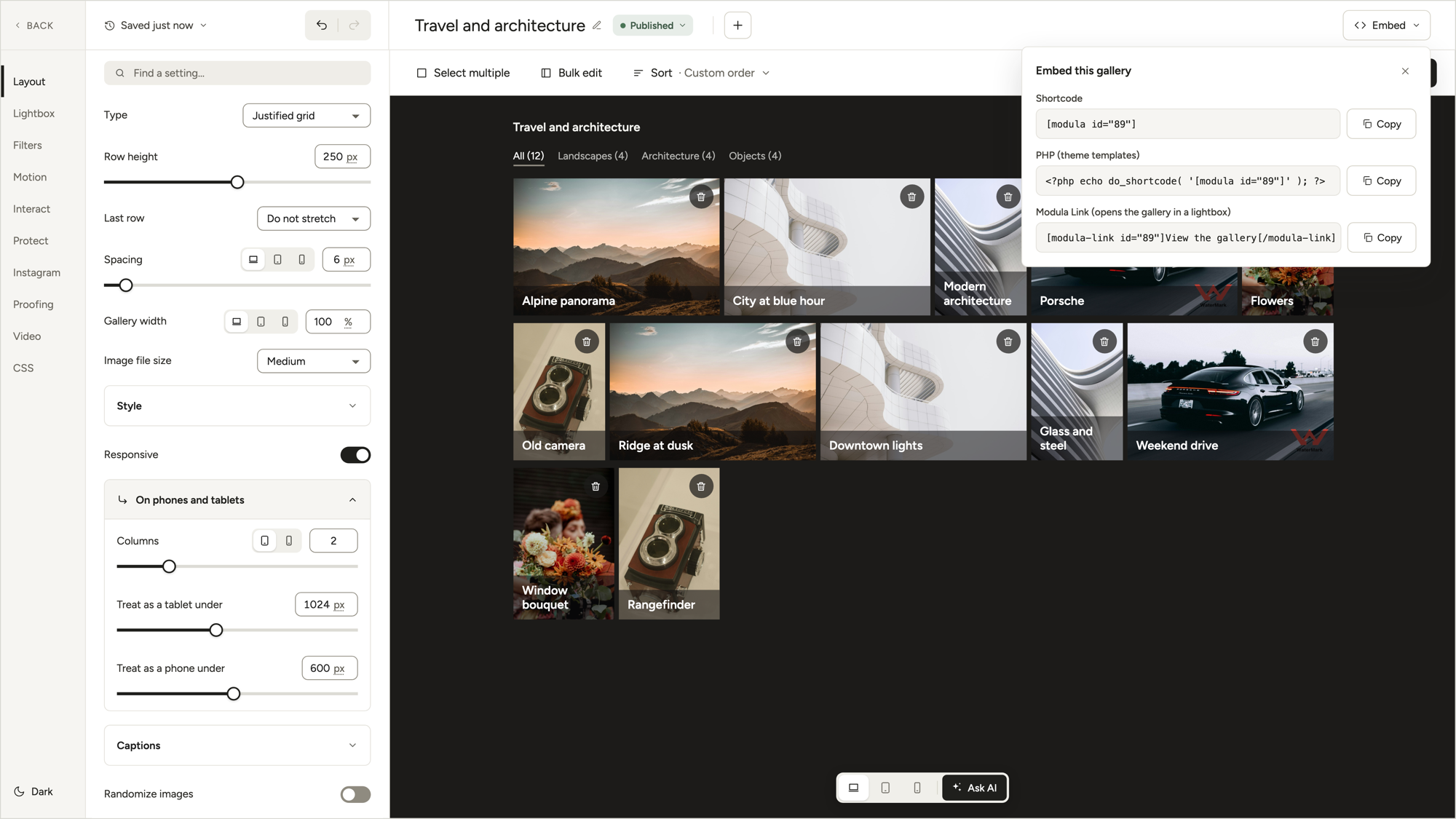
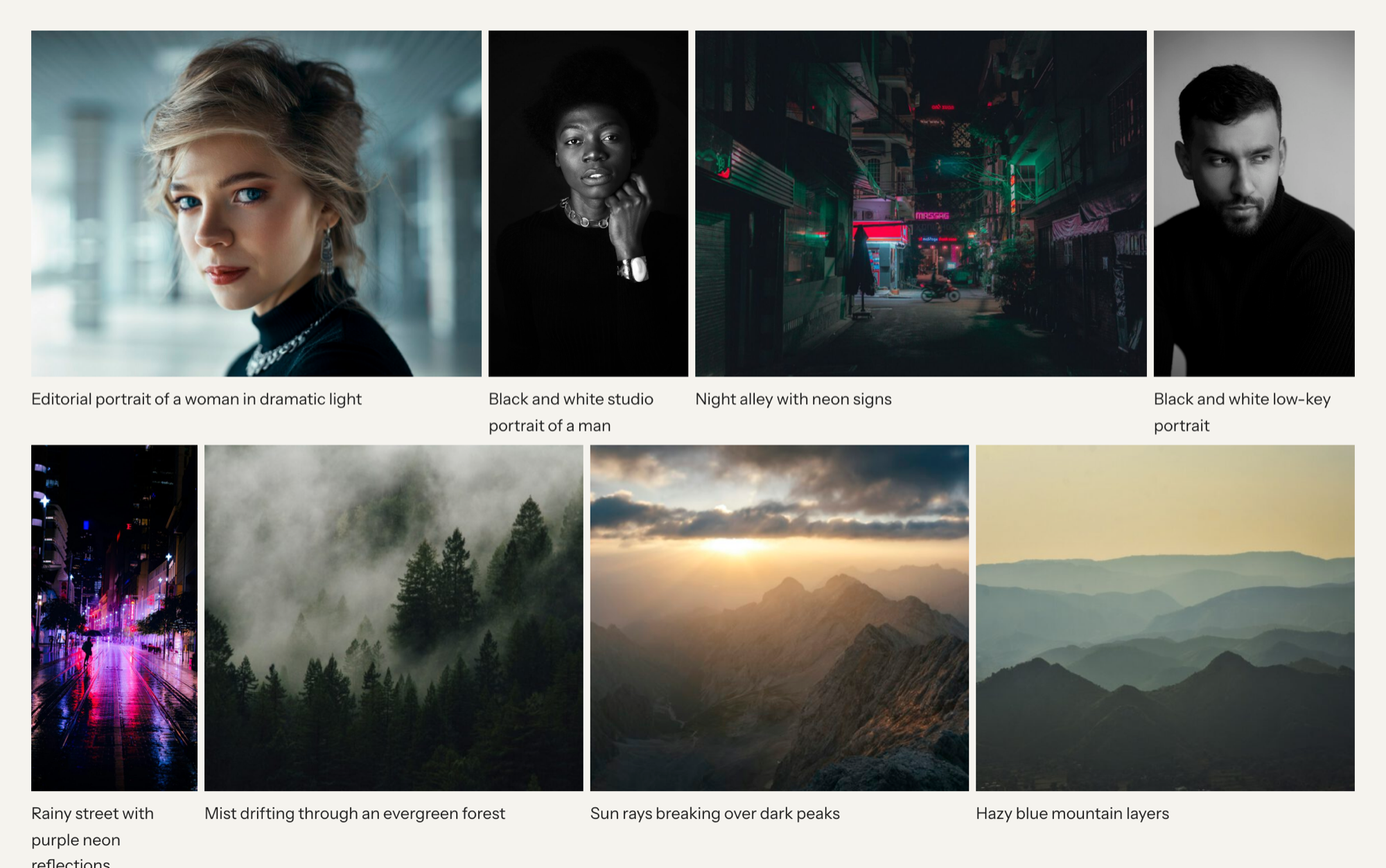
A justified gallery, or justified image grid, is what most people picture when they say “tiled gallery”. Photos sit in rows of the same height that stretch to the full width. Landscapes get wide tiles, portraits narrow ones, and nothing gets squashed.
Two settings shape it:
- Row height: 250 px by default, from 150 to 350 px. Lower it for more photos per row, raise it for bigger tiles. Too high for a narrow page and you’ll get one photo per row.
- Last row: handles a row that isn’t full. Pick Stretch to fill (the default), Do not stretch, Center or Right align.
Say you have 13 photos and the last row gets only one. Stretch to fill can blow it up to the full width; Do not stretch or Center keeps it in line.
Good to know
Coming from Modula 2.x? The old Masonry with Automatic columns and a Row Height is now its own type: Justified grid.
Custom grid: build a grid gallery by hand
Modula’s Custom grid is for perfectionists (we say that with love): a custom grid gallery you shape yourself, no code involved. Every tile starts the same size, and you drag a photo’s corner to make it wider or taller. Guides pop up while you drag, so the tiles line up.
Three looks to try:
- Square tiles: leave every tile the same size for a clean grid.
- One big hero: drag your best shot to two rows tall and let the rest flow around it.
- Tall portraits: stretch each tile until it’s taller than it is wide.
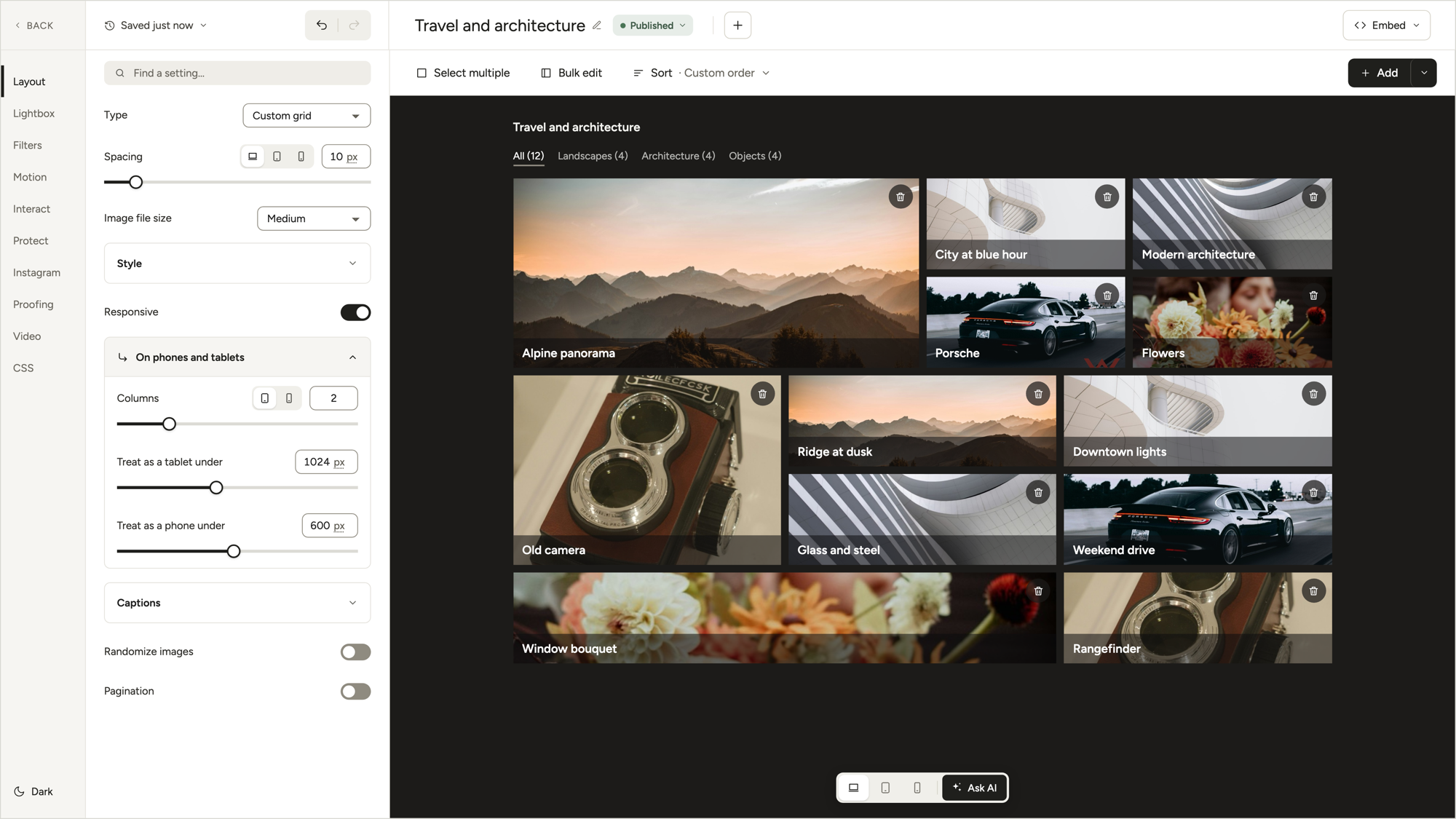
Need an empty spot, say to center three photos? Use a plain white or transparent image, as the white spacers guide shows. And give your mosaic its own column count on phones.
Want total freedom? Canvas in Modula Pro lets you place tiles anywhere.
Creative: an automatic mosaic
Creative does the hard work for you: add your photos, pick Creative, and Modula arranges them into a mosaic gallery that looks like a magazine spread. No more nudging tiles for an hour only to end up with “fine”.
You can’t size single tiles, but three settings tune the result:
- Spacing: the gap between tiles.
- Minimum height: the smallest the gallery can be, per device (800 px by default). Raise it if the tiles look small.
- Randomness: how much tile sizes vary, from 0 (even splits) to 100. It starts at 50.
Photo count matters most here. Six photos make giant tiles; 150 make confetti. If a big set looks cramped, split it or switch to Justified grid.
Masonry, Uniform grid and Fit grid: columns and even tiles
Masonry, Uniform grid and Fit grid work in columns, so they’re the easiest to predict.
Masonry puts photos in columns at their natural height. Nothing gets cropped, and the bottom edge is staggered, Pinterest-style. Columns runs from 1 to 12 (3 by default).
Match the columns to your photo count. Eight photos in six columns leave two columns with two photos and four with one. In four columns, each gets about two. Our masonry gallery guide goes deeper.
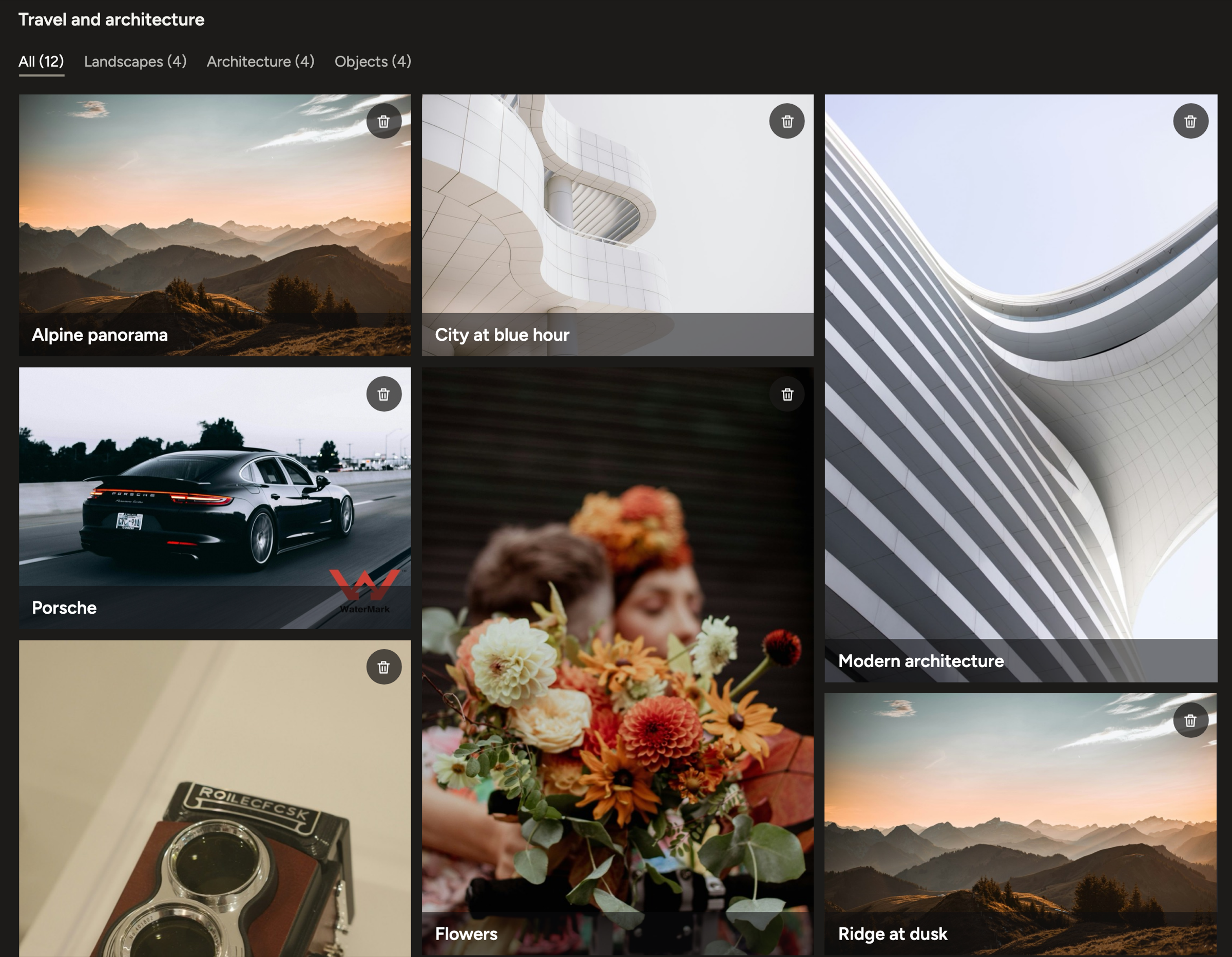
Uniform grid is the classic grid gallery: every tile has the same shape. Set the Columns and the Shape of each image: Square, Portrait, Landscape, or Custom for your own ratio, like 16:9. Modula crops each photo to fill its tile.
Fit grid is the same even grid, but each photo shows whole inside its tile. Image alignment sets where it sits: Center, Top, Bottom, Left or Right.
Tiled gallery ideas
A tiled gallery fits portfolios, travel stories, product grids, weddings and art, and each starts from a different Modula layout. Steal freely.
A photography portfolio
Justified grid, Spacing at 4–6 px, captions Under the image. Bump Row height to 300 px so each shot can breathe.
A travel story
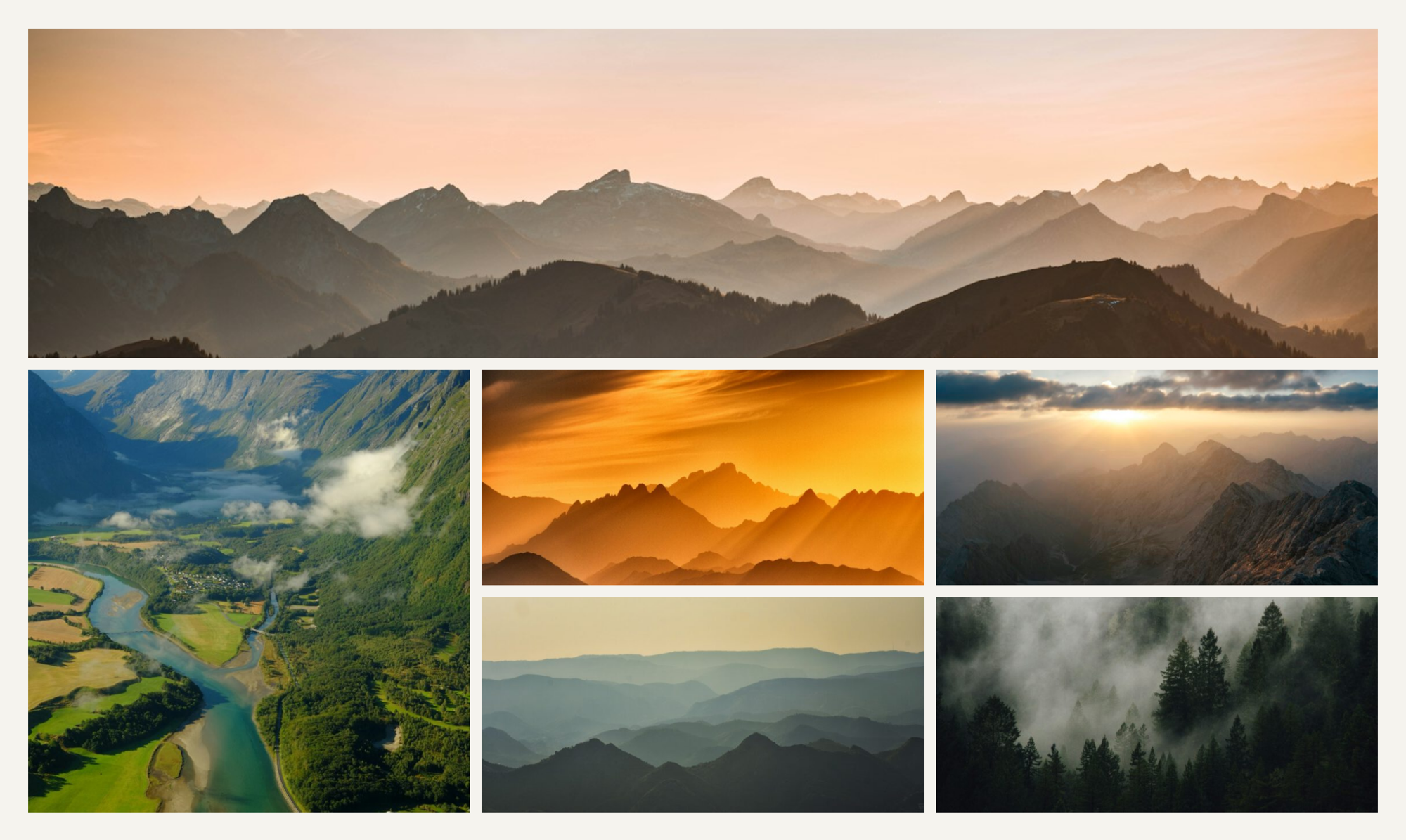
Custom grid, with day one’s panorama across the top row. Keep Randomize images off so the trip runs in order.
A product grid
Picture a café with 12 dishes: Uniform grid, Square shape, 4 columns. That’s three tidy rows on desktop, and six on a phone set to 2 columns.

A wedding or event
Creative for the 30 highlights. For the full day, Justified grid with Pagination and a Load more button (Business plan), so the page shows a batch at a time, not all 300.
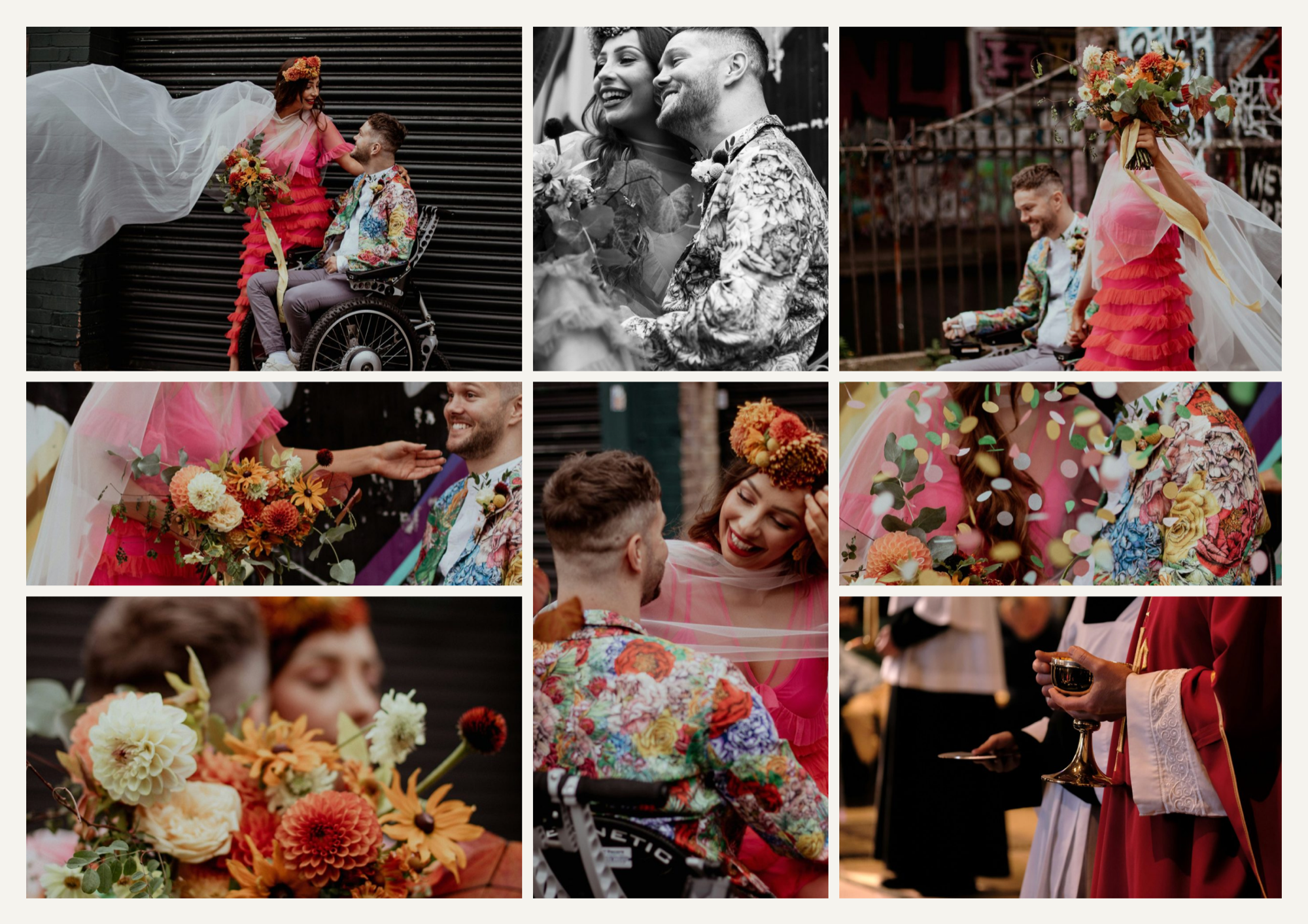
Art or illustration
Fit grid, so no painting loses an edge. Set the shape to Portrait if most pieces are tall.

Add captions, a lightbox and hover effects
In Modula, click a photo in the preview to give it a title and a caption, or, with Modula Pro, use Bulk edit for a whole batch.
Captions
Open Layout → Captions. Where it sits puts the text On the image or Under the image; under is easier to read in a busy mosaic. Turn on Show image title and Show image caption, then set their Color, Size and Boldness. It’s all free, and it’s exactly what the Jetpack block can’t do.
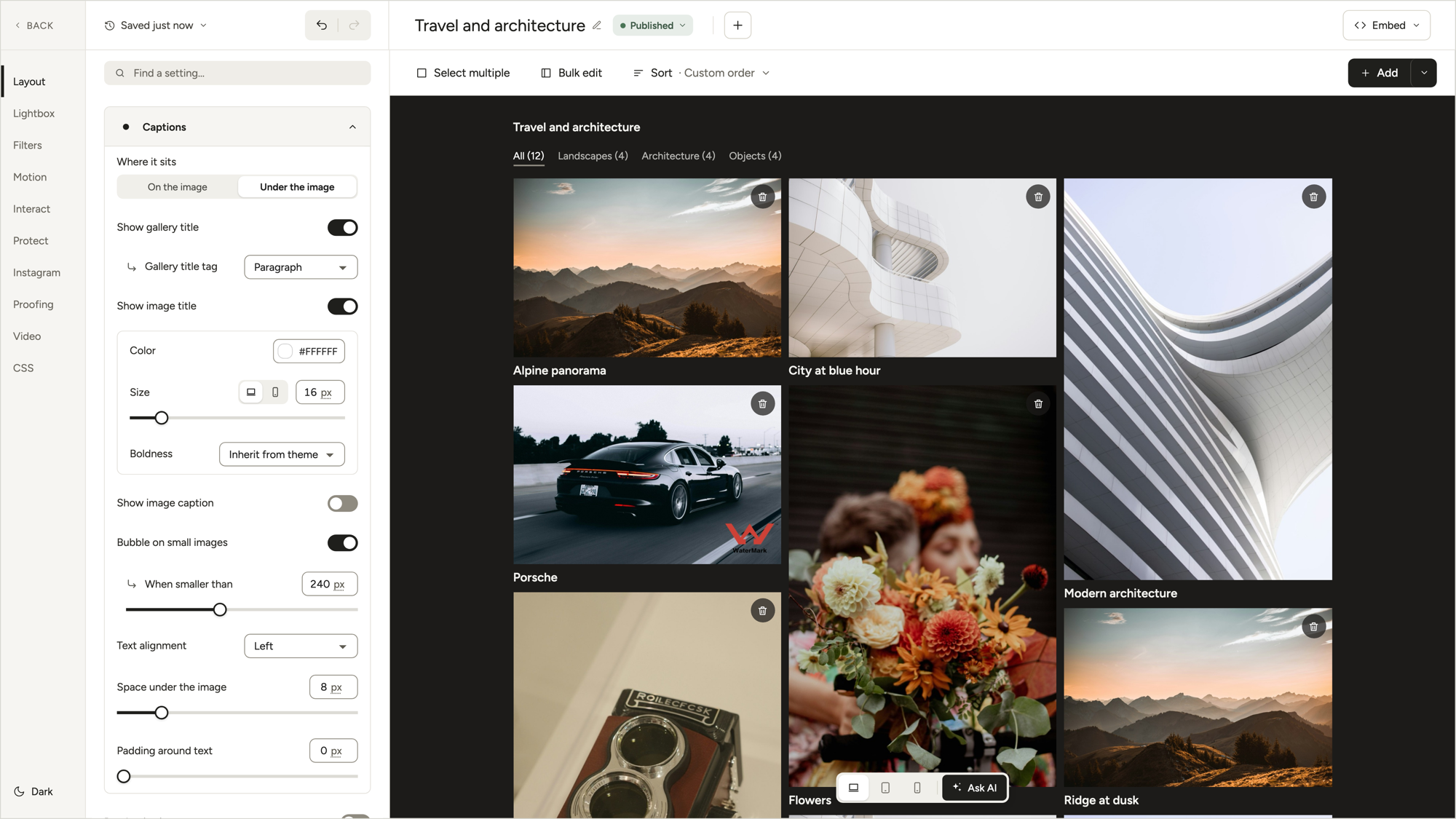
More examples: our guide to galleries with titles and captions.
Lightbox and links
Click Lightbox in the left rail. On click decides what a click on a tile does:
- Open in lightbox: the photo opens large, with arrows to the next one.
- Lightbox, or link when set: photos with a link go there; the rest open the lightbox.
- Go to URL: each tile opens its own link. Handy when every tile is a product.
- No link: a click does nothing.
The free lightbox has arrows, keyboard and swipe navigation. A slideshow comes with Starter, fullscreen with Trio, and zoom and downloads with Business (pricing).
Hover effects and style
Hover effects live in Motion → More settings → Hover effects; pick one from the list. Phones have no mouse, so visitors there won’t see them. The hover effects guide lists every one.
Layout → Style has Rounded corners, Border thickness, Border color, Shadow size and Shadow color. A tiled look usually wants a small corner radius and no border. Let the photos talk.
Make your tiled gallery look good on phones
A mosaic that looks great on your laptop can turn into tiny tiles on a phone, and Modula fixes that under Layout → Responsive → On phones and tablets:
- Columns: set with the tablet and phone buttons. One or two columns usually works on a phone.
- Treat as a tablet under / Treat as a phone under: where those columns kick in (1024 px and 600 px by default).
- Spacing: has its own desktop, tablet and phone values at the top of Layout.
Before you publish, flip through the Desktop, Tablet and Mobile buttons under the preview.
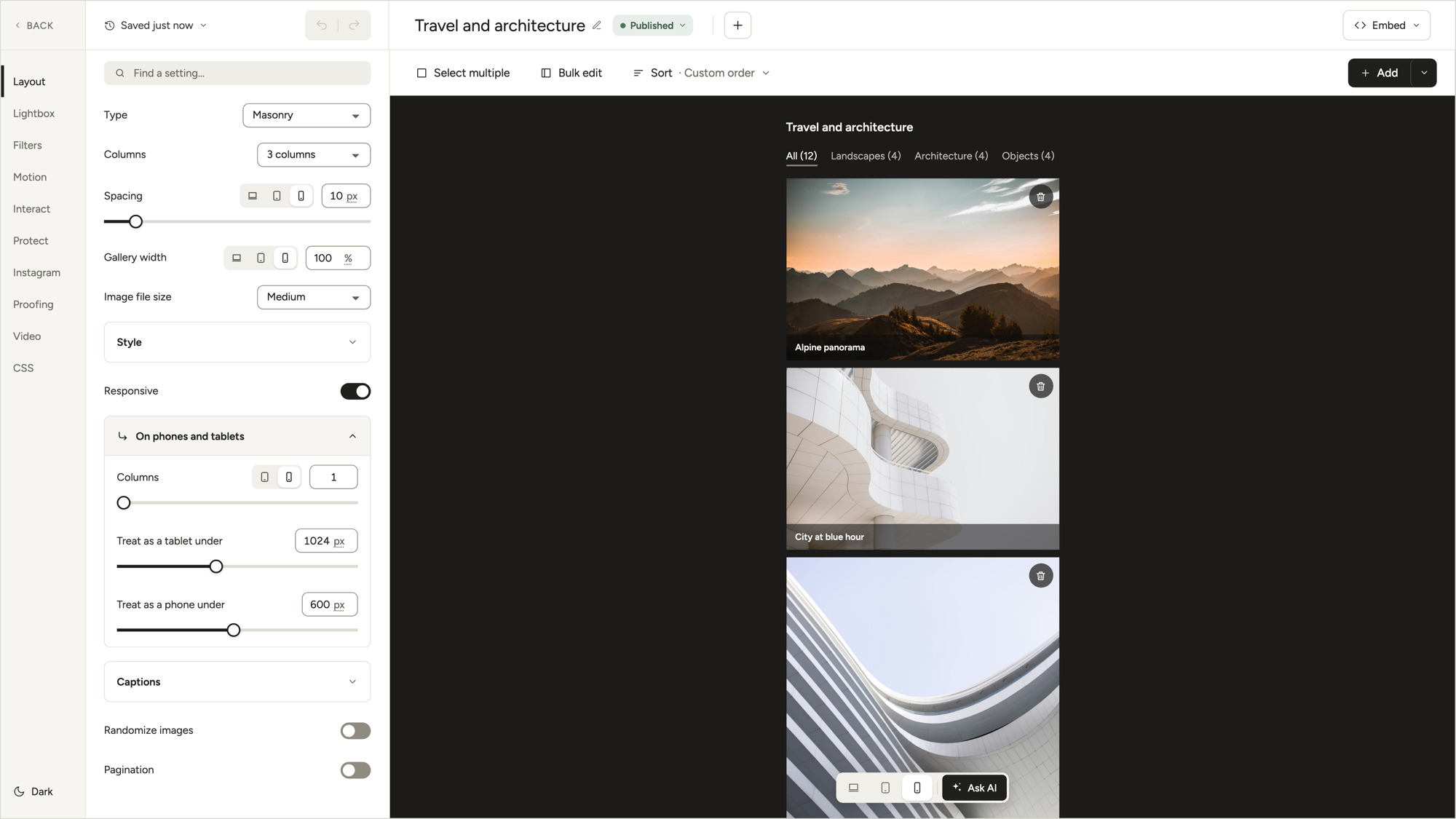
Creative skips this section and uses Minimum height per device instead. More in the responsive settings guide.
If your tiled gallery looks wrong
Most tiled gallery problems come down to one of five things:
- Blurry tiles: the tiles are bigger than the image file behind them. Pick a larger Image file size, like Large.
- The gallery doesn’t show: check that its status says Published, not Draft. Still missing? Clear your cache plugin’s cache.
- A lonely last row: in Justified grid, set Last row to Do not stretch or Center.
- Too narrow: keep Gallery width at 100%. The gallery fills the space your theme gives it, so for full width, put it in a Group block aligned Full width.
- Faces or edges cut off: Uniform grid crops by design. Switch to Masonry or Fit grid.
Tips for a better tiled gallery
- Keep lazy loading on. Load images as people scroll (Layout → More settings → Speed Up) loads photos as visitors reach them. It’s free and on by default.
- Split up big sets. Add filters (Starter plan and up), or turn on Pagination with Infinite scroll or a Load more button (Business plan).
- Mind the order. Randomize images shuffles your photos on every page load. Leave it off if your order tells a story.
- Write alt text. Click a photo and describe what’s in it, for screen readers and search engines.
- Shrink the files. On Trio and Business, Modula can compress your images and serve them from an image CDN (a global network of servers). Our gallery speed guide has more.
- Protect the originals. Password protection comes with Trio and up, Watermark with Business.
Frequently asked questions
Yes. A gallery plugin such as Modula gives you tiled layouts with no Jetpack connection, and its six tiled layouts are free. Skip Tiled Gallery Carousel Without Jetpack, though: wordpress.org closed it on May 28, 2026, for a security issue.
In Modula, click each photo to add a title and a caption, then turn on Show image title and Show image caption under Layout → Captions. Captions under the image read best in a busy mosaic. Jetpack’s Tiled Gallery block doesn’t support captions.
Masonry uses columns, with photos at their natural height and staggered bottom edges. A tiled gallery usually means rows that line up, or a mosaic of mixed tile sizes. Pick Masonry when nothing can be cropped, Justified grid for neat rows.
Yes. In Modula, set Lightbox → On click to Go to URL, then click each photo and add its Link URL. To mix linked tiles with lightbox ones, pick Lightbox, or link when set: photos without a link open in the lightbox.
In Modula, keep Gallery width at 100% under Layout (the default). The gallery fills the space your theme gives it, so place it in a full-width part of the page, like a Group block aligned Full width in the block editor.
Yes. Modula Lite is free on wordpress.org and includes six tiled layouts, with 160,000+ active installations and a 4.7 out of 5 rating. Modula Pro starts at $39 for the first year ($78/year after), with a 14-day money-back guarantee, and adds Canvas, Parallax, video and filters (pricing).
Wrapping up
A good tiled gallery shows a whole shoot without endless scrolling and still lets every photo shine. Start with Justified grid, switch to Custom grid when one shot deserves the spotlight, and check that last row before you publish.
Install Modula and try all six layouts on your own photos. Want clips too? Here’s how to build a photo and video gallery.