Made in Europe, buy from Europe.
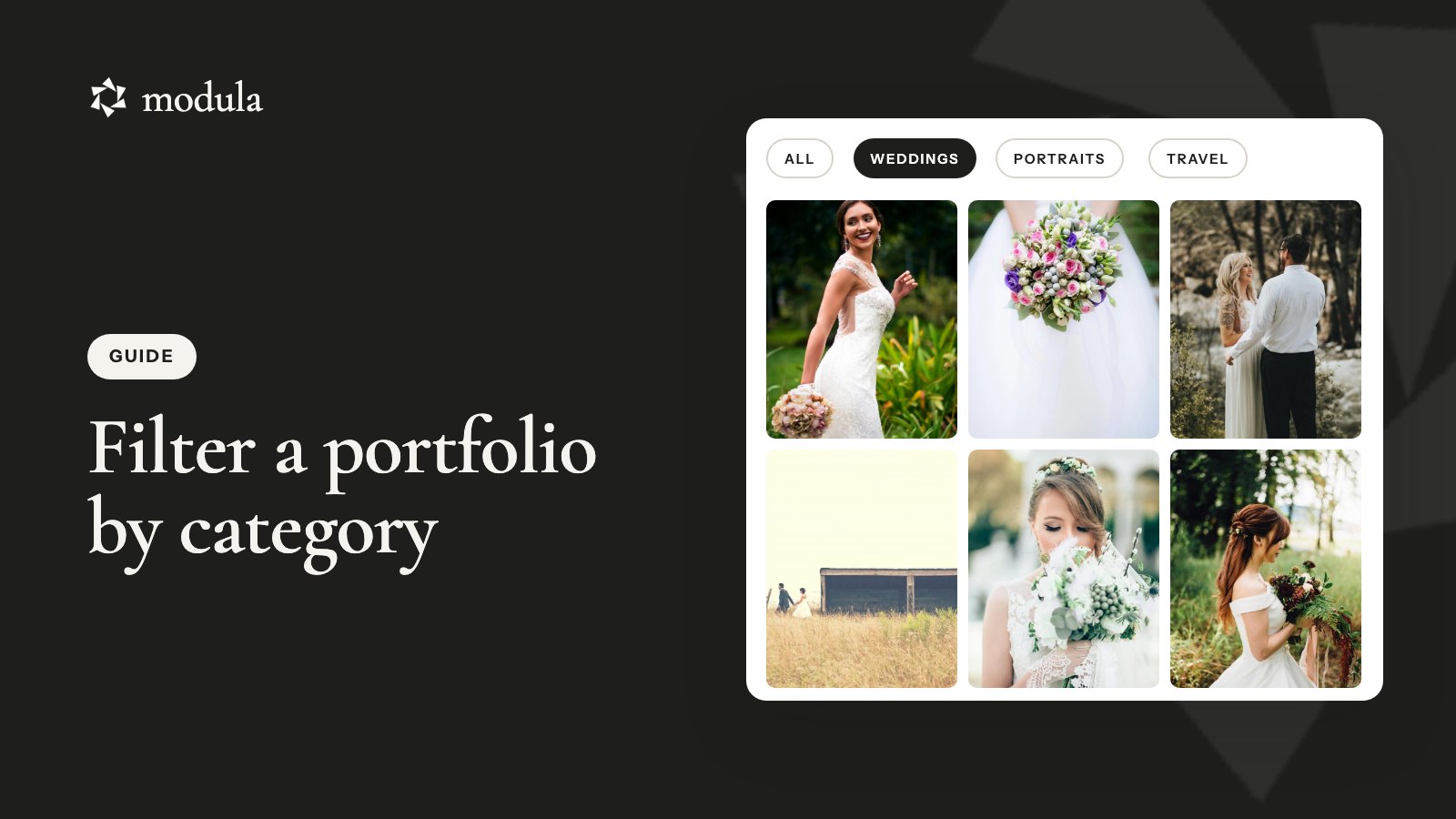
A new client emails you: “Love your work, but where are your newborn photos?” They’re right there, buried between 140 wedding shots and last spring’s brand shoots. Your client scrolled for a while, then gave up and asked. A WordPress filterable gallery fixes that: a row of categories above your work, and one click shows only what the visitor came for.
Here’s how to filter your portfolio by category with Modula, the gallery plugin we make. No code, and no surprises on page 2.
The short version
- Open your gallery in Modula → Content and click Filters in the left rail.
- Type each category in New filter and click Add.
- Tag your photos one by one, or many at once with Bulk edit.
- Click Embed and put the gallery on a page.
What a filterable gallery is (and when you need one)
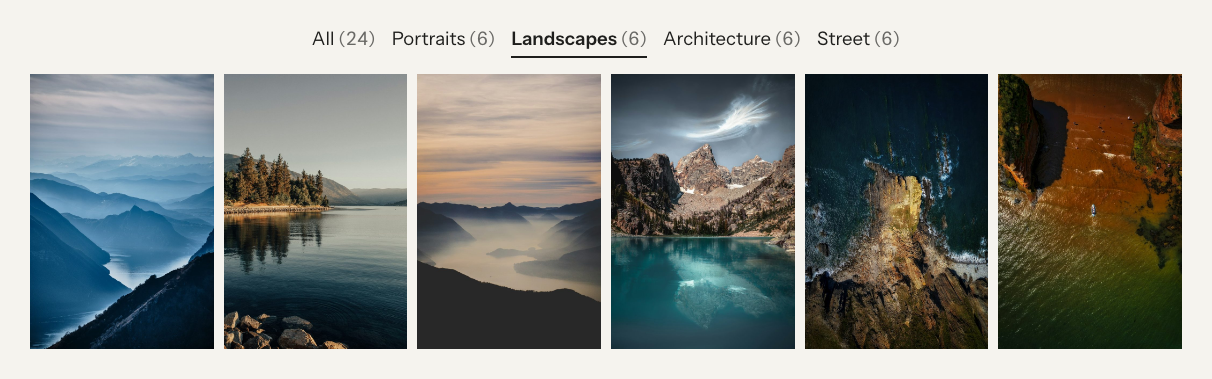
A filterable gallery is one gallery with a filter bar on top: All, Weddings, Newborns, Brand shoots. Each photo carries one or more categories, and a click on a category hides everything else.
It’s worth it when people browse one body of mixed work by type. A rough rule: 30 or more photos and 3–7 categories.
It’s the wrong tool when your work splits by client. A couple wants their wedding, not a “Weddings” filter across 20 couples. Give each client a gallery, or group them in an online photo album.
What you need
Modula’s filters need a Pro plan and a gallery type that supports them.
- Any Pro plan. Every paid plan includes filters, from $39 for the first year ($78/year after), with a 14-day money-back guarantee (pricing). In the free version, the Filters section only shows an upgrade notice.
- A type with filters. Seven of Modula’s 14 types have them: Masonry, Uniform grid, Fit grid, Justified grid, Custom grid, Creative and Polaroid. Canvas, Parallax, BnB, Slider, Showcase, Story and Video gallery don’t.
New to Modula? The install guide covers the free plugin (Plugins → Add Plugin) and your Pro license.
Plan your filterable portfolio before you tag
Ten minutes planning your categories now saves you re-tagging 300 photos later.
- Use your clients’ words. “Weddings” and “Brand shoots” beat “Editorial B” or your Lightroom folder names. Nielsen Norman Group (2018) says filter labels should be “as concrete and precise as possible” (NN/g).
- Keep it to 3–7. People take that in at a glance.
- Let photos live in two places. A bride holding her newborn niece can sit in Weddings and Newborns.
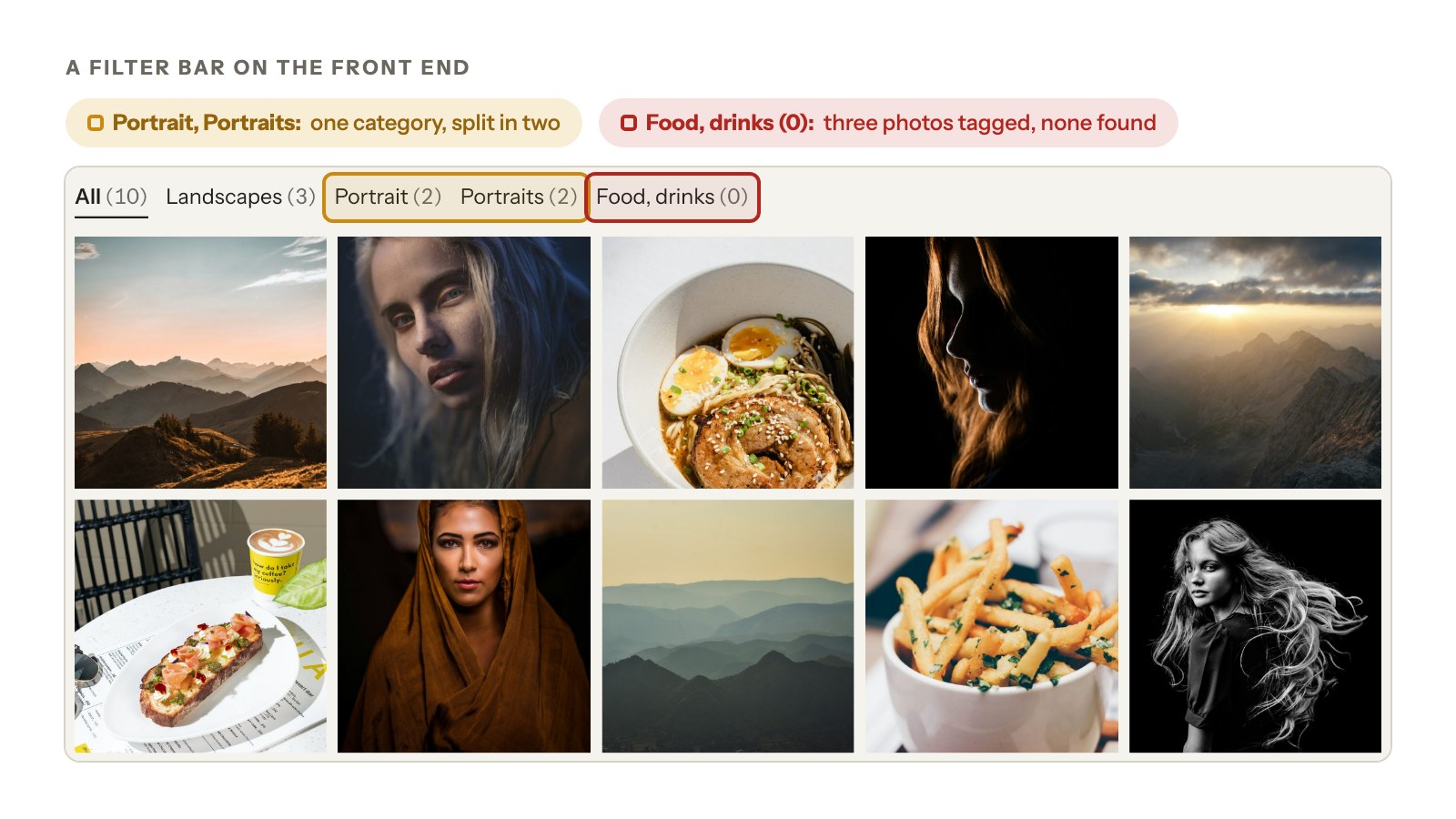
- Pick one spelling. “Portrait” and “Portraits” become two filters.
- Leave commas out. Modula stores a photo’s filters as a comma-separated list, so a “Food, drinks” filter finds no photos. Write “Food and drinks.”
Tip
Add your best category first. The bar shows filters in the order you create them, and Modula 3.0 has no drag-to-reorder. Settle the names before you tag, too: renaming or removing a filter takes it off every photo that had it.
Create the gallery and add your filters
- Go to Modula → Content and click New gallery. Click the pencil next to the title and name it, say “Portfolio.”
- Click + Add above the preview and pick your photos in the Media library. For new files or videos, use the arrow next to it: Upload files or A video.
- Under Layout → Type, choose a type with filters, such as Masonry or Justified grid.
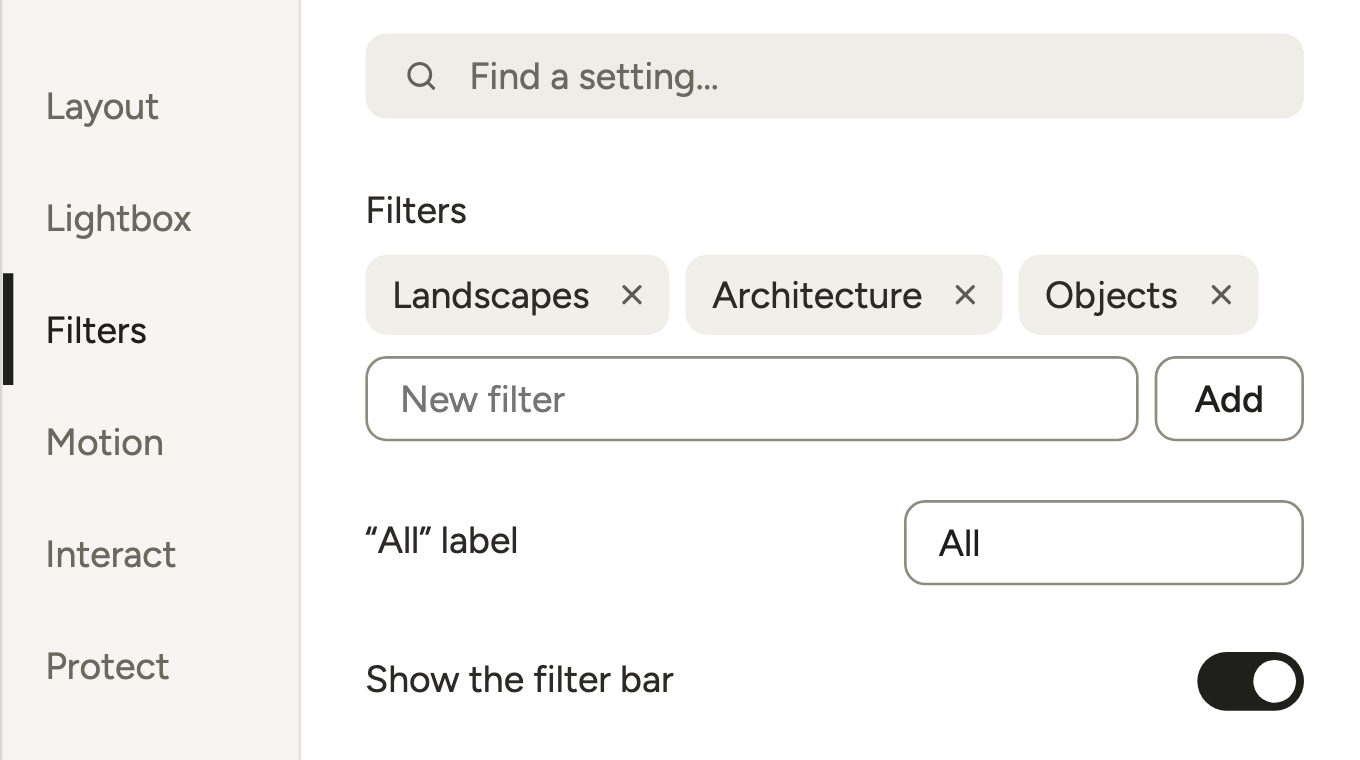
- Click Filters in the left rail. Type a category in New filter, click Add, and repeat.
Each filter becomes a chip, and its × removes it. The “All” label field renames the show-everything filter, so you can call it “All work.”
A filter with no photos still shows in the bar, as “Weddings (0)”, so tag every category before you publish. There’s no Save button: Modula 3.0 saves as you go and shows All changes saved.
Tag each photo or video
A Modula filter only shows the photos that carry it. Tag them one by one, or all at once in a table.
One at a time
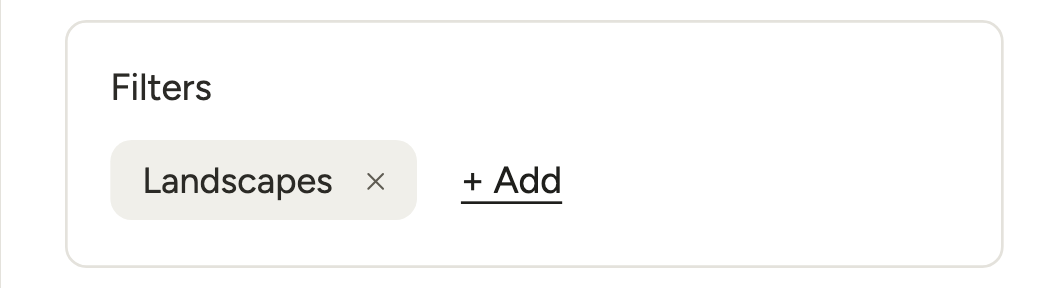
Click a photo in the preview and its settings open on the left. Under Filters, click + Add and pick a category. The arrows at the top of the panel jump to the next photo. Videos take filters the same way.
Many at once
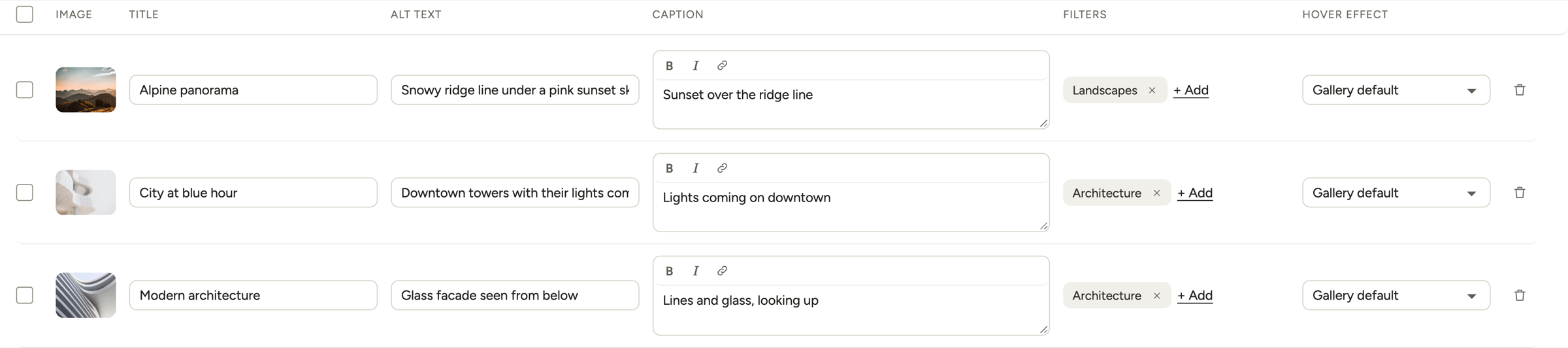
For a whole portfolio, click Bulk edit above the preview. Each image gets a row, with a Filters column next to the title, alt text and caption. Add filters row by row, then click Save all and close.
Say you have 140 photos: 80 weddings, 35 newborns, 25 brand shoots. One pass down the Filters column and they’re sorted.
Only tagging a few? Click Select multiple, tick the photos, then click Bulk edit. See how to bulk edit your images.
Set up the filter bar
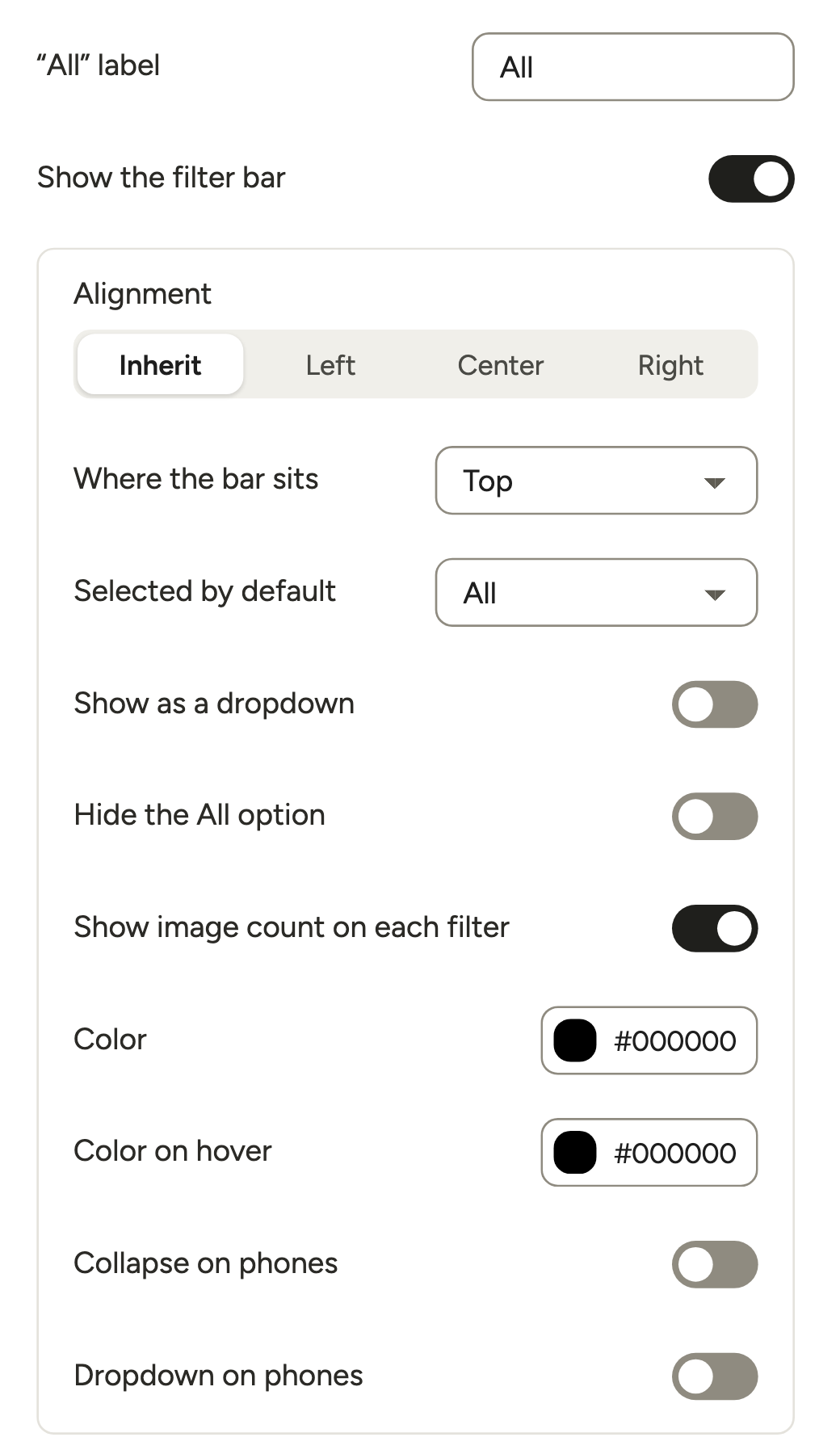
Modula’s filter bar settings sit under your filters. Start from what you want visitors to see.
Open on your best category. Set Selected by default to Weddings and the page lands there. To drop “All” altogether, also turn on Hide the All option, and keep a default picked.
Got 8 or more categories? Turn on Show as a dropdown. It stays one tidy line where a row of links would wrap.
Counts or no counts. Show image count on each filter is on by default, like “Newborns (35)”. Turn it off if a small category looks thin.
Placement and color. Alignment is Inherit, Left, Center or Right. Where the bar sits is Top, Bottom, Left or Right; the current release also lists Top and bottom, and Left and right. Color and Color on hover style the links. For fonts and spacing, see custom CSS for filters.
Tags without the bar. Turning off Show the filter bar hides it but keeps every tag.
Make the filters work on phones
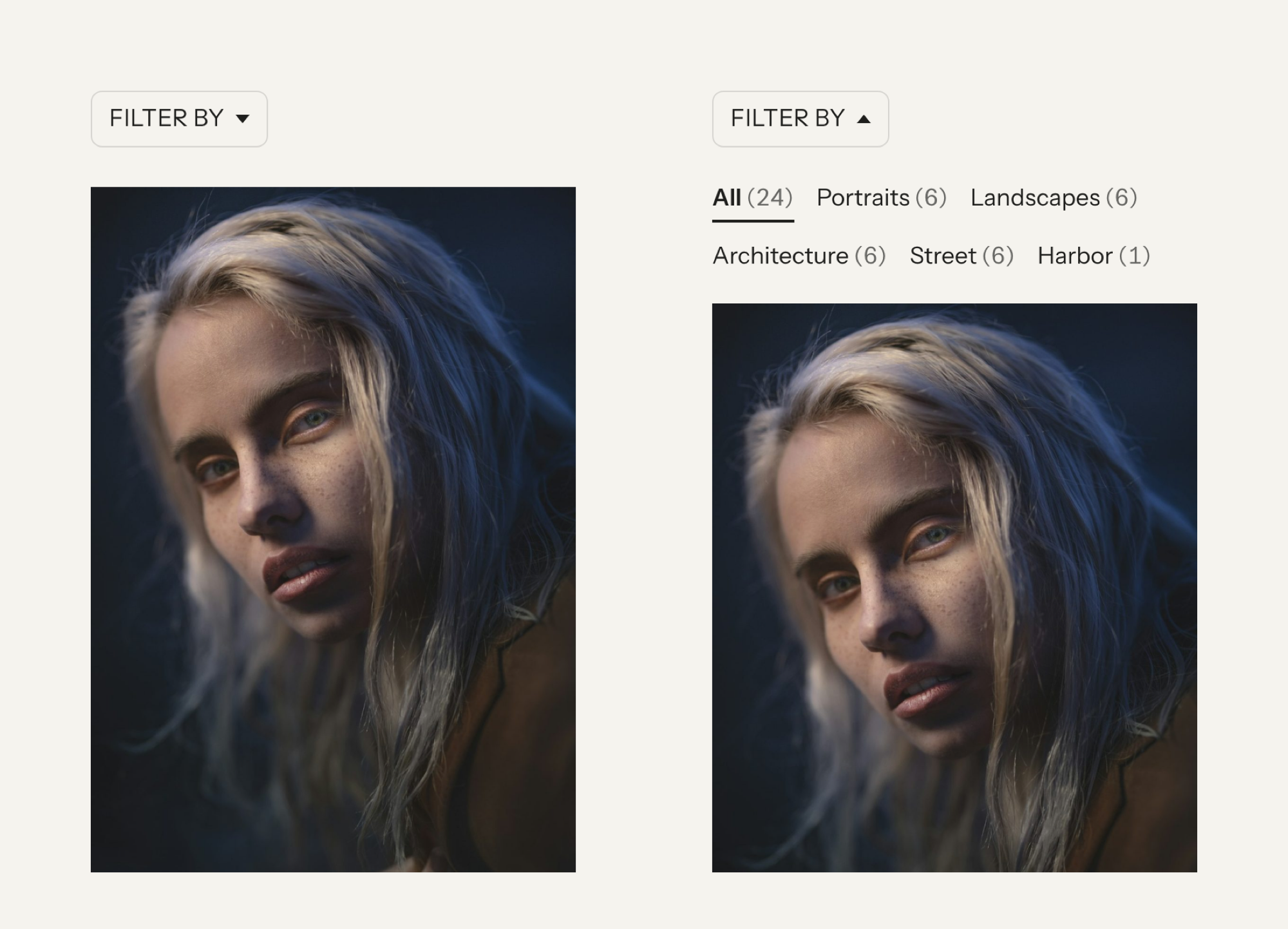
Two Modula switches make the filter bar work on phones, which carried 58.99% of web traffic in September 2026 (StatCounter). Without them, a row of seven filters can push your first photo out of view.
- Collapse on phones tucks the filters behind one button. Button text sets its label (“Filter by” by default). Pick it for 4–7 short names.
- Dropdown on phones shows a dropdown on phones only. Pick it for many categories or long names.
Check the result with the Mobile button under the preview. Our mobile responsive gallery guide covers columns.
Add the filterable gallery to a page
Click Embed at the top of the Modula editor and copy the shortcode, which looks like [modula id="123"]. Paste it into a Shortcode block, or add the Modula Gallery block instead (shortcode guide).
On the page, a click on a filter swaps the photos in place, with no page reload.
Elementor filterable gallery, no Elementor Pro needed
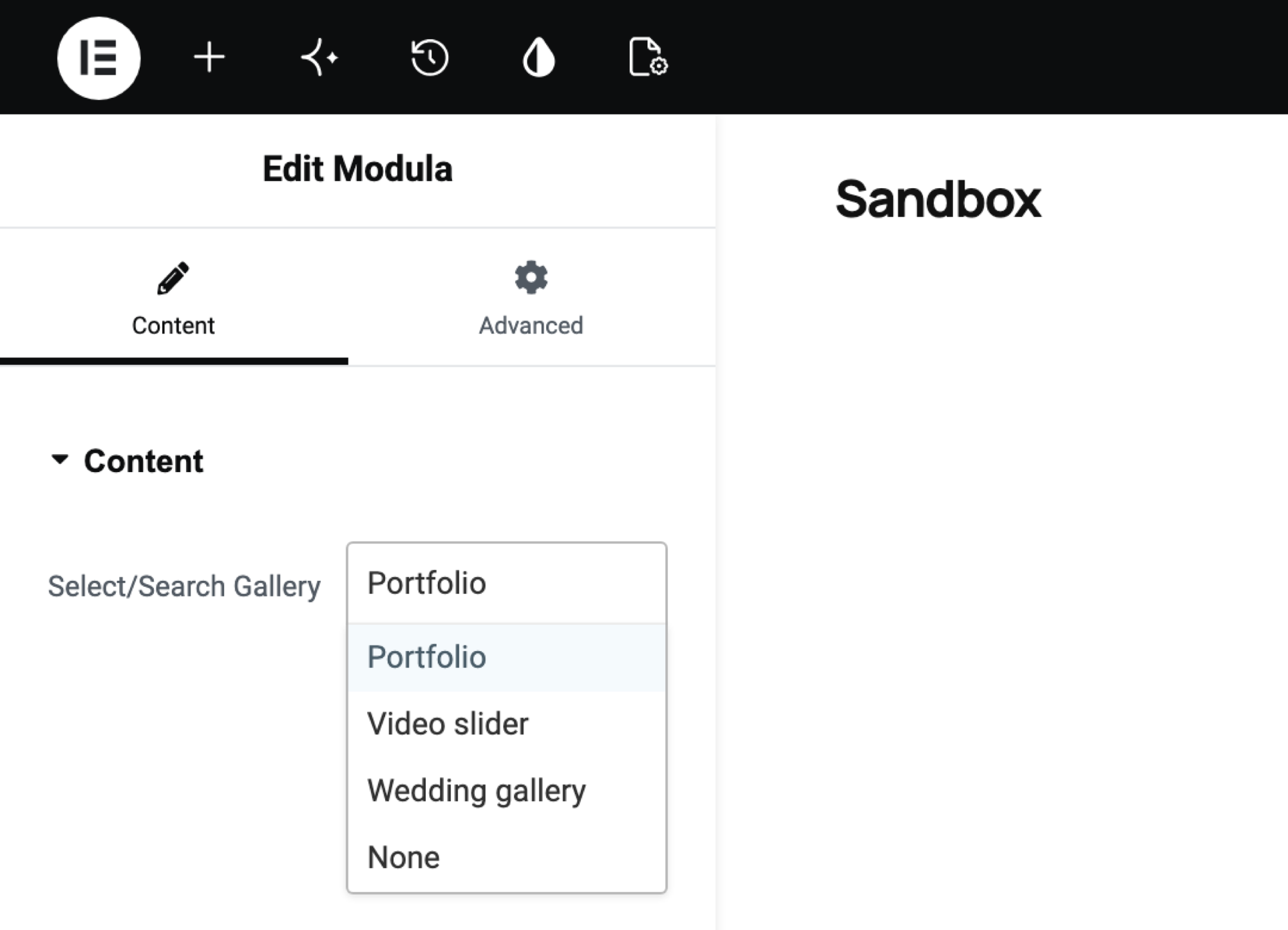
In Elementor, drag the Modula widget (in the General group) onto your page. On the Content tab, pick your gallery in Select/Search Gallery. The filter bar comes from the gallery itself, so there’s nothing to set in Elementor.
The list only shows galleries marked Published. Elementor’s own Gallery widget can filter too, but it needs Elementor Pro, from $60/year (checked October 2026). More in how to add a gallery in Elementor.
Big portfolios: filters with pagination and the lightbox
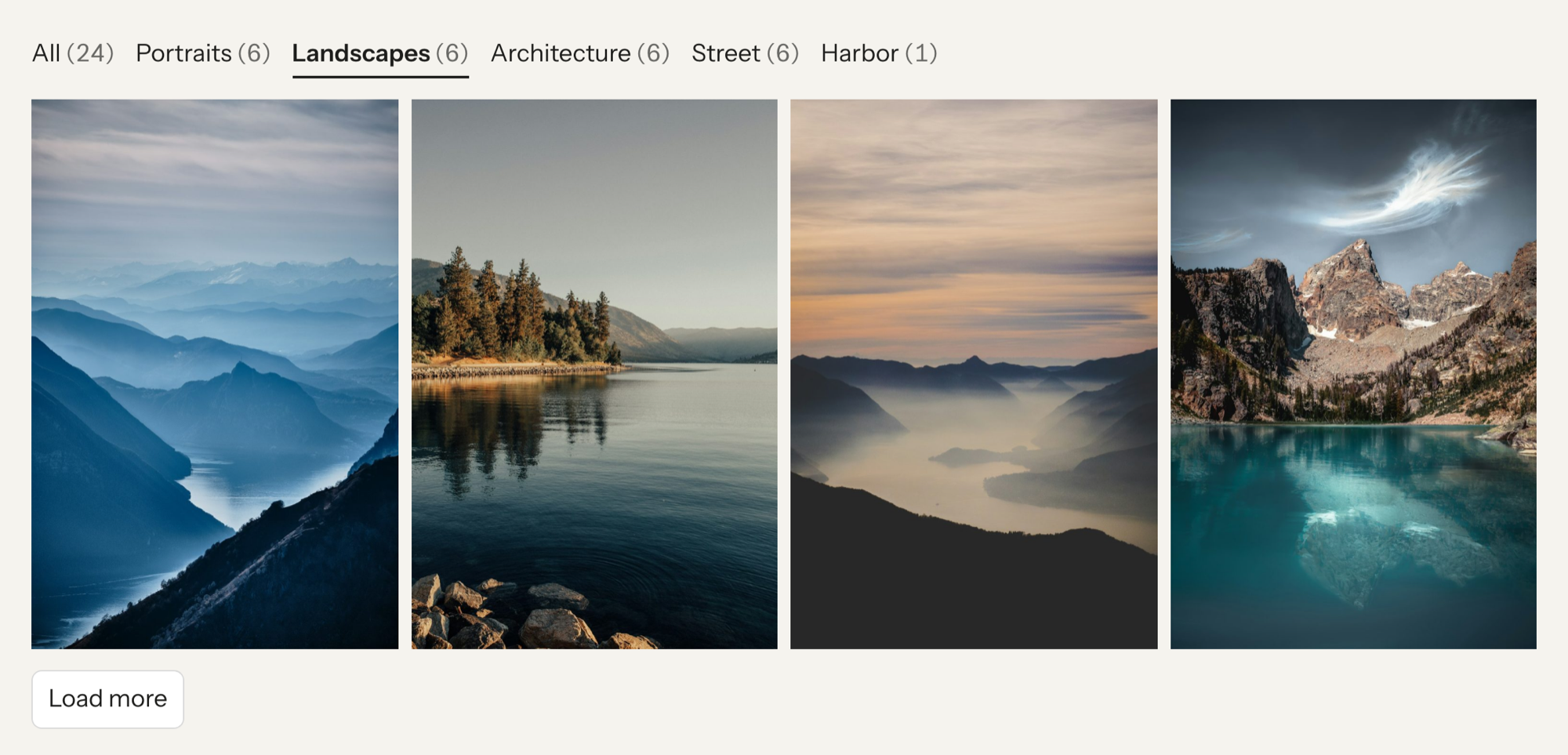
Modula filters keep working when a 300-photo gallery is split into pages. Pagination, Load more and Infinite scroll come with the Business plan ($99 for the first year). Turn on Pagination under Layout, then set Images per page in Page size & navigation. Pick Infinite scroll (not on Creative) or Show a Load more button if you’d rather skip page numbers (pagination guide).
Here’s how filters behave with pages:
- A filter searches the whole gallery. Click Newborns and you get newborns from every page, starting on page 1.
- Load more stays inside the filter. It keeps loading newborns.
- So does the lightbox, the full-screen photo viewer. Its arrows only step through newborns. With Show all images in lightbox on (Lightbox section), that includes newborns that haven’t loaded yet. With it off, you see the ones on screen.
What Modula filters can’t do (and what to use instead)
Modula 3.0 filters have four limits, and each has a workaround:
- No link to one category. In 3.0 galleries, a filter click doesn’t change the page address, so a menu link can’t open “Weddings.” Old
?jtg-filter=links only work in classic-editor galleries. Use Selected by default, or duplicate the gallery (Content → Duplicate) and set the copy to open on Weddings, on its own page. You’ll have two galleries to tag. - One filter at a time. Visitors can’t combine Weddings with Outdoor, and there’s no search box. Keep categories broad.
- No filters on album covers. Albums (Trio plan and up) have no filters. Nest them instead, one album per category, as in this multi-level wedding portfolio.
- No filters in the free version. Use one free gallery per category, each under its own heading on one page.
For most portfolios, though, five clear categories and a bar that opens on your best work is plenty. Tag each new shoot as you add it, and the next client looking for newborns finds them in one click.
When the filters don’t show up
Modula filter problems usually have one of five causes:
- A filter shows (0) and opens empty. No photo carries it yet. Tag some, or remove it.
- No Filters section, or just an upgrade notice. Your gallery type has no filters (switch to Masonry, say), or Modula Pro isn’t active.
- Blank gallery or no filter buttons after moving to the 3.0 editor. Update Modula and Modula Pro, then hard-refresh (Ctrl+Shift+R, or Cmd+Shift+R on a Mac).
- Photos dropped out of a category. Removing a filter takes it off every photo. After you remove or rename one, check each filter’s image count and re-tag what’s missing.
- A tagged filter still shows (0). Its name has a comma. Rename it and re-tag.
Frequently asked questions
Yes to opening on one: set Selected by default to that category, and turn on Hide the All option to drop “All”. A direct link isn’t possible in Modula 3.0 galleries, because a filter click doesn’t change the page address.
No. In a Modula 3.0 gallery, a click on a filter swaps the photos in place, without a page reload, and the page address stays the same. A second click on the active filter clears it and shows the whole gallery again.
Yes. In a Modula gallery, videos you add with A video (the arrow next to + Add) take filters exactly like photos. That’s how you build a mixed photo and video gallery with one filter bar. The separate Video gallery type has no filters.
Not with Modula: filters start at $39 for the first year, on the Starter plan. For free, put one Modula gallery per category on the same page. The separate Portfolio Filter Gallery plugin has category filters in its free version (checked October 2026).